Disclaimer: The information published on LoansJagat is intended for general informational and educational purposes only and should not be considered financial, legal, or investment advice. Interest rates, loan terms, statistics, and other data may change over time and may vary by lender or source. Please verify the latest information and consult a qualified financial advisor or the respective Bank/NBFC before making any financial decisions.
Subscribe Now
About the author

Arshathul Afia is a journalism graduate and fintech content writer with 4+ years of experience in digital publishing and research-led writing. She has written 200+ articles covering personal finance, lending, banking, digital payments, credit, insurance, and major financial developments in India. At LoansJagat, she focuses on simplifying complex fintech news, RBI updates, loan-related changes, policy developments, and industry trends for everyday readers. Her journalism background helps her approach stories with research, context, and clarity, while her SEO experience ensures content remains discoverable and relevant. She aims to make financial news easier to understand, practical, and useful for readers across India.
Related News
Simplify All Your Loans Into One Affordable EMI

Customers Served

Debt Consolidated

1200+ Reviews

Locations in India
Club all Loans & Credit Card Bills into Single EMI

Quick Apply Loan
Consolidate your debts into one easy EMI.

Takes less than 2 minutes. No paperwork.

10 Lakhs+
Trusted Customers

2000 Cr+
Loans Disbursed

4.7/5
Google Reviews

50+
Banks & NBFCs Offers
West Bengal accounted for 43 of the 49 NBFC registrations cancelled by the RBI, and nine companies listed the same room at Kolkata’s Poddar Court.
Key Highlights
The Reserve Bank of India (RBI) announced on 16 November 2026 that it had cancelled the certificates of registration of 49 non-banking financial companies (NBFCs). Kolkata accounted for 41 of the 43 West Bengal companies on the list. Six companies had registered offices outside the state.
Most orders were issued on 15 October, including all nine for firms at the shared Kolkata address. The RBI published the registration number and cancellation order date for each company. It did not give the grounds for individual decisions.
The RBI issued four orders on 1 October. The final order, dated 29 October, covered Gandhinagar Leasing and Finance Ltd. The figures below reflect registered office addresses. The companies may have carried out business in other locations.
West Bengal also accounted for most of the companies in the previous round. On 9 October 2026, the RBI published a list of 13 NBFCs whose registrations had been cancelled under the same provision. Those orders were issued in September.
Read also: India’s Inflation Breaches 6%, Raising the Odds of a December Repo Rate Hike
Nine firms listed Room 303 on the third floor of Poddar Court, Gate 2, at 18 Rabindra Sarani in central Kolkata. The earliest registration among them dates to 1998 and the latest to 2013. All nine cancellation orders are dated 15 October 2026.
The companies were Alankrit Vyapaar, Dreamon Commercial, Emersec Holdings, Jemco Vanijya, Jet (India), M.L. Finlease, Nikita Electrotrades, Purvi Vanijya Niyojan and Strength Fincap Markets. The RBI notice establishes the address they shared. Common ownership, directors or business dealings would require separate records to verify.
The RBI acted under Section 45-IA(6) of the Reserve Bank of India Act, 1934. Its notice says the 49 companies can no longer carry on the business of a non-banking financial institution as defined in Section 45-I(a) of the Act.
The law allows cancellation in several circumstances. A company may have stopped carrying on financial business or failed to meet a condition of registration. Other grounds include failure to follow RBI directions, keep the required books or produce records for inspection. Certain orders prohibiting a company from accepting deposits can also trigger cancellation. The notice leaves open which ground applied to each firm and whether any firm was in default or insolvent.
The RBI published a second notice on 16 November covering 13 NBFCs and one housing finance company. Six gave up their certificates after leaving the business. Five qualified to operate as unregistered Type I NBFCs. The other three had ceased to exist as legal entities after corporate actions such as a merger, dissolution or voluntary strike-off.
The RBI issued the amendment on 29 April 2026, and the exemption took effect on 1 July 2026. It applies to qualifying firms with assets below ₹1,000 crore whose long-term business model involves neither public funds nor dealings with customers. Eligible existing firms have until 31 December 2026 to apply for deregistration under the six-month window. Public funds include bank borrowing and inter-corporate deposits. Lending and guarantees count as dealings with customers.
The RBI combines the assets of unregistered Type I NBFCs in the same group when applying the threshold. At ₹1,000 crore or above, Type I registration is required for firms that continue to operate without public funds or customer dealings. A firm that plans to access public funds or deal with customers must first obtain Type II registration. The RBI retains its powers under the applicable provisions of Chapter IIIB of the Act.
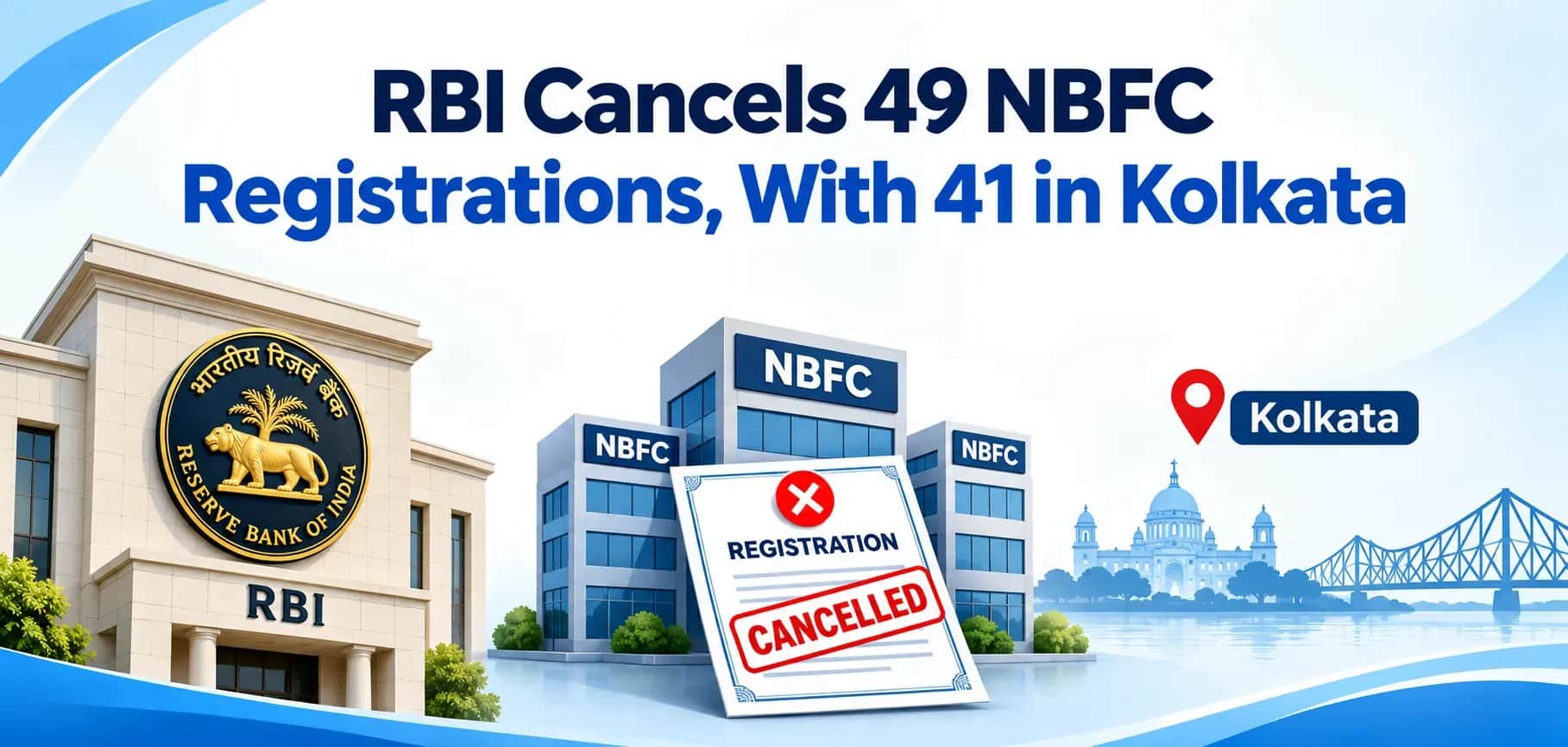
On 16 November 2026, the RBI announced the cancellation of 49 NBFC registrations. Of these, 43 companies had registered offices in West Bengal, including 41 in Kolkata. Nine shared a registered address at Poddar Court, and all nine orders were dated 15 October. The RBI did not disclose individual reasons.
The orders were issued between 1 and 29 October 2026. The RBI published the full list of affected companies and order dates on 16 November.
The RBI cited Section 45-IA(6) of the Reserve Bank of India Act, 1934. Its notice did not specify which statutory ground applied to each company.
Five companies in the separate surrender notice qualified as unregistered Type I NBFCs after meeting the asset limit and conditions on funding and customer dealings.
Find the lender in your Key Facts Statement. Compare it with the app’s RBI directory entry, which reflects what the lender reported without an RBI check.
NBFCs can lend and invest. They cannot accept demand deposits or issue cheques drawn on themselves, and their deposits fall outside the DICGC deposit insurance scheme.
Start your journey today
Apply Now*T&C apply