
By continuing, you agree to LoansJagat's Credit Report Terms of Use, Terms and Conditions, Privacy Policy, and authorize contact via Call, SMS, Email, or WhatsApp
Disclaimer: The information published on LoansJagat is intended for general informational and educational purposes only and should not be considered financial, legal, or investment advice. Interest rates, loan terms, statistics, and other data may change over time and may vary by lender or source. Please verify the latest information and consult a qualified financial advisor or the respective Bank/NBFC before making any financial decisions.
Subscribe Now
About the author

Arshathul Afia
Arshathul Afia is a journalism graduate and fintech content writer with 4+ years of experience in digital publishing and research-led writing. She has written 200+ articles covering personal finance, lending, banking, digital payments, credit, insurance, and major financial developments in India. At LoansJagat, she focuses on simplifying complex fintech news, RBI updates, loan-related changes, policy developments, and industry trends for everyday readers. Her journalism background helps her approach stories with research, context, and clarity, while her SEO experience ensures content remains discoverable and relevant. She aims to make financial news easier to understand, practical, and useful for readers across India.
Related Blog Post
Simplify All Your Loans Into One Affordable EMI

Customers Served

Debt Consolidated

1200+ Reviews

Locations in India
Club all Loans & Credit Card Bills into Single EMI

Quick Apply Loan
Consolidate your debts into one easy EMI.

Takes less than 2 minutes. No paperwork.

10 Lakhs+
Trusted Customers

2000 Cr+
Loans Disbursed

4.7/5
Google Reviews

50+
Banks & NBFCs Offers
Other services mentioned in this article
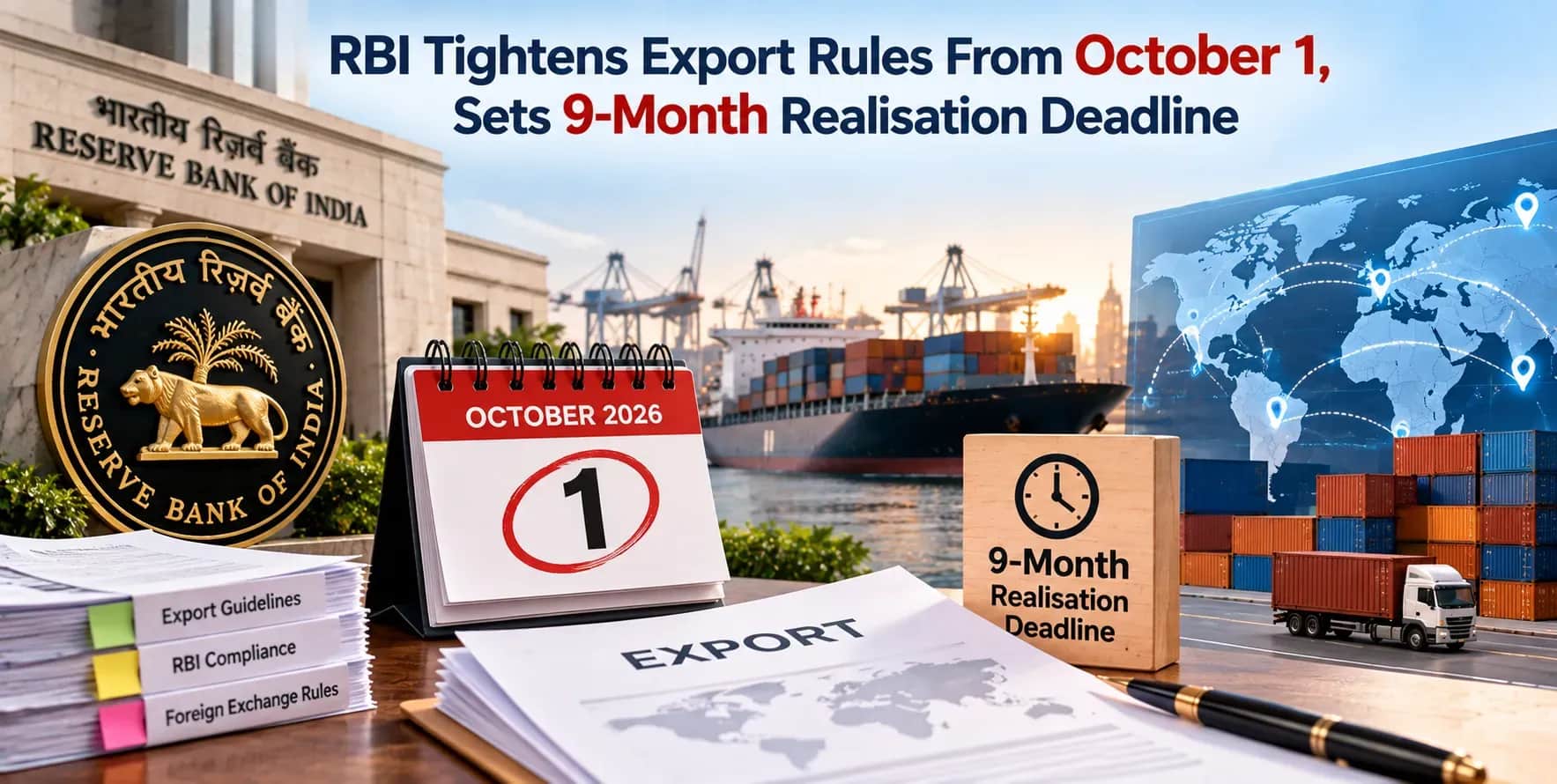
Indian exporters will continue on a 9-month payment clock from 1 October 2026, after the latest amendment removed a proposed 15-month realisation window for exports.
The Reserve Bank of India amended the Foreign Exchange Management (Export and Import of Goods and Services) Regulations, 2026 on 22 September 2026. The amendment was published in the Official Gazette on 24 September 2026 and takes effect on 1 October 2026. For goods, the 9-month period runs from shipment. For services, it runs from the invoice date. Goods sold from a warehouse outside India get 9 months from the date of sale. Project exports continue according to contractual payment terms.
The immediate effect falls on exporters, their overseas buyers and Authorised Dealer banks. Companies that allow long customer credit periods will have less regulatory time than the 15 months originally written into the October framework. The rule retains a route for genuine delays, as an Authorised Dealer may extend the period when an exporter gives reasons and the bank is satisfied with them.
The September amendment shortens the timelines in Regulation 5 of the new framework to 9 months from the starting date. For the majority of goods and services, the amendment also shortens the 15-month timelines to 9 months. The special timeline for transactions involving Indian Rupee has also been reduced to 12 months from 18 months. As a result of the amendment, the 9-month window starting from the effective date will not be extended on October 1, 2021.
Banks can grant more time after examining an exporter’s reasons for delayed receipts. The October framework also requires Authorised Dealers to monitor export proceeds and follow up with exporters within the applicable period.
For ordinary consumers, 1 October does not change a bank account, card payment or household bill. The direct burden is on exporters that collect money from customers abroad. A shorter regulatory window means finance teams need closer control over invoice ageing, customer credit terms and overdue collections, especially where contracts already allow buyers several months to pay.
An official trade release dated 15 September 2026 estimated India’s merchandise and services exports at $82.68 billion in August 2026, up 25.41% from August 2025. The August services figure was an estimate because the latest services data available at the time covered July 2026.
LoansJagat’s view is that the 9-month clock puts the first operational pressure on receivables tracking rather than export pricing. Firms that spot a delayed overseas payment early have more time to speak with the buyer and, where required, approach the Authorised Dealer before the deadline. A related LoansJagat report on nearly ₹1 lakh crore of old trade mismatches also shows why timely matching of export receipts and shipping records has become a banking concern.
The timeline has moved more than once. On 13 November 2025, the export realisation period under the then-existing rules was increased from 9 months to 15 months. The Federation of Indian Export Organizations celebrated the announced changes on 14 November 2025, including the extended period for shipping goods against payment.
A fresh amendment dated 5 June 2026 changed the existing regulations again, substituting 9 months for 15 months. Exporters were therefore already operating under a 9-month limit before October. The separate consolidated regulations issued on 13 January 2026, however, were due to start on 1 October with 15 months for most exports and 18 months for eligible INR transactions. The 5 June change is recorded in Notification No. FEMA 23(R)/(8)/2026-RB
The 22 September 2026 amendment removes that mismatch. It changes the October framework before commencement, so 9 months remains the general period and 12 months applies to exports invoiced or settled in Indian rupees.
The November 2025 reaction gives useful context. The Federation of Indian Export Organisations had welcomed the move from 9 months to 15 months, showing that the longer collection period was viewed as relief for exporters. By June 2026, export bodies were also raising concerns around parts of the wider FEMA framework, particularly where overdue proceeds could restrict future exports.
The new regulations state that if export proceeds remain unrealised for more than 1 year beyond the due date, or beyond an extension allowed by an Authorised Dealer, further exports must be against full advance payment or an irrevocable Letter of Credit. Industry representatives had argued in June that such restrictions should be linked to the defaulting buyer rather than all buyers of the exporter.
The government has separately kept export-finance support in place. The Export Promotion Mission, approved on 12 November 2025, carries an outlay of ₹25,060 crore for FY2025-26 to FY2030-31. Niryat Protsahan under the mission covers trade-finance measures including interest subvention, export factoring and collateral support, according to an official government release.
Exporters will continue to work with the 9-month realisation period after 1 October 2026. Those receiving eligible payments in Indian rupees will have 12 months, while project exports will follow the payment schedule agreed in the contract.
Late payments from overseas buyers could become harder to leave unresolved for long. Exporters may have to chase older invoices sooner and contact their Authorised Dealer if a genuine delay looks likely to cross the deadline.
Most goods and services have a 9-month period. The starting date depends on whether the transaction covers goods, services or warehouse stock.
Yes. From 1 October 2026, services export proceeds generally have to be realised within 9 months from the invoice date.
Yes. An Authorised Dealer may allow an extension when the exporter gives reasons for the delay and the bank accepts those reasons.
No. The existing regulations had already returned to 9 months on 5 June 2026. The September amendment prevents the new October framework from restoring 15 months.
If proceeds remain unrealised for more than 1 year beyond the due date or approved extension, future exports must follow the advance-payment or irrevocable Letter of Credit condition.








.png&w=3840&q=75)


