

By continuing, you agree to LoansJagat's Credit Report Terms of Use, Terms and Conditions, Privacy Policy, and authorize contact via Call, SMS, Email, or WhatsApp
Disclaimer: The information published on LoansJagat is intended for general informational and educational purposes only and should not be considered financial, legal, or investment advice. Interest rates, loan terms, statistics, and other data may change over time and may vary by lender or source. Please verify the latest information and consult a qualified financial advisor or the respective Bank/NBFC before making any financial decisions.
Subscribe Now
About the author

Arshathul Afia
Arshathul Afia is a journalism graduate and fintech content writer with 4+ years of experience in digital publishing and research-led writing. She has written 200+ articles covering personal finance, lending, banking, digital payments, credit, insurance, and major financial developments in India. At LoansJagat, she focuses on simplifying complex fintech news, RBI updates, loan-related changes, policy developments, and industry trends for everyday readers. Her journalism background helps her approach stories with research, context, and clarity, while her SEO experience ensures content remains discoverable and relevant. She aims to make financial news easier to understand, practical, and useful for readers across India.
Related News
Simplify All Your Loans Into One Affordable EMI

Customers Served

Debt Consolidated

1200+ Reviews

Locations in India
Club all Loans & Credit Card Bills into Single EMI

Quick Apply Loan
Consolidate your debts into one easy EMI.

Takes less than 2 minutes. No paperwork.

10 Lakhs+
Trusted Customers

2000 Cr+
Loans Disbursed

4.7/5
Google Reviews

50+
Banks & NBFCs Offers
RBI has finalised tougher loan recovery standards, limiting contact hours, recording calls and protecting borrowers from harassment while preserving lenders’ lawful recovery rights across India.
Borrowers should see a more documented collection process. Lenders must record conversations, supervise outside agencies and provide grievance officer details. That brings extra compliance and training work for financial institutions. People financing phones, tablets or laptops should also read their contracts carefully, since limited device restrictions may still follow a prolonged default.
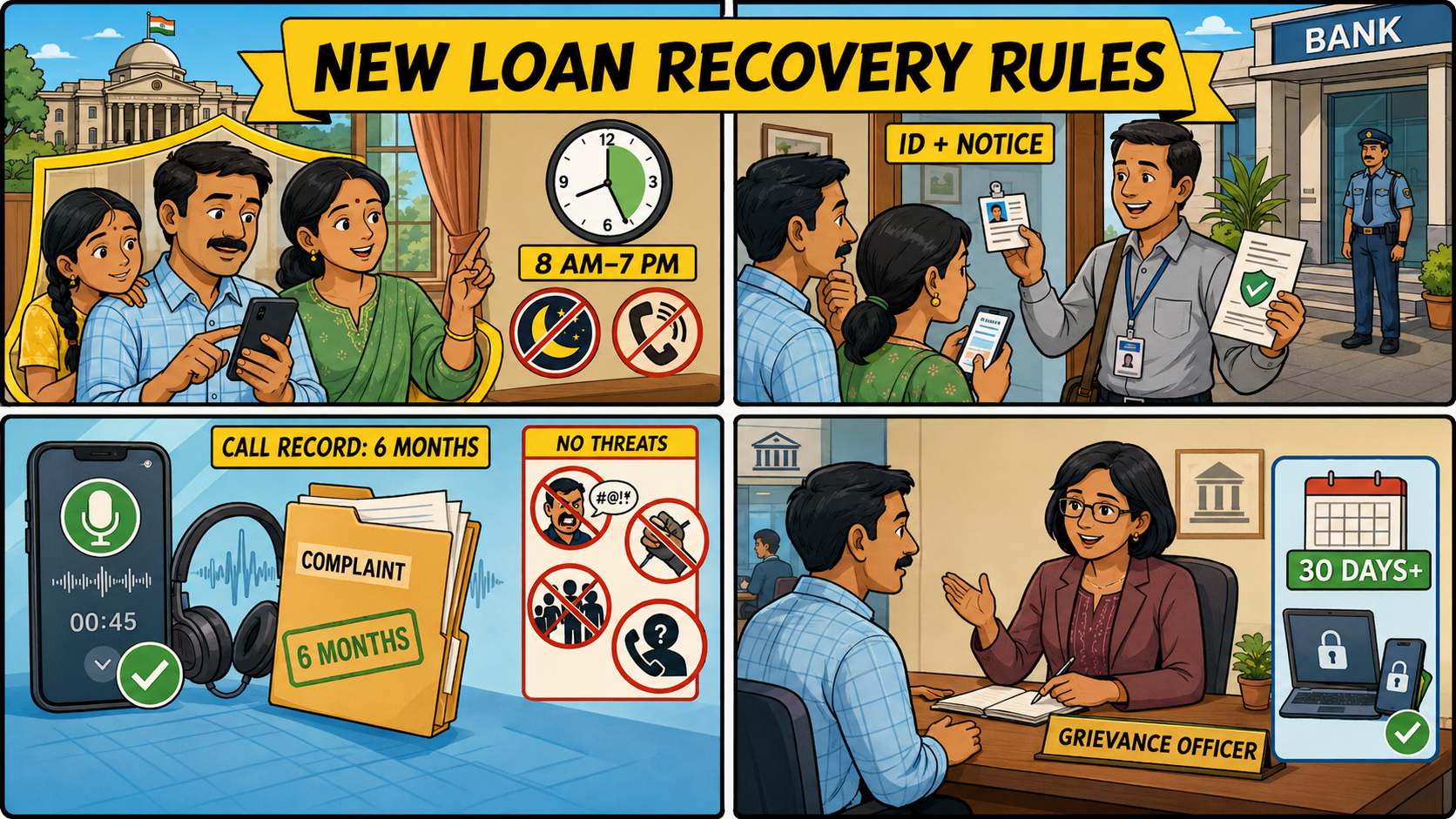
The Reserve Bank of India released 9 parallel directions for commercial banks, small finance banks, regional rural banks, local area banks, co-operative banks, all-India financial institutions, NBFCs and housing finance companies.
Each lender must maintain a recovery policy covering escalation stages, employee conduct, agent behaviour, borrowers in financial distress, possession of secured assets and compensation for recovery action that breaches the directions.
The table below shows the main rules and their effect on borrowers.
The directions govern collection behaviour. They do not remove the outstanding loan, waive a valid EMI or stop a lender from pursuing lawful recovery.
The permitted calling period offers an immediate safeguard. Employees and agents must ordinarily contact borrowers between 8 a.m. and 7 p.m. A borrower’s request to avoid calls during a work shift, hospital appointment or another specified period should be respected in normal circumstances. Repeated messaging may still count as harassment even when it happens within permitted hours.
Field visits will follow a defined process. A borrower can select a meeting place. An agent may visit the home or workplace if no location is chosen or if the borrower misses 2 successive meetings. The visitor must carry an identity card, authorisation letter and lender notice. Visits should be avoided during bereavements, medical emergencies and marriage functions.
The 8 a.m. to 7 p.m. rule existed before the 2026 framework. The bigger shift comes from mandatory records. Lenders must document the time and number of recovery calls. Conversations made by employees, agents and borrowers using the designated recovery number must also be recorded.
A 6-month record gives the grievance officer something concrete to examine. False warnings about arrest, abusive words or repeated demands can be checked. If a dispute reaches court, the lender must preserve the recording until the proceeding ends.
An agent may discuss overdue amounts and repayment options with the borrower or guarantor. The conversation must remain civil. False claims about police action, immediate arrest or unauthorised asset seizure are prohibited.
Loan details cannot be shared with neighbours, relatives, friends or co-workers to pressure the borrower. Agents cannot post photographs, recordings or personal information on social media. The lender must also restrict how much customer information reaches an outside recovery agency.
The borrower-focused view published by LoansJagat highlighted call recording as a useful audit trail. Stored conversations can discourage abusive speech and support a complaint when an agent crosses the permitted line.
A borrower who loses a job, faces a medical expense or waits for delayed business payments should write to the lender early. The request can ask about revised repayment terms or another available resolution. Messages, call logs, notices and receipts should be preserved. If harassment continues, the complaint should first go to the lender’s grievance officer, followed by the RBI Complaint Management System when required.
A lender cannot lock a borrower’s phone to recover an unrelated personal, home, vehicle or education loan. Restrictions apply only when the lender financed that specific phone, tablet or laptop.
The loan agreement must expressly permit the action. The borrower must receive prior notice explaining which functions may be affected. The locking technology also needs certification from the device manufacturer or operating-system provider, where available.
No restriction can begin before the associated loan becomes 30 days past due. The lender may then introduce gradual restrictions. The complete contractual set can apply only after 60 days past due.
Incoming calls, SMS and emergency SOS functions must remain available. Restrictions cannot prevent employment-related work. The lender and its technology provider cannot access contacts, photographs, messages, call logs or location history.
Once the lender receives the overdue payment, it must restore restricted functions within 1 hour. A wrongful restriction or lender-caused delay attracts compensation of ₹250 for every hour, capped at the original loan amount disbursed.
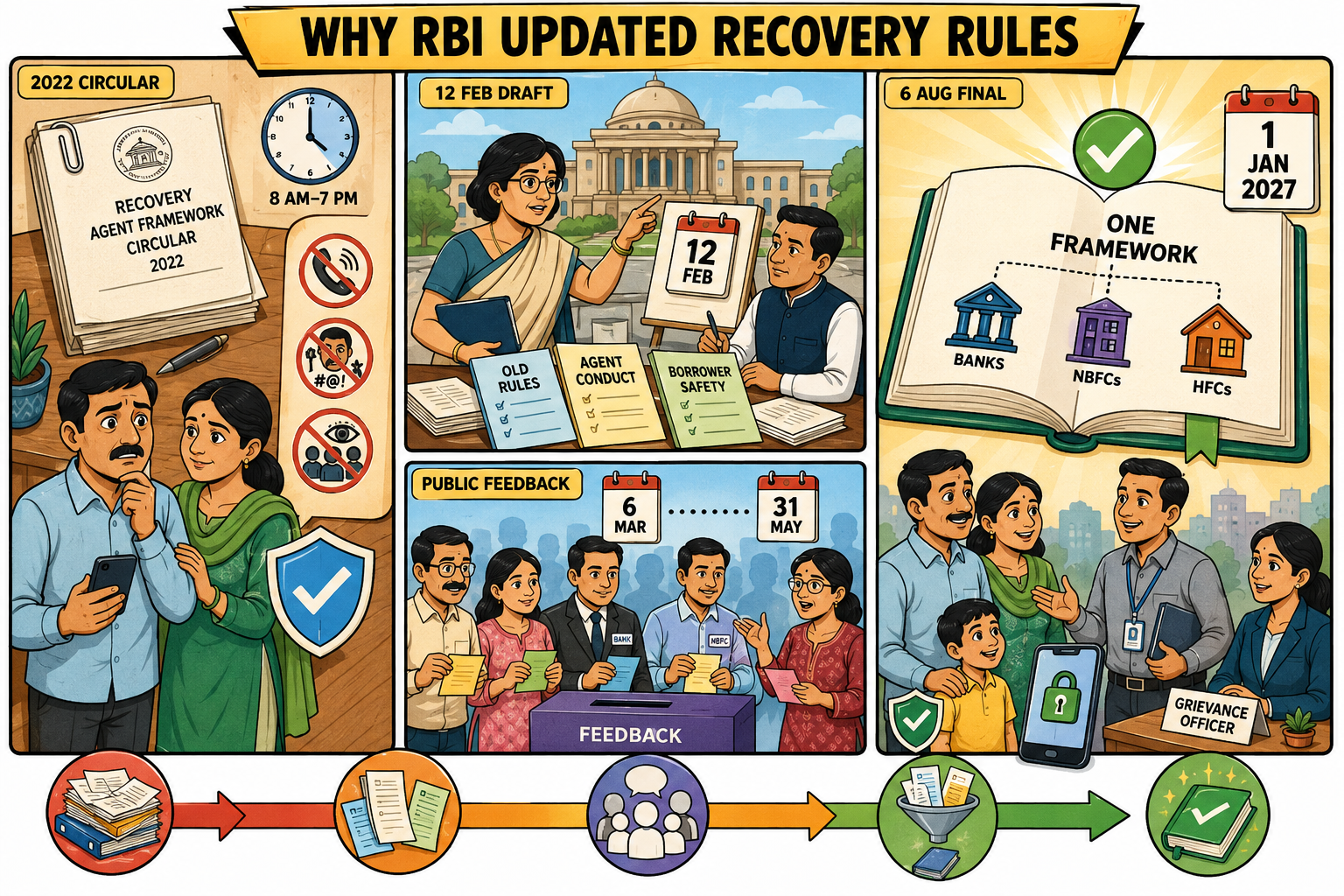
Akashvani News reported on 6 February 2026 that the RBI planned to review and harmonise its existing recovery-agent instructions. The first draft followed on 12 February, with public comments invited until 6 March.
A revised draft arrived on 20 May and accepted feedback until 31 May. It added detailed conditions for technology-based restrictions on financed mobile devices. RBI released the final directions on 6 August, with implementation scheduled for 1 January 2027.
The contact-hour restriction was already present in RBI’s 12 August 2022 circular. That order barred calls before 8 a.m. and after 7 p.m., along with intimidation, public humiliation and privacy intrusions. The 2026 directions bring those protections into one wider framework.
Lenders must publish an updated list of their empanelled recovery agencies. Changes should appear within 7 calendar days, while terminated agencies must be removed promptly.
Before the first physical visit, the lender must send agency details at least 1 day in advance. A later change in agency also requires immediate communication. Recovery targets cannot encourage threats or excessive contact.
Agents must complete the prescribed IIBF Debt Recovery Agent training. Lenders also need to verify their backgrounds, inspect agency performance and act on complaints. Every recovery communication must include the grievance officer’s name, email, telephone number and address.
The RBI Loan Recovery Rules 2026 place tighter controls on calls, visits and the use of personal information. Recorded conversations and advance agency details should help borrowers challenge improper behaviour.
Repayment duties remain unchanged. From 1 January 2027, lenders must show that recovery followed permitted hours, approved procedures and documented safeguards. Early written contact with the lender remains the safer step when an EMI cannot be paid.
Only when the borrower or guarantor has expressly requested or authorised contact outside the permitted period.
The borrower may choose another location. Home visits are possible after 2 missed meetings or when no place is selected.
No. An agent cannot use false threats. The lender may pursue lawful recovery, but intimidation remains prohibited.
They cannot disclose loan details to relatives or use family calls to shame and pressure the borrower.
No. A complaint addresses recovery conduct. The borrower must still repay valid dues or seek an available repayment arrangement.









.png&w=3840&q=75)


