By continuing, you agree to LoansJagat's Credit Report Terms of Use, Terms and Conditions, Privacy Policy, and authorize contact via Call, SMS, Email, or WhatsApp
Disclaimer: The information published on LoansJagat is intended for general informational and educational purposes only and should not be considered financial, legal, or investment advice. Interest rates, loan terms, statistics, and other data may change over time and may vary by lender or source. Please verify the latest information and consult a qualified financial advisor or the respective Bank/NBFC before making any financial decisions.
Subscribe Now
About the author

Vaishnavi kale
Vaishnavi is a Financial Content Writer at LoansJagat. She holds a B.Sc. and an M.Sc. She has experience in writing SEO-focused content across finance, digital marketing, education, and Ayurveda. Before joining LoansJagat, she worked with digital marketing agencies serving fintech clients and quick-commerce brands like Zepto and blinkit. At LoansJagat, Vaishnavi writes on banking, loans, personal finance, and insurance. Her work involves researching financial topics, understanding user search intent, and creating content that is clear and accurate. She has experience in SEO content writing, keyword research, content optimisation, and AEO. She enjoys simplifying complex topics into practical information that readers can easily understand and use. She believes that well-researched and reliable content plays an important role in helping people make informed financial decisions.
Related Blog Post
Simplify All Your Loans Into One Affordable EMI

Customers Served

Debt Consolidated

1200+ Reviews

Locations in India
Club all Loans & Credit Card Bills into Single EMI

Quick Apply Loan
Consolidate your debts into one easy EMI.

Takes less than 2 minutes. No paperwork.

10 Lakhs+
Trusted Customers

2000 Cr+
Loans Disbursed

4.7/5
Google Reviews

50+
Banks & NBFCs Offers
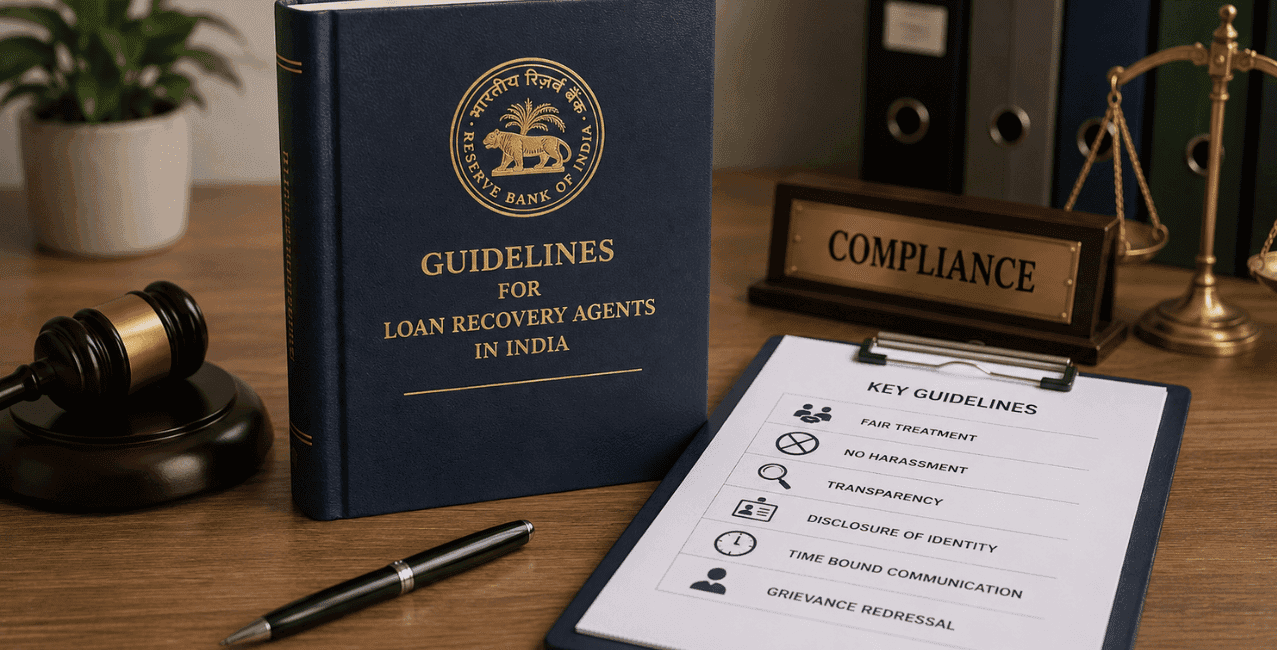
The Reserve Bank of India is the regulatory body of banks. The RBI has issued guidelines to ensure that banks recover their loan in a fair, transparent, and respectful manner. Banks can not hire just anyone as recovery agents. Recovery agents should be properly trained. According to the RBI, banks have to monitor the conduct of recovery agents and prohibit harassment, intimidation, or unfair recovery practices. In this blog, we are going to discuss the RBI Guidelines for Loan Recovery Agents in India.
When banks try a lot and are still not able to recover the loan from the borrower, they hire recovery agents. Recovery agents are persons or agencies authorised by the bank to recover the loan or credit card payments from the borrower.
Recovery agents can work directly through banks or NBFCs. They can also work for third-party recovery agencies.
Recovery agents are responsible for the following work:
Recovery agents are also called collecting agents, debt collectors, or recovery executives.
Yes, in India, recovery agents are legal. The Reserve Bank of India (RBI) allows banks and NBFCs to get help from recovery agents to collect their loans. But recovery agents should follow RBI's guidelines; otherwise, they have to face consequences.
No recovery agent can harass, threaten, intimidate, or use force against borrowers. If recovery agents behave improperly or violate RBI guidelines, Borrowers can register complaints against them.
Banks can't appoint just anyone as recovery agents. There are some guidelines of the RBI for recovery agent appointment. If they are following these requirements, then the bank can appoint them as recovery agents.
Key requirements:
What does this training cover?
It's the bank's responsibility to ensure that the recovery agents they are hiring are properly trained and comply with RBI's recovery guidelines.
The RBI has given some guidelines to banks for appointing recovery agents. These guidelines ensure that the recovery agents and borrowers are treated fairly during the recovery process.
Before appointing any recovery agent, banks should verify their background properly.
Banks can not directly send recovery agents to the borrower's address. First, banks have to inform the borrower about this. Borrowers should know about:
If a bank changes the recovery agents, they have to inform borrowers.
Recovery agents can not directly visit borrowers' homes. They have to carry proper documentation. They should have:
When agents visit a borrower, the borrower can identify them easily with these documents.
Banks publish their authorised recovery agencies, so borrowers can check them.
If, as a borrower, you face any type of problem like bad behaviour, violence, abusive language, or harassment, then you can complain about recovery agents to the bank. According to the RBI guidelines, banks should review and resolve it through their grievance redressal mechanism.
There are many cases where recovery agents harass customers. They call, use abusive language, threaten, and sometimes become violent. If you are facing something like this, you can complain about them. Before going to complain, try to accumulate evidence. Collect recordings and screenshots of them being abusive on the call or text. Record a video if they are insulting you in your area.
To file a complaint. You need to visit your bank's website. You will see grievance aid; there you can register your complaint and add all the evidence. If your bank does not take any action against it within 30 days. Get a complaint number, ID number, and all the evidence and complain to the Reserve Bank of India. You can register your complaint via these modes:
If these recovery agents threaten you to publish your personal information. They are trying to hack your data and blackmail you. This case comes under cybercrime.
Banks and NBFCs get help from recovery agents and recovery agencies for recovering loans from borrowers. But sometimes we hear news of bad behaviour of recovery agents towards customers. According to the RBI's guidelines, recovery agents can't threaten, harass, intimidate, or use abusive language.
Banks should always verify recovery agents before hiring them. Recovery agents should be properly trained and comply with the prescribed code of conduct. Banks do not send recovery agents directly; first, you get notice and reminders. The bank is responsible for letting you know about recovery agents. If you face any issues with recovery agents, you can register a proper complaint on the bank's website. If you do not get any response within 30 days. You can complain against the bank and recovery agents on the RBI portal. To know more such information, stay connected with Loansjagat.
Yes, recovery agents are legal in India. If a bank is facing difficulty in getting loan repayment, banks can hire recovery agents or recovery agencies. But these recovery agents should follow RBI Guidelines.
No, the Reserve Bank of India strictly prohibits threatening or harassing borrowers. According to the RBI guidelines, recovery agents can not use abusive language, physical force, public shaming, or endless calling.
Every recovery agent should carry a valid ID card, authorization letter, and recovery notice. Plus, it's the bank's responsibility to inform customers about recovery agents.
Recovery agents can contact customers only between 8:00 AM and 7:00 PM. They can't contact customers at night. Also, they are not allowed to bother customers with endless calls.
No, they can not visit without informing you. Banks should inform borrowers before assigning or changing a recovery agent.
You can verify this by asking for their identity card and authorization letter, and verify details with your bank.
If recovery agents are misbehaving with you, you can collect evidence and register a complaint on the bank's website. If you do not get a reply within 30 days. You can register a complaint on the RBI's portal. If agents are blackmailing or threatening you with your personal information, you can contact cybercrime and register a complaint.
Yes, if your bank does not respond to you within 30 days from the date of complaint registration, you can complain to the RBI.
No, they are not allowed to do so. They are not allowed to get your personal information from anywhere and contact your friends and family. If they do so, you can register a complaint on the cyber crime portal.
Borrowers have the right to respectful treatment, privacy, and a fair grievance redressal process.