.webp&w=3840&q=65)
By continuing, you agree to LoansJagat's Credit Report Terms of Use, Terms and Conditions, Privacy Policy, and authorize contact via Call, SMS, Email, or WhatsApp
Disclaimer: The information published on LoansJagat is intended for general informational and educational purposes only and should not be considered financial, legal, or investment advice. Interest rates, loan terms, statistics, and other data may change over time and may vary by lender or source. Please verify the latest information and consult a qualified financial advisor or the respective Bank/NBFC before making any financial decisions.
Subscribe Now
About the author

Arshathul Afia is a journalism graduate and fintech content writer with 4+ years of experience in digital publishing and research-led writing. She has written 200+ articles covering personal finance, lending, banking, digital payments, credit, insurance, and major financial developments in India. At LoansJagat, she focuses on simplifying complex fintech news, RBI updates, loan-related changes, policy developments, and industry trends for everyday readers. Her journalism background helps her approach stories with research, context, and clarity, while her SEO experience ensures content remains discoverable and relevant. She aims to make financial news easier to understand, practical, and useful for readers across India.
Related News
Simplify All Your Loans Into One Affordable EMI

Customers Served

Debt Consolidated

1200+ Reviews

Locations in India
Club all Loans & Credit Card Bills into Single EMI

Quick Apply Loan
Consolidate your debts into one easy EMI.

Takes less than 2 minutes. No paperwork.

10 Lakhs+
Trusted Customers

2000 Cr+
Loans Disbursed

4.7/5
Google Reviews

50+
Banks & NBFCs Offers
Other services mentioned in this article
RBI’s August MPC ends on August 5, with experts expecting a 5.25% repo pause as inflation and global risks shape borrower expectations nationwide this week.
As the last day of the Reserve Bank of India’s Monetary Policy Committee’s August 2026 review has arrived, the main prediction is a pause at 5.25%. The decision will be announced on August 5, 2026. Committee Chair RBI Governor Sanjay Malhotra will have to evaluate price pressure, loan demand, global uncertainty and the impact on household EMIs to determine the committee’s policy signal.
In the short-term, borrowers will be the first to feel the impact. When a pause happens to the repo rate, floating-rate home loan EMIs don’t fall. Because of this pause, new borrowers will have to wait for the opportunity to secure lower offers for loans. For banks, a stable repo rate will prevent them from repricing, but the stable rates will frustrate homebuyers who thought loan costs would follow earlier rate cuts and fall.
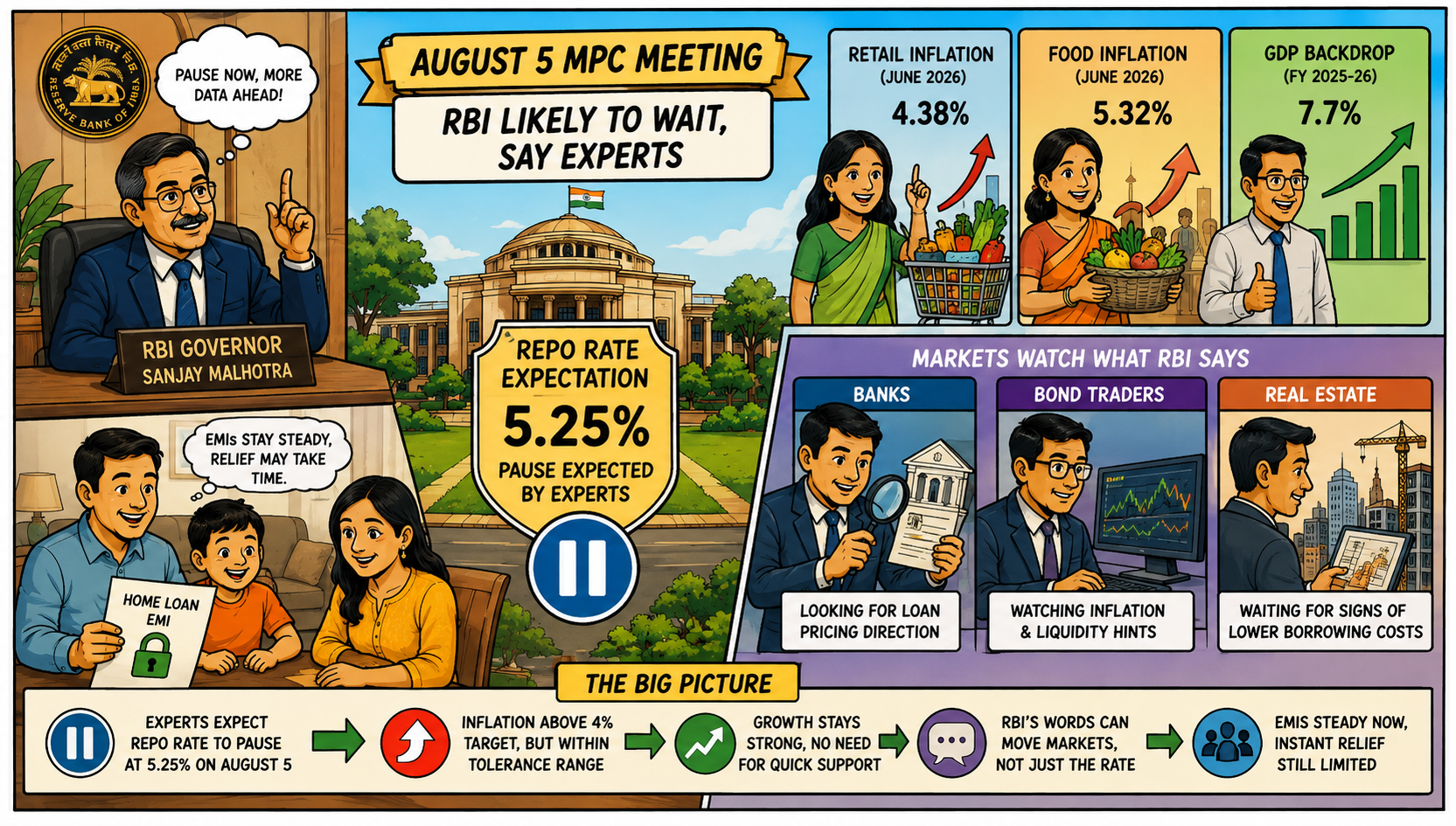
The main story is simple. RBI is likely to wait. Experts quoted in the reference report expect no change in the repo rate on August 5, mainly because inflation has moved above the 4% target level but has not crossed the wider tolerance range. Growth has also stayed firm enough for the RBI to avoid a quick support move.
This policy review is important because the rate number may stay the same, but the words used in the statement can still move markets. Banks will read it for loan-pricing direction. Bond traders will look for hints on inflation and liquidity. Real estate companies will look for any sign that lower borrowing costs could return later.
Before moving to the impact, the main data points need to be placed in one view.
The table explains why the market is expecting caution. Inflation gives the RBI a reason to wait. Growth gives it space to avoid a hurried cut. Borrowers, however, may read the same decision through their monthly EMI.
For home loan customers, the repo rate affects the loan through external benchmark-linked pricing. If the repo rate stays at 5.25%, most floating-rate borrowers should not expect an automatic EMI reduction after August 5. Banks may still adjust offers in selected products, but that depends on lender strategy, credit profile, funding cost and competition.
A family planning to buy a flat in Pune, Bengaluru, Noida or Hyderabad may not cancel the plan only because the RBI pauses. Still, the EMI math becomes tighter. A small difference in rate can change the monthly outgo for 15 or 20 years. That is why buyers often wait for policy weeks before signing loan papers.
There is one useful side. A pause can protect borrowers from a sudden rise. People already paying EMIs get stability in the near term. Fixed deposit savers may also prefer this period because banks are less likely to slash deposit rates aggressively when the policy rate stays steady. For senior citizens, that can carry more weight than a small loan-rate cut.
LoansJagat’s borrower-focused view fits this situation well. Its April 23, 2026, report said a steady repo rate at 5.25% kept home loan EMIs stable for borrowers. That same reading applies now too. A pause does not bring instant savings, but it can stop fresh pressure on monthly repayments.
Also Read: RBI Maintains Repo Rate at 5.25% For The Eighth Time 2026
Madan Sabnavis, chief economist at Bank of Baroda, said the policy comes at a time when global uncertainty has not settled. He pointed out that growth indicators remain steady, so RBI may keep both the repo rate and stance unchanged. His view reflects the broader economist call for the status quo.
Vineet Agrawal, co-founder of Jiraaf, pointed towards India’s 10-year government bond yield near 6.7%. He said bond traders were not pricing in an immediate rate change. That means the market is not preparing for a surprise cut or hike. It is waiting for RBI’s wording on inflation, liquidity and external pressure.
Real estate has a different wish list. Shishir Baijal, International Partner, Chairman and Managing Director at Knight Frank India, said a repo rate cut would improve housing affordability, mainly in mid-income and affordable housing segments. That view shows why developers want cheaper credit. Buyers want it too.
The solution for borrowers is not to wait blindly for the policy date. A floating-rate borrower should check the loan spread, benchmark reset date, foreclosure rules and switching charges. A new borrower should compare banks after the policy statement, not before it. In many cases, the lender’s spread can hurt more than the repo rate itself.
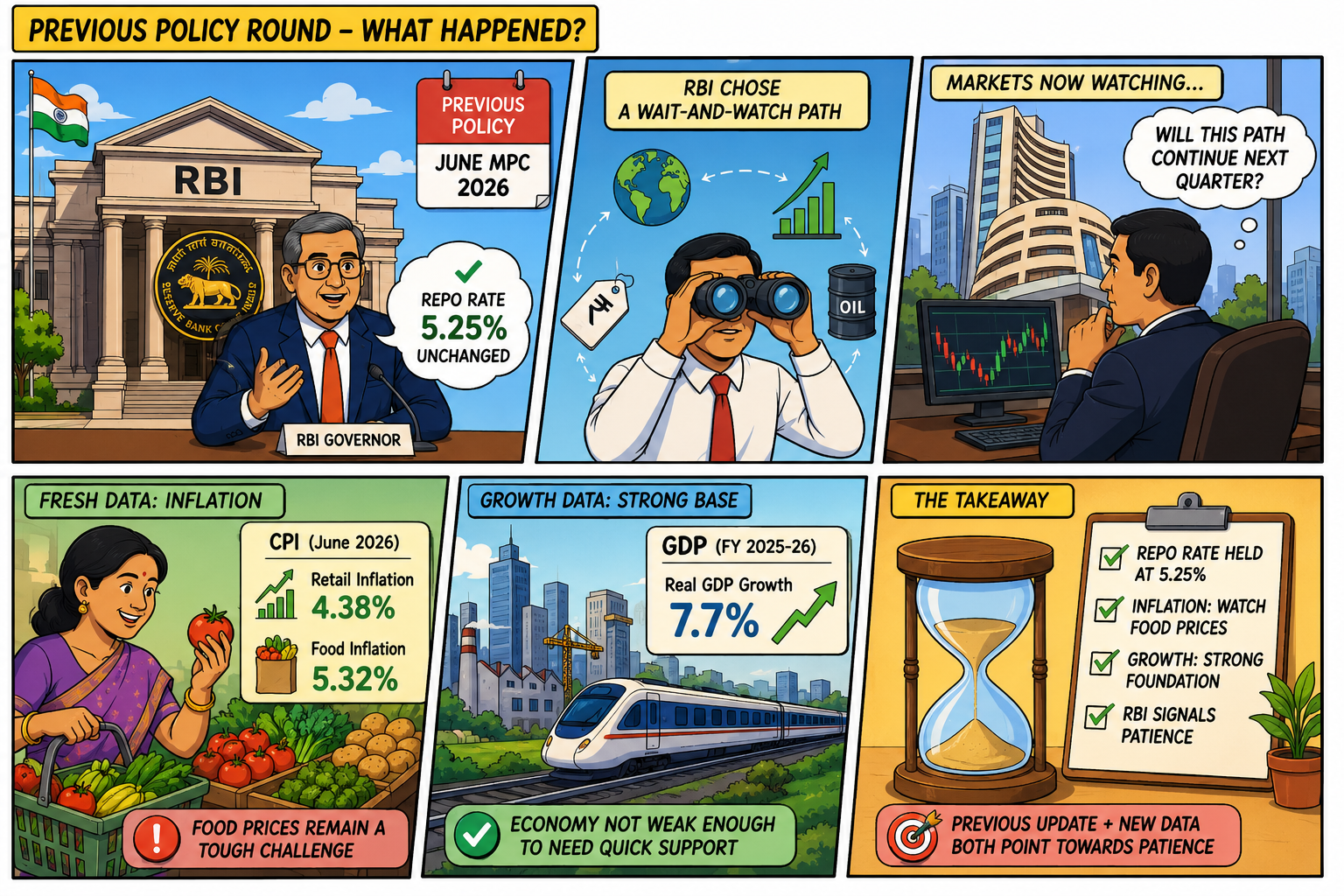
The previous policy round also ended with a 5.25% repo rate. That made the August 5 meeting more of a signal event than a shock event. RBI had already chosen a wait-and-watch path, and markets now want to know whether that path will continue through the next quarter.
After the previous update, fresh government numbers gave both comfort and caution. The Ministry of Statistics and Programme Implementation’s CPI release, posted by PIB Delhi on 13 July 2026 at 4:00 PM, showed retail inflation at 4.38% in June 2026. The same release said food inflation stood at 5.32%. That food number is the harder part for policy because households feel it first in grocery bills.
Growth data gave the other side. The MoSPI GDP press release, posted by PIB Delhi on 5 June 2026 at 4:00 PM, estimated real GDP growth at 7.7% for FY 2025-26. That tells RBI the economy has not slipped badly enough to demand quick rate support. So the previous update and the new data both point towards patience.
Borrowers are watching EMIs. Banks are watching loan demand and deposit costs. Real estate companies are watching buyer sentiment. Bond traders are watching the wording. Each group wants a different signal from the same policy statement.
A borrower wants relief. A bank wants margin protection. A developer wants a rate cut to push sales. A saver wants deposit rates to stay healthy. RBI has to balance all these pressures while keeping inflation under watch.
For markets, the repo rate itself may be the least surprising part of the day. The bigger trigger may be the tone of the policy statement. If the RBI sounds worried about food prices, crude oil and the rupee, bond yields may react. If the language stays balanced, banks and borrowers may treat this as another pause before the next inflation release.
RBI’s August 5 MPC decision is expected to be a pause, but it will not be a routine event for borrowers. A 5.25% repo rate hold would mean no quick EMI relief for many floating-rate loan customers. It would also give savers and banks a more stable rate period.
The final signal will come from the policy language. If RBI sounds cautious on inflation, borrowers may have to wait longer for lower loan rates. If it leaves room for future easing, banks and real estate markets may get a softer signal. For now, experts see patience as the most likely move.
Experts expect the RBI to keep the repo rate unchanged at 5.25% in the August policy review.
EMIs may not fall immediately if RBI keeps the repo rate unchanged at 5.25%.
Inflation, food prices and global risks may push the RBI to wait for more data.
Borrowers can wait for the policy statement, then compare bank spreads and reset terms.
Your EMI may stay locked because banks do not pass repo rate cuts instantly. The benefit reaches borrowers only after the loan reset date, lender review and spread adjustment.










.png&w=3840&q=75)


