By continuing, you agree to LoansJagat's Credit Report Terms of Use, Terms and Conditions, Privacy Policy, and authorize contact via Call, SMS, Email, or WhatsApp
Disclaimer: The information published on LoansJagat is intended for general informational and educational purposes only and should not be considered financial, legal, or investment advice. Interest rates, loan terms, statistics, and other data may change over time and may vary by lender or source. Please verify the latest information and consult a qualified financial advisor or the respective Bank/NBFC before making any financial decisions.
Subscribe Now
About the author

LoansJagat Team
‘Simplify Finance for Everyone.’ This is the common goal of our team, as we try to explain any topic with relatable examples. From personal to business finance, managing EMIs to becoming debt-free, we do extensive research on each and every parameter, so you don’t have to. Scroll up and have a look at what 15+ years of experience in the BFSI sector looks like.
Related Blog Post
Simplify All Your Loans Into One Affordable EMI

Customers Served

Debt Consolidated

1200+ Reviews

Locations in India
Club all Loans & Credit Card Bills into Single EMI

Quick Apply Loan
Consolidate your debts into one easy EMI.

Takes less than 2 minutes. No paperwork.

10 Lakhs+
Trusted Customers

2000 Cr+
Loans Disbursed

4.7/5
Google Reviews

50+
Banks & NBFCs Offers
Other services mentioned in this article
Key Insights
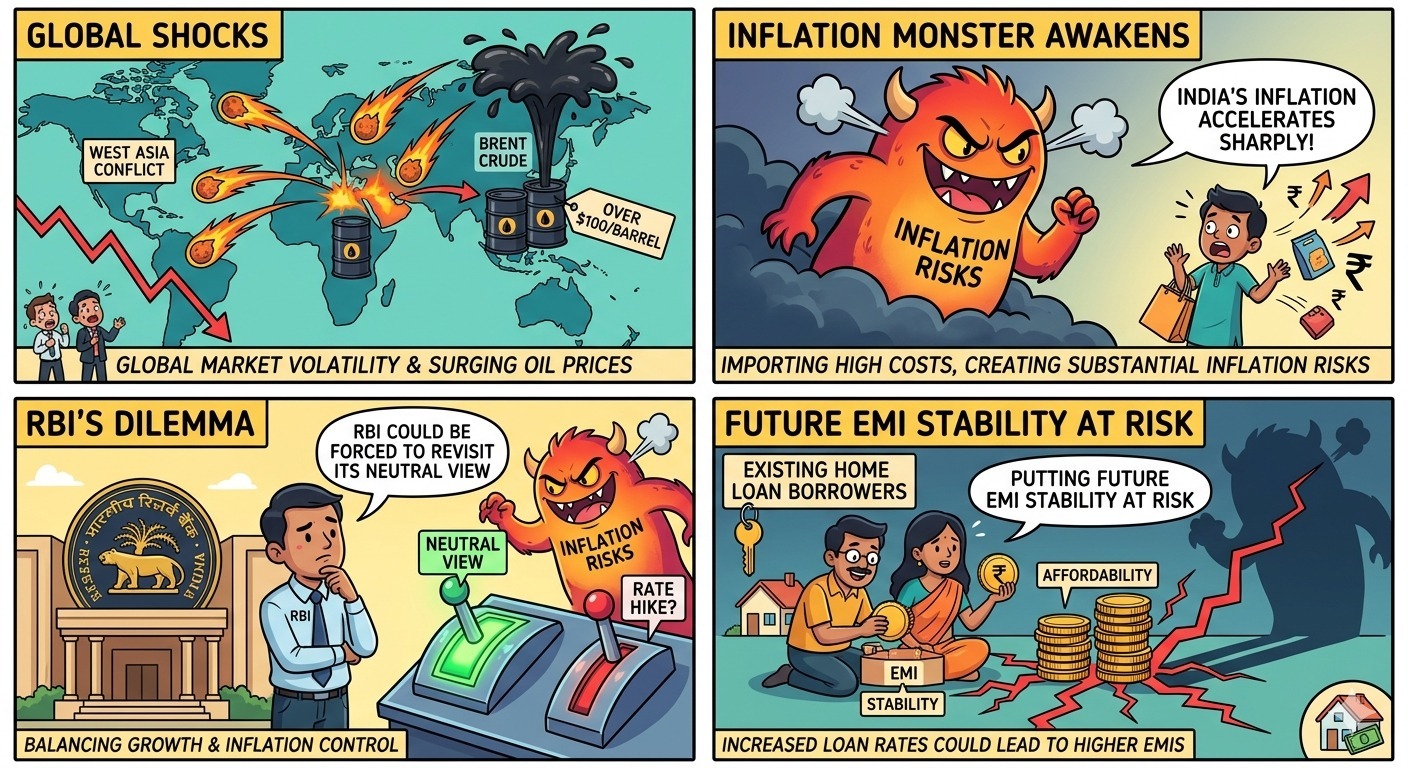
In India, where loan rates are linked to the repo rate, the benefits of this flow through to EMIs, preserving affordability for both existing and new home loan customers.
The ongoing conflict in West Asia has introduced severe volatility into global markets, with Brent crude surging to over $100 per barrel, creating substantial inflation risks for India.
If inflation accelerates sharply, the RBI could be forced to revisit its neutral view, which may put future EMI stability at risk.
For someone with a ₹50 lakh home loan over 20 years before repo rate cuts got the interest rate down from around 8.50% to 7.25%, reducing the EMI from about ₹43,391 to ₹39,519.
A monthly saving of roughly ₹3,057 and a total interest saving of nearly ₹7.34 lakh over the loan tenure.
For those with a ₹75,00,000 loan, monthly savings reach ₹5,800, translating into total interest savings of roughly ₹13.94 lakh a life-changing number for the Indian family.
For the 15 crore Indians paying home loans, this is a major relief.
Public sector giants like State Bank of India and Bank of Baroda are now offering home loans starting at 7.10–7.35%, down from 8.50–9.00% at the 2025.
The rate pause means these savings will no longer be eroded, giving families better monthly cash flow and financial certainty.
Adhil Shetty, CEO of BankBazaar, said:
“The RBI has held the repo rate at 5.25% for the second successive meeting, but the context this time is meaningfully different.
The MPC has flagged a supply shock driven by the West Asia conflict, with crude oil surging well above its own planning assumptions.
The unanimous decision to hold reflects a calculated choice to wait and watch before acting in either direction.”
Borrowers on older loan rules, such as base rate or MCLR should consider whether switching to a repo-linked loan could offer better clarity and faster rate transmission.
Those with existing floating-rate loans linked to external benchmarks will continue to benefit as any rate hike would directly translate into higher EMIs.
The RBI's choice to keep the repo rate at 5.25% is a careful pause, not a setback. Borrowers are still benefiting from the sharp rate cuts in 2025, saving up to ₹13.9 lakh on bigger loans. For now, stability is the main advantage.
Is the RBI just holding the rate at 5.25%?
Yes, the Reserve Bank of India (RBI) unanimously held the repo rate regular at 5.25% during its April 8, 2026, meeting.
Is it possible for home loan EMI to decrease after the recent decrease in the repo rate by the Reserve Bank of India (RBI)?
Yes, home loan EMIs can decrease following an RBI repo rate cut, particularly for borrowers with floating-rate loans linked to the External Benchmark Lending Rate (EBLR).
*T&C Apply









.png&w=3840&q=75)



