
By continuing, you agree to LoansJagat's Credit Report Terms of Use, Terms and Conditions, Privacy Policy, and authorize contact via Call, SMS, Email, or WhatsApp
Disclaimer: The information published on LoansJagat is intended for general informational and educational purposes only and should not be considered financial, legal, or investment advice. Interest rates, loan terms, statistics, and other data may change over time and may vary by lender or source. Please verify the latest information and consult a qualified financial advisor or the respective Bank/NBFC before making any financial decisions.
Subscribe Now
About the author

Arshathul Afia
Arshathul Afia is a journalism graduate and fintech content writer with 4+ years of experience in digital publishing and research-led writing. She has written 200+ articles covering personal finance, lending, banking, digital payments, credit, insurance, and major financial developments in India. At LoansJagat, she focuses on simplifying complex fintech news, RBI updates, loan-related changes, policy developments, and industry trends for everyday readers. Her journalism background helps her approach stories with research, context, and clarity, while her SEO experience ensures content remains discoverable and relevant. She aims to make financial news easier to understand, practical, and useful for readers across India.
Related News
Simplify All Your Loans Into One Affordable EMI

Customers Served

Debt Consolidated

1200+ Reviews

Locations in India
Club all Loans & Credit Card Bills into Single EMI

Quick Apply Loan
Consolidate your debts into one easy EMI.

Takes less than 2 minutes. No paperwork.

10 Lakhs+
Trusted Customers

2000 Cr+
Loans Disbursed

4.7/5
Google Reviews

50+
Banks & NBFCs Offers
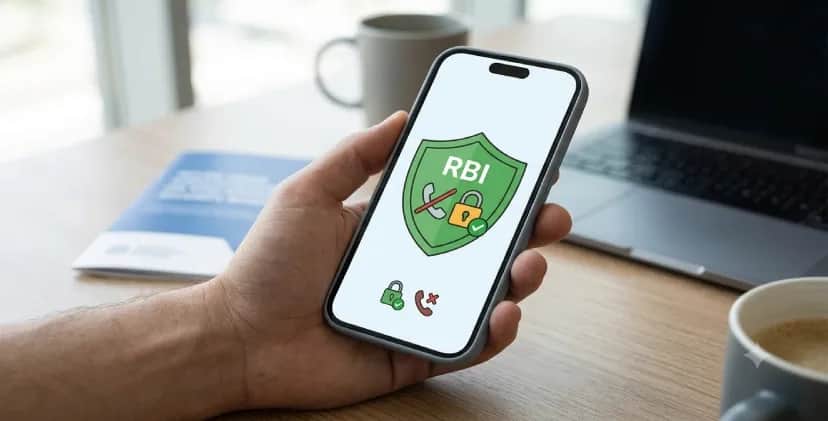
RBI’s new recovery rules curb threatening calls, restrict device locking and require recorded contact, giving borrowers stronger protection while keeping repayment duties unchanged from 2027.
Restrictions on a lender-financed device can begin only after 30 days past due and must follow written safeguards.
The Reserve Bank of India issued new recovery rules on 6 August 2026 for banks, NBFCs, housing finance companies, cooperative banks and other covered lenders across India. According to RBI’s official directions dated 6 August 2026, the framework will take effect on 1 January 2027. It limits how agents contact borrowers, requires call records and controls when a financed mobile device may face restrictions.
For a household dealing with delayed income or a hospital expense, the short-term gain is protection from late calls, surprise visits and family threats. Stored recordings should also help grievance officers examine complaints. The repayment duty stays. A missed EMI can still attract valid charges, affect the borrower’s credit record and lead to lawful recovery.
Recovery employees and agents may ordinarily contact a borrower or guarantor only between 8 a.m. and 7 p.m. Contact outside this period needs the borrower’s express request or authorisation. Even within those hours, repeated calls may count as harsh conduct. A borrower who asks the lender to avoid a hospital appointment, work shift or another specified period should have that request honoured in normal circumstances.
Physical visits will follow a defined process. The lender must send the agency’s details at least 1 day before its first visit. An agent has to display an identity card and carry an authorisation letter with the lender’s notice. Borrowers may choose a meeting place. A home or workplace visit becomes possible after 2 missed appointments there.
Agents cannot use abusive language, anonymous calls, false arrest warnings or threats against a borrower’s family, property or reputation. They cannot post photographs, recordings or loan details on social media. Contacting relatives, referees, friends or colleagues to humiliate a borrower is also prohibited. Recovery discussions should remain with the borrower or guarantor.
Calls and visits should be avoided during bereavement, a medical emergency, a marriage function or a comparable difficult event. Lenders must also record recovery conversations, along with the time and number of calls. Those records need to be preserved for 6 months. When a dispute reaches court, the lender must retain the recording until the proceeding ends.
The device provision has a narrow reach. A bank cannot lock someone’s existing phone because a home loan, personal loan, car loan or education loan EMI remains unpaid. The provision applies only when the same lender financed that phone, tablet or laptop. The contract must expressly permit restrictions, and the borrower must receive notice describing the functions that may be affected.
The table below separates an ordinary missed EMI from a default involving a specifically financed device.
| Recovery Stage | What The Lender Can Do |
| Before 30 days past due | Send permitted reminders, but impose no device restriction |
| After 30 days past due | Begin gradual restrictions after the required notice |
| After 60 days past due | Apply the full contractual set of restrictions |
| During any restriction | Keep incoming calls, SMS and emergency SOS available |
| After receiving the dues | Restore restricted functions within 1 hour |
| Wrongful restriction or lender-caused delay | Pay ₹250 per hour, capped at the disbursed loan amount |
The lender cannot block outgoing calls before the account becomes 60 days past due. Restrictions must not prevent the borrower from carrying out employment-related work. A delivery worker, shop owner or field employee cannot be denied functions needed to earn an income merely because the financed device has entered the recovery process.
Privacy protection goes further. Neither the lender nor its technology provider may access contacts, photographs, SMS, call logs or location history through the locking mechanism. Once the lender receives the overdue amount, it has 1 hour to reverse the restrictions. A delay caused by the lender brings the ₹250 hourly compensation requirement into force.
Unlocking Is Delayed: Compensation runs at ₹250 for each lender-caused hour.
Ananth Shroff, co-founder and chief executive officer of DPDzero, described the framework as a “structural reset” for recovery. Lenders will need systems that stop calls outside permitted hours, flag aggressive wording and preserve conversations. A policy document alone cannot prove how an agent behaved during a call.
The borrower-focused view from LoansJagat’s earlier coverage of the recovery draft is that call recording creates a usable trail when behaviour is disputed. That protection works best when the borrower also keeps notices, screenshots, receipts and dates. LoansJagat’s analysis also indicates that early written contact is safer than avoiding every call when temporary financial trouble appears.
For borrowers, the practical solution begins before the account moves deeper into default. A person facing job loss, illness or delayed customer payments should write to the lender and ask about an available repayment arrangement. The new framework tells lenders to maintain a documented process for financial-distress cases, including contact before escalation and guidance on possible resolution routes.
The policy process began on 6 February 2026, when RBI Governor Sanjay Malhotra announced a review of scattered recovery-agent instructions. Akashvani News reported the announcement that afternoon. The goal was to bring recovery conduct across different regulated lenders under more consistent requirements.
RBI released the first draft on 12 February and accepted comments until 6 March. It concentrated on agent training, customer information, call recording, lender supervision and banned recovery practices. The revised draft arrived on 20 May after stakeholder feedback. That version added detailed conditions for technology-based restrictions on financed mobile devices and remained open for comments until 31 May.
The regulator published the final directions on 6 August and set 1 January 2027 as the start date. They cover banks, cooperative banks, all India financial institutions, NBFCs and housing finance companies. Earlier rules had already prohibited threats and calls outside the 8 a.m. to 7 p.m. window. The 2026 framework adds wider documentation and device safeguards.
Lenders remain responsible when an outside agency handles recovery. They must check agents’ backgrounds, monitor agency work and use trained recovery personnel. Incentive plans cannot encourage excessive calling, abusive speech or public pressure. Each recovery communication must carry the grievance officer’s name, email address, telephone number and office address.
An updated list of empanelled recovery agencies must appear on the lender’s website. A change should be published within 7 calendar days, while a terminated agency should be removed promptly. Device-locking software also needs certification from the manufacturer or operating-system platform where such certification is provided. That requirement should keep untested tools away from borrower devices.
The rules change recovery behaviour, not the loan contract. Borrowers remain liable for valid dues, while lenders keep lawful recovery rights. From 1 January 2027, however, agents must follow permitted hours, identify themselves and avoid pressure through relatives, colleagues or social media.
Device locking also receives firm limits. It applies only to the financed device, begins in stages, and cannot cut off emergency or employment functions. For a borrower expecting to miss an EMI, early written contact with the lender remains the better first step.
An office visit is not automatic. The borrower may choose another location. The agent also needs prior agency disclosure, identification and valid authorisation.
No. A lender may restrict only the phone, tablet or laptop financed through that lender’s specific device loan.
Only when the borrower or guarantor has expressly requested or authorised contact outside the ordinary 8 a.m. to 7 p.m. period.
No. The complaint addresses recovery behaviour. Valid principal, interest and permitted charges remain payable unless the lender approves another arrangement.
The borrower should retain call logs, messages, notices, payment receipts, agent details and every written complaint sent to the lender.









.png&w=3840&q=75)


