
By continuing, you agree to LoansJagat's Credit Report Terms of Use, Terms and Conditions, Privacy Policy, and authorize contact via Call, SMS, Email, or WhatsApp
Disclaimer: The information published on LoansJagat is intended for general informational and educational purposes only and should not be considered financial, legal, or investment advice. Interest rates, loan terms, statistics, and other data may change over time and may vary by lender or source. Please verify the latest information and consult a qualified financial advisor or the respective Bank/NBFC before making any financial decisions.
Subscribe Now
About the author

Arshathul Afia
Arshathul Afia is a journalism graduate and fintech content writer with 4+ years of experience in digital publishing and research-led writing. She has written 200+ articles covering personal finance, lending, banking, digital payments, credit, insurance, and major financial developments in India. At LoansJagat, she focuses on simplifying complex fintech news, RBI updates, loan-related changes, policy developments, and industry trends for everyday readers. Her journalism background helps her approach stories with research, context, and clarity, while her SEO experience ensures content remains discoverable and relevant. She aims to make financial news easier to understand, practical, and useful for readers across India.
Related News
Simplify All Your Loans Into One Affordable EMI

Customers Served

Debt Consolidated

1200+ Reviews

Locations in India
Club all Loans & Credit Card Bills into Single EMI

Quick Apply Loan
Consolidate your debts into one easy EMI.

Takes less than 2 minutes. No paperwork.

10 Lakhs+
Trusted Customers

2000 Cr+
Loans Disbursed

4.7/5
Google Reviews

50+
Banks & NBFCs Offers
Other services mentioned in this article
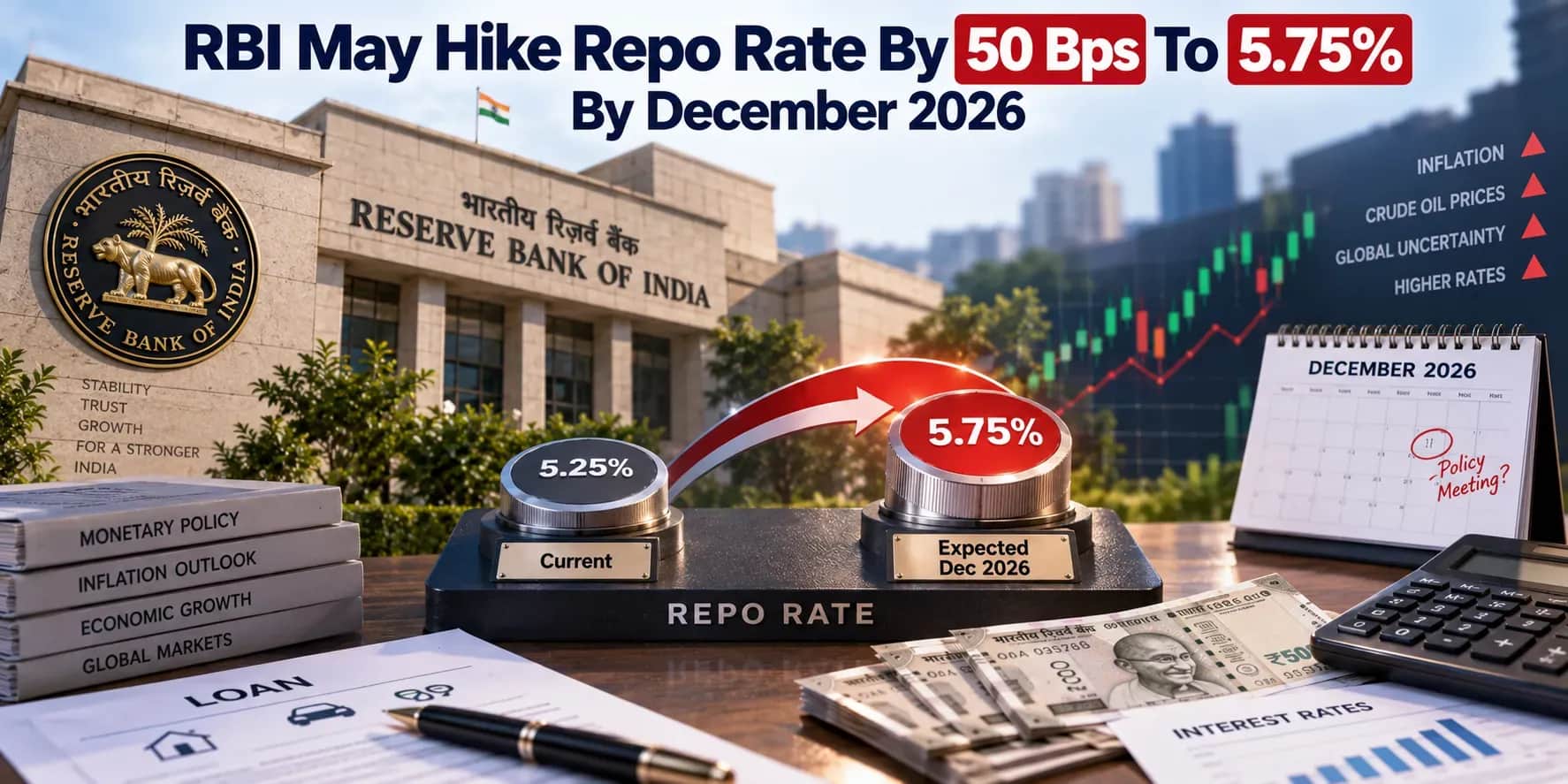
The repo rate could reach 5.75% by December with rate hikes in the next two meetings. Borrowers will then have to keep a tab on EMIs.
The Reserve Bank of India may raise its main lending rate twice before 2026 ends. Economists at Axis Capital see room for action in October and December, while ICRA, CRISIL and HDFC Bank differ over when the first increase may arrive. The 6-member Monetary Policy Committee will take the decision in Mumbai after examining inflation, growth, oil prices and the amount of money available with banks.
Nothing has been announced yet. A higher repo rate can lift floating home loan costs at the next reset and make fresh loans dearer. Savers could receive better deposit offers later, though not from every bank at once.
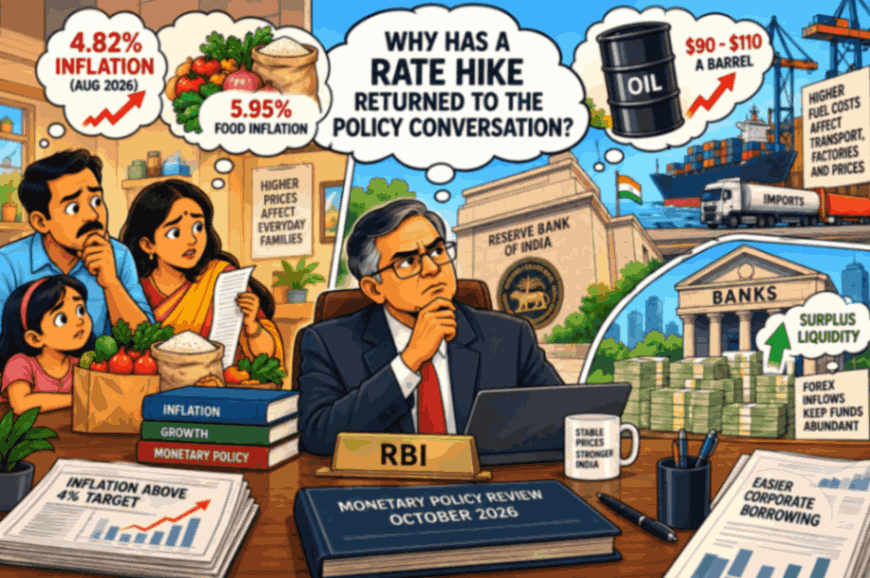
Retail inflation reached 4.82% in August 2026, up from 4.45% in July. The Ministry of Statistics and Programme Implementation released the Consumer Price Index update on 14 September 2026. Food inflation, which has a direct bearing on household spending, rose to 5.95%.
Those readings stayed within India’s 2% to 6% tolerance band but exceeded the 4% target. Members will now check whether transport, household goods and services keep getting costlier.
One month cannot settle the October vote. A rate increase cannot produce onions or repair rain-damaged fields. Policymakers are more likely to act when freight, fuel and input costs spread across categories.
Oil is the difficult part. India buys much of its crude overseas, so expensive barrels can reach factory bills, deliveries and transport. Systematix Group warned that inflation could exceed earlier projections if crude remained between $90 and $110 a barrel. The effect on household bills can be slow, but it adds pressure.
Banks also hold surplus funds. Forex inflows have made up for the rupees mopped up by the central bank through reverse repo auctions, foreign exchange swaps and sales of government securities. Cheap and abundant funds have resulted in easier conditions for corporate borrowing.
Repo-linked loans are usually the first to react. If the committee raises the rate by 25 bps and a lender passes on the entire change, an eligible floating loan becomes 0.25 percentage points costlier at its next reset. A second move of the same size would make the cumulative increase 0.50 percentage points.
Take a ₹50 lakh home loan with 20 years left. At 8.50%, the monthly instalment works out to roughly ₹43,391. At 9%, it comes to about ₹44,986. The difference is ₹1,595 every month, enough to alter a household budget already carrying school fees, rent for another family member, insurance or medical costs.
The EMI does not always go up. A bank may keep the instalment unchanged and add months to the schedule, leaving the borrower in debt longer. A July 2026 borrower note from LoansJagat advises customers to compare the higher-EMI and longer-tenure options.
Deposit customers may get a better deal after a hike. Banks seeking stable funds can raise rates on new fixed deposits, which may help pensioners and families living partly on interest income. The revision is not automatic. A bank with enough deposits may do nothing, while a smaller lender may offer more to attract money.
The arithmetic is simple, but it has caused confusion. The repo rate is currently 5.25%. An increase of 25 basis points takes the interest rate to 5.50%. Another 25 basis points takes it to 5.75%. From this level, the interest rate would have to increase by 75 basis points to reach 6.00%.
This is an illustration, not a bank quotation. Reset dates and lender spreads differ, so the full increase may not arrive at once. Fixed-rate loans normally keep their contracted terms until the stated reset or conversion date.
The committee met from 3 to 5 August 2026. All 6 members voted to leave the repo rate at 5.25%, and the policy stance remained neutral. That gave the committee time to see whether food and fuel increases were turning into a wider inflation problem.
For repo-linked borrowers, the pause meant no fresh increase from the August decision. It did not freeze bank lending rates, which also reflect funding costs, borrower risk and internal spreads.
By mid-September, inflation had accelerated, crude remained expensive and foreign inflows had added rupees to bank balance sheets. Liquidity withdrawals can tighten conditions while policymakers wait for another inflation reading.
Aditi Nayar, Chief Economist at ICRA, has a December 2026 increase in her base forecast. She has left October open if high crude prices begin affecting petrol, diesel and a wider set of retail prices. Her test is the spread of inflation, not one headline number.
Prateek Ancha, Chief Economist at Axis Capital, expects 50 bps of tightening in 2026, split between October and December. He expects the complete increase cycle to stop at 75 bps. Murthy Nagarajan, Head of Fixed Income at Tata Asset Management, also sees an October case because inflation and surplus banking funds have both risen.
Dipti Deshpande, Principal Economist at CRISIL, takes a slower view. She does not expect an October increase and places the likelier move near the financial year’s end. December or February could work, depending on whether oil creates a second round of price increases.
HDFC Bank Principal Economist Sakshi Gupta expects inflation to cross 5% from October. Yet she expects the committee to wait during the October review and start raising rates in December 2026 or February 2027. Their disagreement leaves borrowers with a range of dates, not a settled calendar.

The first job is to find the benchmark written into the loan agreement. Repo-linked accounts may reset faster. MCLR loans follow a bank’s funding costs and their own schedule. Some contracts reset monthly, others every 3 months, while older loans may wait longer.
A borrower can request 2 repayment sheets. One should show the revised EMI after a 25-bps or 50-bps increase. The other should hold the EMI steady and show the new closing date. Comparing total interest can expose a costly extension.
Part-prepayment may cut future interest, especially early in a home loan. Emptying emergency savings is risky. Smaller principal payments made regularly can be easier to carry.
A balance transfer needs care too. Processing charges, legal fees, the new spread and the remaining term decide whether it saves money.
A 50-bps increase by December 2026 would take the repo rate to 5.75%, not 6%. October remains uncertain because economists disagree on whether August inflation offers enough evidence for immediate action. December has broader support, with February 2027 still present in several forecasts.
Floating-rate borrowers carry the first risk through a higher EMI or a later loan-closing date. Deposit customers may gain after banks revise their offers. For now, checking the benchmark, reset clause and repayment choices is more useful than treating 5.75% as a confirmed destination.
It would move from 5.25% to 5.75%. The forecast assumes 2 increases of 25 bps each, although the committee has announced neither move.
No. The timing depends on the benchmark and reset date written into the loan agreement. A lender may raise the EMI, extend the tenure or use both.
Prepayment can lower future interest, particularly when many years remain. The borrower should retain emergency savings and check tax benefits or charges before paying a large amount.
A fixed rate offers protection during its contracted period but may begin at a higher level. Reset conditions, conversion fees and foreclosure terms need checking first.
Some banks may improve rates on new deposits when they require funds. Existing fixed deposits normally retain their agreed rate until maturity unless the customer closes them early.









.png&w=3840&q=75)


