
By continuing, you agree to LoansJagat's Credit Report Terms of Use, Terms and Conditions, Privacy Policy, and authorize contact via Call, SMS, Email, or WhatsApp
Disclaimer: The information published on LoansJagat is intended for general informational and educational purposes only and should not be considered financial, legal, or investment advice. Interest rates, loan terms, statistics, and other data may change over time and may vary by lender or source. Please verify the latest information and consult a qualified financial advisor or the respective Bank/NBFC before making any financial decisions.
Subscribe Now
About the author

Arshathul Afia is a journalism graduate and fintech content writer with 4+ years of experience in digital publishing and research-led writing. She has written 200+ articles covering personal finance, lending, banking, digital payments, credit, insurance, and major financial developments in India. At LoansJagat, she focuses on simplifying complex fintech news, RBI updates, loan-related changes, policy developments, and industry trends for everyday readers. Her journalism background helps her approach stories with research, context, and clarity, while her SEO experience ensures content remains discoverable and relevant. She aims to make financial news easier to understand, practical, and useful for readers across India.
Related News
Simplify All Your Loans Into One Affordable EMI

Customers Served

Debt Consolidated

1200+ Reviews

Locations in India
Club all Loans & Credit Card Bills into Single EMI

Quick Apply Loan
Consolidate your debts into one easy EMI.

Takes less than 2 minutes. No paperwork.

10 Lakhs+
Trusted Customers

2000 Cr+
Loans Disbursed

4.7/5
Google Reviews

50+
Banks & NBFCs Offers
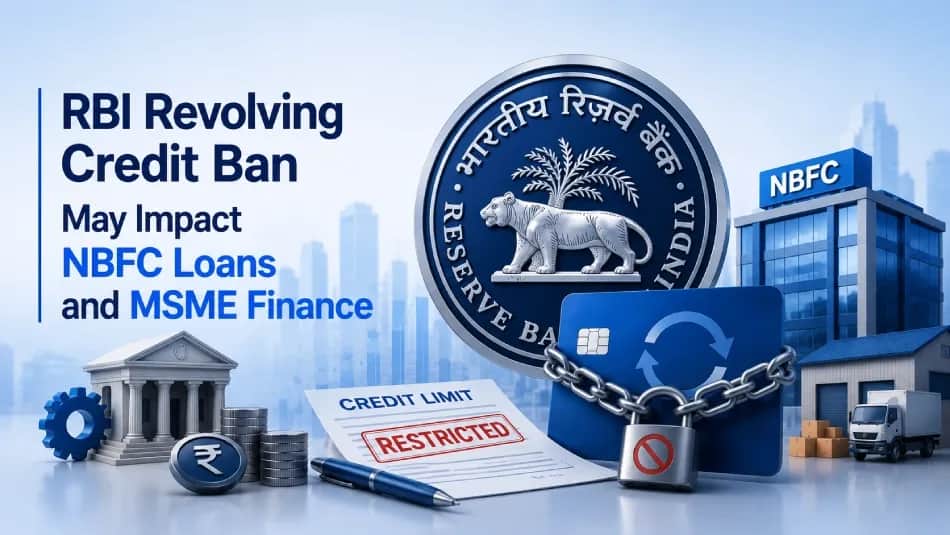
NBFCs are asking for a narrower revolving credit rule after warning that a blanket restriction could disrupt working capital, redraw facilities and supply chain finance.
India’s non-banking lenders have intensified their push for changes to the proposed restriction on revolving credit. FIDC and representatives of NBFCs met Deputy Governor S C Murmu in Mumbai on September 3, 2026, and said the impact could stretch across a wider section of the industry. Business Standard reported that around 30-40 lenders had sent responses to FIDC. The debate now covers more than flexi personal loans. MSME working capital, supply chain finance, loans against securities and products with limited redraw features are also under discussion.
The short-term risk for borrowers is practical. A small manufacturer that repays part of an approved working capital line may no longer be able to reuse that amount under the same facility if the final rule follows the broad draft approach. Fresh loans could mean another application, new checks, and extra processing. Over time, a tighter structure may reduce repeated debt rollovers and expose repayment stress earlier. The policy challenge is to curb open-ended borrowing without cutting transaction-backed business credit.
Revolving credit allows a borrower to use part of an approved limit, repay principal, and draw again within the available amount. For a wholesaler, contractor, or small factory, that can follow the business cycle. Cash goes out for inventory or wages, a customer pays later, and the borrowed amount is returned before the next requirement arrives.
A Press Information Bureau release dated July 10, 2026, said more than 8.70 crore enterprises were registered through Udyam Registration and Udyam Assist. It also said TReDS invoice discounting had reached ₹3.47 lakh crore in FY 2025-26. The Ministry of MSME’s MyMSME portal also directs MSME units towards TReDS onboarding.
The possible borrower impact is easier to see across individual products.
Repeated redraws can keep a customer inside the same debt facility for years, especially when fresh use follows soon after repayment. A fixed repayment path pushes principal towards closure. That can reduce debt recycling. Problems arise if the same restriction reaches invoice-backed business funding.
A trader waiting for a buyer to pay an invoice has a different cash-flow problem from a consumer repeatedly borrowing against the same credit pool. That distinction has become central to the industry’s demand for changes.
FIDC has asked for narrower treatment rather than unrestricted revolving credit. Its August representation sought permission for principal repaid ahead of schedule to be restored within the original sanctioned amount, subject to safeguards. Reuters reported on August 28 that the body also warned of higher interest and operating costs if small businesses had to take fresh term loans repeatedly.
The industry’s proposed safeguards are fairly specific. A facility could have a fixed limit and final maturity, with fresh eligibility checks before each draw. Redraw could stop after a missed payment or deterioration in the borrower’s credit profile. Invoice-backed finance could require proof of the underlying transaction before money moves. That could preserve genuine business funding while limiting repeated debt rollovers.
A LoansJagat analysis published on August 18 looked at the issue from the borrower side. Its view was that tighter rules could reduce rollover risk, but could also narrow short-term credit for self-employed borrowers and small businesses. For a shop owner or supplier, that can affect routine cash flow.
A workable approach could therefore separate an open consumer credit pool from a monitored business facility with a fixed end date. Periodic credit reviews, transaction evidence and redraw blocks after repayment trouble appears could preserve short-duration funding without allowing weak accounts to keep rolling forward.
That is also where borrower protection and business access can meet. A lender would still have to reassess risk, while a healthy small business would not necessarily need a completely fresh loan every time another invoice cycle begins.
Read Also : Used-Car Loans Surge 26.2% as Hidden Fees Raise Borrowing Risks
Industry concern became public during August 2026. NBFC executives began discussing which products could fall within the restriction and whether banks would continue offering similar working capital structures. FIDC then collected feedback from lenders involved in supply chain finance, loan against property and MSME credit. By August 17, reports were already pointing to concern that a wide NBFC restriction could shift some business towards banks.
The debate sharpened on August 25 when the Federation of Indian Micro and Small and Medium Enterprises, or FISME, warned against an across-the-board approach. It argued that productive working capital should be separated from consumer-style revolving borrowing. FIDC followed with its formal representation on August 27.
Reuters reported on August 28 that FIDC wanted early principal repayments to be replenishable under safeguards. The industry body warned that a blanket restriction could reduce NBFC participation in trade and working capital finance, particularly where businesses have fewer bank borrowing options.
By September 3, the estimated reach had widened. Business Standard reported that around 30-40 lenders had submitted responses to FIDC, while an NBFC chief executive said the initial view had been that only 3 or 4 lenders would face a major impact. Supply chain finance became a specific concern because funding can be linked to GST data, invoices and direct supplier payments.
The ₹30 lakh crore figure in the headline also needs context. Shriram Finance Executive Vice-Chairman Umesh Revankar said on September 1 that the NBFC sector was around ₹30 lakh crore and estimated revolving products at about ₹2 lakh crore. That is an industry estimate, not a government figure.
Revankar’s argument was that revolving loans account for a relatively small portion of overall NBFC lending. The September feedback points to a different issue, however. Even if the loan amount is smaller compared with total sector assets, the product definition could still require changes across many lenders.
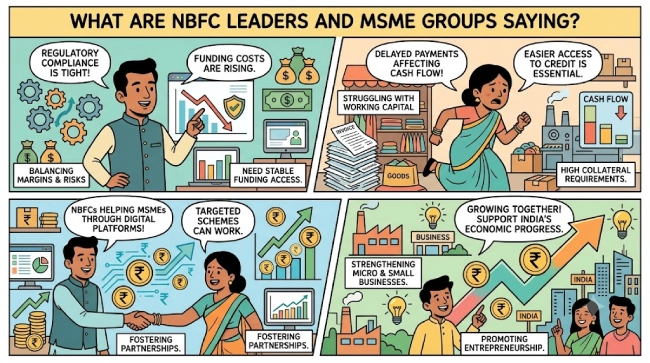
Revankar has taken a less worried position than some industry participants. He said revolving loans are not the main product for most NBFCs and described Shriram Finance’s own exposure as small, largely involving trade advances to dealers. The impact may therefore differ sharply by business model.
FIDC is more cautious. The body has warned that an overly broad definition could reduce NBFC participation in trade finance and working capital lending, especially for MSMEs with limited bank access. Its case is for controlled replenishment where the borrower pays principal early, the sanctioned amount does not rise, and the lender can stop further drawings when risk increases.
FISME has focused on day-to-day business use. A small firm may buy raw material today, sell finished goods next week, and receive payment later. Funding is needed during that gap. Repeated term-loan applications could make a routine requirement slower and more expensive. TReDS expansion also shows that invoice-linked cash remains an active MSME policy priority.
Exposure differs sharply among large NBFCs too. Brokerage estimates reported in August put revolving credit at around 15% of Bajaj Finance’s AUM, while Cholamandalam Investment and Finance was estimated below 1%. Those are analyst estimates, not official figures. They explain why the same rule could force a major product redesign at 1 lender and only minor adjustments at another.
For borrowers, the immediate job is simpler. Sanction letters should be checked for redraw rights, annual charges, repayment conditions and what happens after principal is paid. If the final rules change the product, lenders will need to explain whether an existing facility continues until maturity, converts into a term loan or moves to revised conditions.
Customers should not assume that every flexi loan will disappear immediately. The final regulatory wording and any transition arrangement will decide what happens to existing facilities.
The September 3 meeting has widened the revolving credit debate. What first appeared concentrated among a few NBFCs now includes MSME working capital, supply chain finance, loans against securities and limited-redraw products. Feedback from around 30-40 lenders shows that the final wording could influence product design across a broader group.
A narrower rule could still reduce debt recycling while allowing fixed-maturity, transaction-backed business facilities under tighter checks. For small firms, that distinction could decide whether working capital remains available when an invoice is pending or stock has to be purchased quickly.
The final rules will decide how much of today’s flexi structure survives. Until then, the proposed restriction remains a policy under consideration, rather than a complete ban across the NBFC sector.
It is a facility where a borrower can use money from an approved limit, repay it and later draw again, subject to the lender’s terms and available limit.
Not necessarily. Treatment of existing loans will depend on the final directions, effective date, transition terms, and each loan agreement.
A dropline overdraft generally allows withdrawals within a reducing approved limit. A term loan disburses a fixed principal amount that is repaid according to an agreed schedule. Exact terms differ by lender.
Under many existing flexi structures, repayment can restore available drawing power. The present regulatory debate is directly about whether NBFC products should continue allowing that replenishment.
Industry bodies have asked for separate treatment, especially where funding is tied to invoices, GST records or direct supplier payments. No final exemption had been announced as of September 4, 2026.









.png&w=3840&q=75)


