
By continuing, you agree to LoansJagat's Credit Report Terms of Use, Terms and Conditions, Privacy Policy, and authorize contact via Call, SMS, Email, or WhatsApp
Disclaimer: The information published on LoansJagat is intended for general informational and educational purposes only and should not be considered financial, legal, or investment advice. Interest rates, loan terms, statistics, and other data may change over time and may vary by lender or source. Please verify the latest information and consult a qualified financial advisor or the respective Bank/NBFC before making any financial decisions.
Subscribe Now
About the author

Arshathul Afia is a journalism graduate and fintech content writer with 4+ years of experience in digital publishing and research-led writing. She has written 200+ articles covering personal finance, lending, banking, digital payments, credit, insurance, and major financial developments in India. At LoansJagat, she focuses on simplifying complex fintech news, RBI updates, loan-related changes, policy developments, and industry trends for everyday readers. Her journalism background helps her approach stories with research, context, and clarity, while her SEO experience ensures content remains discoverable and relevant. She aims to make financial news easier to understand, practical, and useful for readers across India.
Related News
Simplify All Your Loans Into One Affordable EMI

Customers Served

Debt Consolidated

1200+ Reviews

Locations in India
Club all Loans & Credit Card Bills into Single EMI

Quick Apply Loan
Consolidate your debts into one easy EMI.

Takes less than 2 minutes. No paperwork.

10 Lakhs+
Trusted Customers

2000 Cr+
Loans Disbursed

4.7/5
Google Reviews

50+
Banks & NBFCs Offers
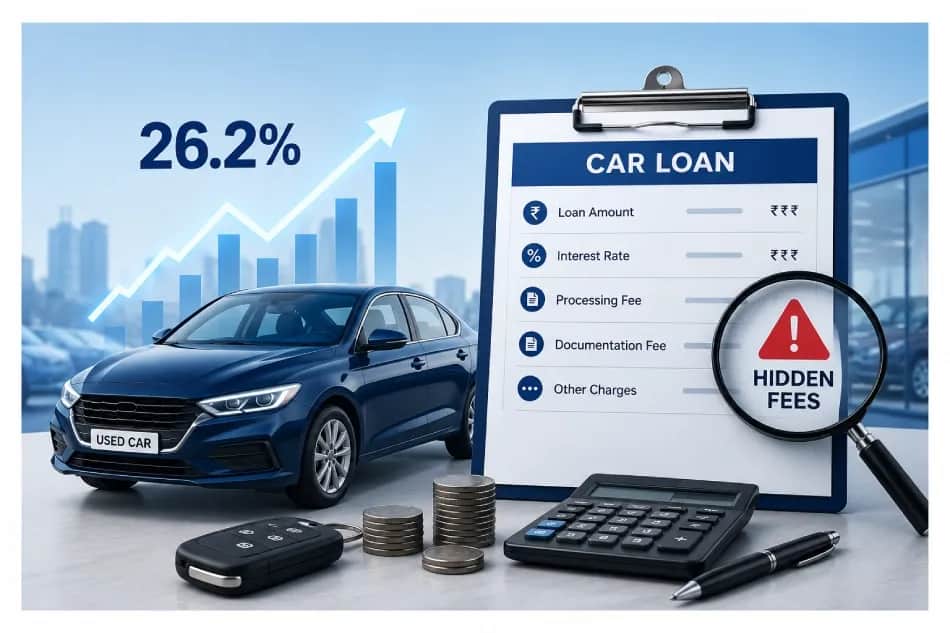
India’s used-car loan market grew 26.2% annually over 5 years to June 2026, exposing more borrowers to added fees and long repayment periods after purchase.
The risk begins when a buyer works backwards from the dealer’s EMI quote. In the next few months, processing fees, insurance and initial repairs may strain cash flow. Over a longer period, interest keeps running while the vehicle loses value and needs more maintenance. A borrower may then owe more than the car can fetch in the resale market. That gap is painful.
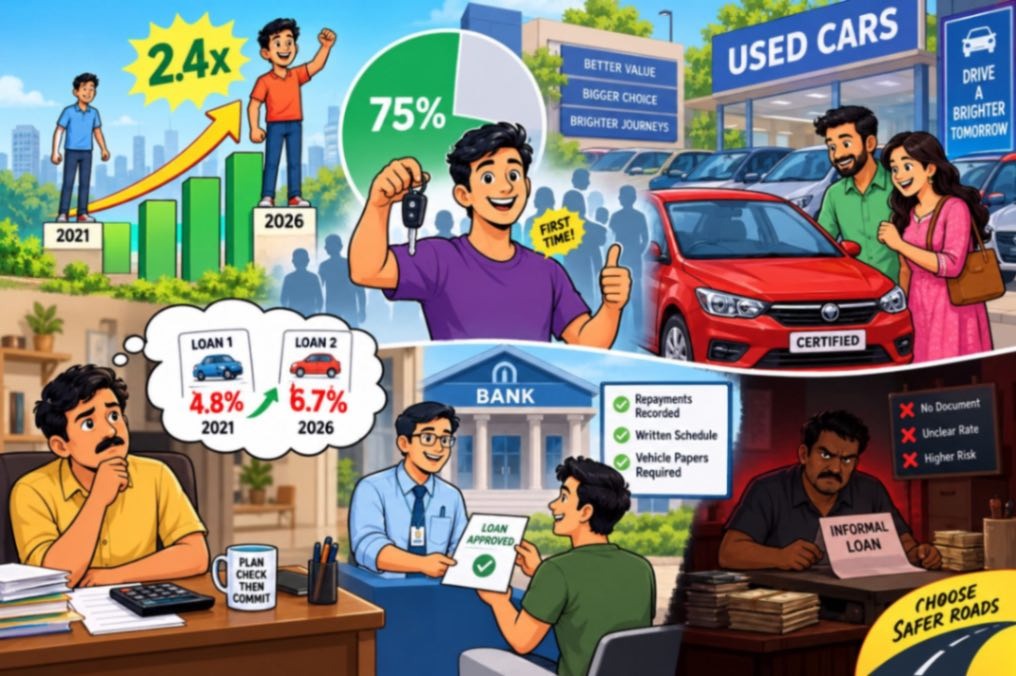
CRIF High Mark found that the used-car loan borrower base expanded 2.4 times over the 5 years ending June 2026. About 75% of recent originations were new-to-product accounts. Many are taking a used-car loan for the first time.
LoansJagat’s reading of the bureau data flagged another pressure point. Used-car borrowers holding 2 or more active loans within the segment increased from 4.8% to 6.7%. For a household, the practical reading is simple: a new EMI has to be tested alongside every existing repayment. Looking at it alone can produce a false picture of affordability.
There is a positive side. Formal lenders record repayments, provide written schedules and usually require vehicle papers before disbursal. That can be safer than an informal cash loan with no documented rate, particularly for workers and small business owners.
A long tenure makes the monthly instalment look easier. The total interest bill moves in the other direction. Used cars add another problem because the asset is already ageing. A 5-year loan taken on a 6-year-old vehicle could still be running when major repairs start appearing and resale demand begins to weaken.
The loan file should therefore be read as a full cost sheet. The table below separates what attracts a buyer at the showroom from what can arrive later.
The borrower should ask for a written breakdown of the loan amount, interest calculation, each fee, total repayment and early-closure conditions. A verbal promise from an agent offers little protection when the first statement arrives.
The seller decides the asking price. The lender decides how much of that car it is prepared to finance. Those figures can differ because the lender examines age, model, physical condition and expected resale demand. A commonly traded hatchback may receive better terms than an older premium car with costly parts and a smaller pool of buyers.
Suppose a dealer asks ₹7 lakh and the lender values the car at ₹6 lakh. If finance is calculated on the lower figure, the customer must pay the difference as well as the required margin. Some buyers discover this after paying a booking amount. Walking away then becomes harder, which is exactly why valuation should happen before the purchase is treated as final.
Read Also : WhatsApp Adds Electricity, Water, Gas, and Credit Card Bill Payments for 22,722 Billers
Adhil Shetty, chief executive officer of BankBazaar, told Business Standard in its September 3, 2026 report that used-car loans generally carry higher rates because the vehicle has already depreciated. Shivanshu Makkar, India's chief financial officer at Cars24, said lenders assess both sides of the transaction. They check the customer’s repayment profile and the car’s likely resale strength before setting the terms.
Akash Bararia, head of consumer finance at HDB Financial Services, advised choosing the shortest tenure that remains affordable. SEBI-registered investment adviser Abhishek Kumar suggested 36 to 48 months as a workable range for many borrowers and proposed a 20%-30% down payment, depending on available funds. Amit Kakkar, chief executive officer of Spinny Capital, added a practical warning. A bigger down payment can reduce interest, but it should not empty the family’s emergency savings.
The solution starts before the car search. A household can decide the highest EMI it can pay after rent, food, school costs, insurance and existing debt. It should then choose the loan amount and vehicle. Dealers often encourage the reverse order, where a preferred car is selected first and the tenure is stretched until the EMI looks acceptable.
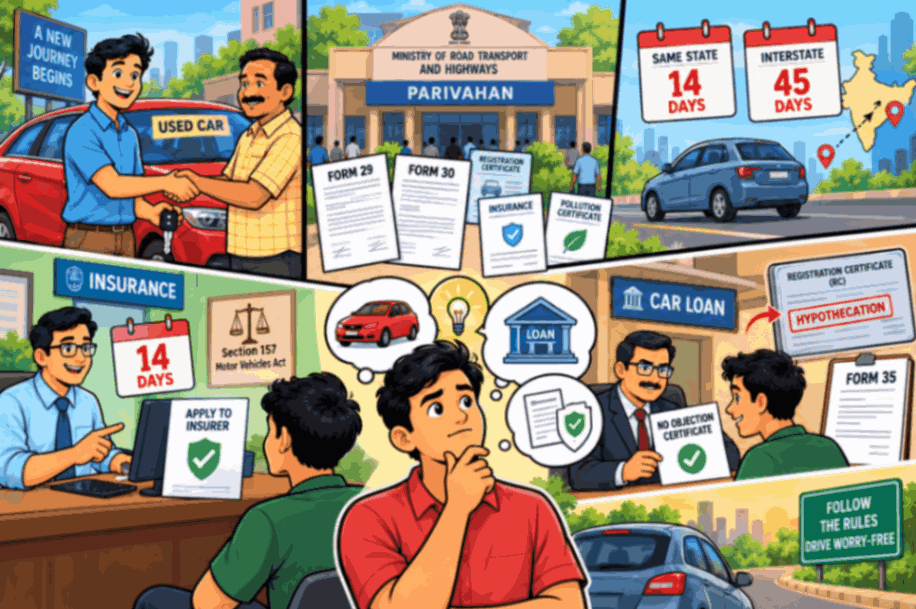
Ownership-transfer duties existed long before the latest finance growth. The Ministry of Road Transport and Highways’ Parivahan ownership-transfer guidance lists Form 29 and Form 30 for a normal sale, along with the registration certificate, insurance and pollution documents. For a vehicle registered in the same state, the transfer application should be made within 14 days. Interstate transfers have 45 days.
Insurance needs separate attention. Section 157 of the Motor Vehicles Act, available through the Ministry of Law and Justice’s India Code portal, requires the transferee to apply to the insurer within 14 days of the vehicle transfer. Starting an RC transfer does not complete the insurer’s process. Both records need the buyer’s name.
An earlier loan can delay the transaction as well. If the seller’s financier remains recorded on the RC, the buyer should ask for the loan-closure proof and no-objection documents. After repaying the new loan, the borrower will again need the lender’s no-objection certificate and Form 35 to remove hypothecation from the vehicle record.
Read Also : India’s Affordable Car Market Roars Back as Maruti Credits GST Reforms
The quickest test is a bad-month calculation. The household should check whether the EMI can still be paid if income drops for a month or a repair lands at the same time. If the answer depends on using a credit card or delaying another bill, the proposed car is probably too expensive for the present budget.
A down payment can lower both the principal and interest, though using every rupee of savings defeats the purpose. Buyers also need room for registration work, insurance renewal, servicing and worn parts. An independent mechanic should inspect the chassis, engine, tyres and signs of flood or accident damage before money changes hands.
The 26.2% growth in used-car lending shows that formal finance is reaching many more Indian buyers. It also places more people in loans tied to vehicles that will continue losing value.
A safe deal needs 3 checks before the signature: what the lender values, what the borrower will repay in total and what the car may cost to keep running. If the numbers work only after stretching the tenure or draining savings, the buyer should step back. Another car, or a few more months of saving, may leave the household in a far stronger position.
The borrower should check processing, documentation, valuation, insurance, payment-return, part-payment and foreclosure charges. Each amount should appear in writing before the agreement is signed.
It reduces the EMI, but it raises total interest and keeps the loan active as the vehicle ages. The shortest affordable tenure usually limits that overlap.
Abhishek Kumar suggested 20%-30%, though the final amount depends on income, other debt and available savings. An emergency reserve should remain untouched after payment.
The answer depends on the approved rate, total fees, repayment period and security terms. Both written offers should be compared using total repayment, not the advertised starting rate.
Common expenses include immediate servicing, tyres, battery, insurance transfer, registration work and repairs missed during inspection. These costs should be budgeted separately from the EMI.









.png&w=3840&q=75)


