
By continuing, you agree to LoansJagat's Credit Report Terms of Use, Terms and Conditions, Privacy Policy, and authorize contact via Call, SMS, Email, or WhatsApp
Disclaimer: The information published on LoansJagat is intended for general informational and educational purposes only and should not be considered financial, legal, or investment advice. Interest rates, loan terms, statistics, and other data may change over time and may vary by lender or source. Please verify the latest information and consult a qualified financial advisor or the respective Bank/NBFC before making any financial decisions.
Subscribe Now
About the author

Arshathul Afia is a journalism graduate and fintech content writer with 4+ years of experience in digital publishing and research-led writing. She has written 200+ articles covering personal finance, lending, banking, digital payments, credit, insurance, and major financial developments in India. At LoansJagat, she focuses on simplifying complex fintech news, RBI updates, loan-related changes, policy developments, and industry trends for everyday readers. Her journalism background helps her approach stories with research, context, and clarity, while her SEO experience ensures content remains discoverable and relevant. She aims to make financial news easier to understand, practical, and useful for readers across India.
Related News
Simplify All Your Loans Into One Affordable EMI

Customers Served

Debt Consolidated

1200+ Reviews

Locations in India
Club all Loans & Credit Card Bills into Single EMI

Quick Apply Loan
Consolidate your debts into one easy EMI.

Takes less than 2 minutes. No paperwork.

10 Lakhs+
Trusted Customers

2000 Cr+
Loans Disbursed

4.7/5
Google Reviews

50+
Banks & NBFCs Offers
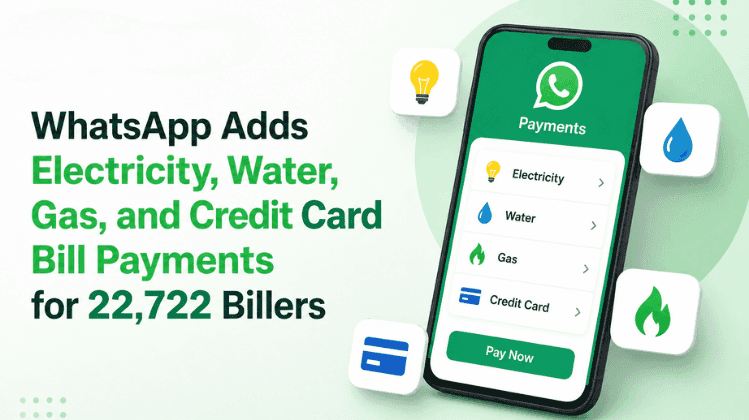
WhatsApp’s new bill-payment rollout puts everyday utility, FASTag, credit-card, and loan dues inside its Payments tab, using Bharat Connect to reach users across India gradually.
WhatsApp has started rolling out Bill Payments across India, allowing users to pay electricity, water, piped gas, FASTag, insurance premiums, credit card bills, loan repayments, mobile and DTH bills from the same app. The feature is powered by Bharat Connect, formerly BBPS. WhatsApp says the service covers 22,722 billers in 30 categories and will reach Android and iOS users in phases over the coming weeks. Users enter through the ₹ icon, select a biller, fetch the amount where supported, and pay through UPI, debit card or credit card.
For households, the short-term benefit is practical. A monthly electricity payment or FASTag recharge can be completed without moving between several apps. Over time, the feature could pull more routine payments into WhatsApp because many users open it far more often than a dedicated financial app. There is a weak spot too. A payment request inside a familiar chat app can look trustworthy even when it is fake, so biller names, account numbers, and amounts still need checking.
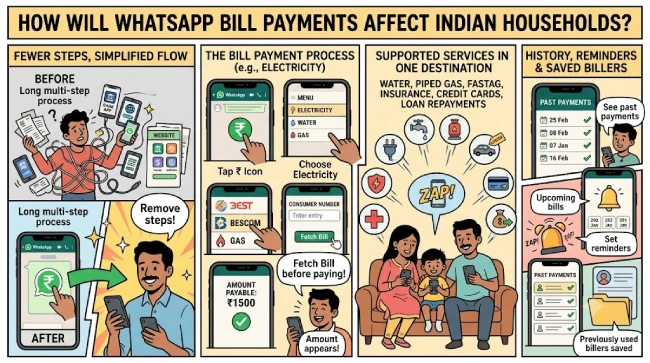
For an ordinary user, the new flow removes a few steps. Someone paying a power bill can tap the ₹ icon, choose Electricity, select the available distribution company, and enter the consumer number. Where bill fetching is supported, the amount appears before payment. The same basic route applies to water, piped gas, FASTag, insurance, credit cards and loan repayments. Users can also see past payments, upcoming bills and previously used billers.
That could help homes where 1 person handles bills for parents, rented property or more than 1 connection. The timing is notable. The Ministry of Finance said in a Press Information Bureau release dated August 24, 2026, that UPI accounted for 84% of India’s digital-payment transaction volume in FY2025-26. WhatsApp is adding bill payment to a method people already use widely, rather than asking them to learn a new checkout process.
Customers should still check whether their exact provider appears. A category being available does not mean every power company, insurer, lender or credit-card issuer in India will show up immediately.
The table also shows why WhatsApp does not replace every existing payment route. If a provider is missing, customers can use the utility’s official site, their bank app or another Bharat Connect-enabled service. That option is useful close to a due date, when waiting for a phased feature rollout may cause a late payment.
Credit-card and loan repayments need more care than a small recharge. The user should verify the issuer, account details, due amount, and acknowledgement before closing the app. A payment that has been initiated is not always the same as one already posted by the lender. Anyone paying near the deadline should check the card or loan account afterwards and keep the receipt until the amount appears.
A June 5, 2026 LoansJagat explainer on third-party credit-card bill payments said cardholders benefit from routes that are fast, traceable, and easy to repeat as more apps use Bharat Connect at the backend. That view fits WhatsApp’s new feature. The consumer gain comes from a standard route where the biller can be selected, the amount can be fetched, and the payment trail can be checked later.
There is still room for user error. Paying a credit-card bill through WhatsApp does not mean the app has checked every entry on the customer’s behalf. If the issuer, amount, or account looks wrong, the payment should stop until the card company confirms the details.
Read Also : Same Bank, Same CIBIL Score, Yet Home Loan Interest Rates May Still Differ
Bill payments on WhatsApp will be handy, but users will need to be a little careful too. Scammers often copy company logos, pose as customer-care staff, or send messages saying a bill has to be paid immediately. On a phone screen, these messages can sometimes look genuine. The safer way is to ignore payment links from unknown numbers and open the ₹ Payments section inside WhatsApp directly. OTPs, UPI PINs, and card details should not be shared in a chat.
CERT-In had already flagged similar fraud risks in Advisory CIAD-2024-0050, issued on October 24, 2024. The advisory covered phishing, fake customer support, card fraud, loan scams, and suspicious requests for money. Users were advised to check the sender before making a payment and review their bank or card account after the transaction. One basic rule is useful here too. A UPI PIN or OTP is not required to receive money. Before paying a bill on WhatsApp, the user should simply check the provider name, account details, and amount shown on the screen.
If an electricity message threatens disconnection within minutes, a user should compare it with the bill fetched through the official payment route. A mismatch in the amount or consumer number is a reason to stop.
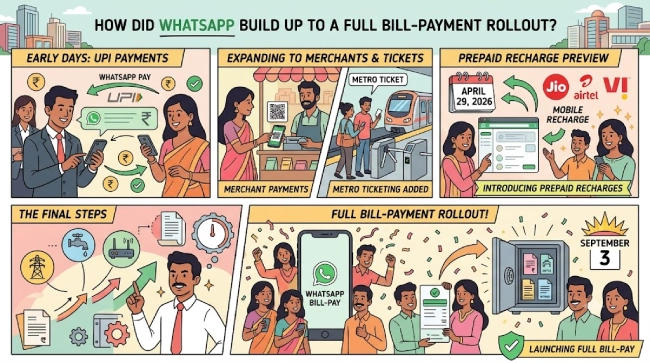
The September 3 launch follows earlier payment features. WhatsApp Pay entered India as a UPI-based money-transfer service, and the app later expanded into merchant payments and metro ticketing. A more direct preview arrived on April 29, 2026, when WhatsApp introduced prepaid mobile recharge for Jio, Airtel and Vi users.
That April update made the ₹ icon more prominent on the home screen. Users could select a mobile number, confirm the operator, pick a plan, and pay through UPI, debit card, or credit card. Bill Payments now uses the same entry point for a wider group of recurring expenses. A recharge involves a handful of telecom operators. Household bills can involve local power companies, banks, insurers, gas suppliers, and lenders.
Bharat Connect makes that expansion possible by providing a common bill-payment network below the consumer app. WhatsApp supplies the front end people see, while participating billers connect through the wider network.
Read Also : Piyush Goyal Slams Opposition Over India’s 7.8% Q1 GDP Row
Arun Srinivas, Managing Director and Country Head of Meta India, said the company wants paying a bill on WhatsApp to be “as effortless as sending a message”. He also linked the launch to wider access in remote parts of India. The claim is ambitious, and actual adoption will depend on biller coverage, payment posting and user trust.
Meta made a similar point when prepaid recharge launched in April. Ravi Garg, Director of Business Messaging at Meta India, said people should be able to finish everyday tasks without switching between multiple apps. Bill Payments extends that approach from mobile recharge to household dues.
For borrowers and cardholders, there is another practical angle. Easier access may reduce missed payments when bills are simpler to find and repeat. At the same time, relying on 1 app for many financial chores can create dependence. Keeping issuer alerts active, checking whether large repayments have been posted, and retaining another recognised payment route can reduce that risk.
WhatsApp’s Bill Payments rollout gives Indian users a shorter route for paying electricity, water, piped gas, FASTag, insurance, credit-card and loan dues from an app already used for everyday communication. The launch covers 22,722 billers across 30 Bharat Connect categories and is being released gradually from September 3, 2026.
Convenience may get people to try it. Trust will decide whether they keep using it. The safest routine is simple: fetch the bill through the official Payments section, verify the provider and account details, pay only after checking the amount, and confirm that larger repayments have posted with the issuer.
Yes. Users with Bill Payments can choose Electricity, select a supported provider, enter consumer details, fetch the bill, and complete payment.
The rollout is gradual across Android and iOS. Some accounts will receive the feature later even if the app is already updated.
Yes, if the card issuer appears as a supported Bharat Connect biller. Users should verify the issuer, amount, and payment status.
Yes. FASTag is among the announced categories, subject to the relevant issuer being available inside Payments.
No. A UPI PIN authorises outgoing UPI payments. It should never be shared with anyone asking for it to release incoming money.









.png&w=3840&q=75)


