

By continuing, you agree to LoansJagat's Credit Report Terms of Use, Terms and Conditions, Privacy Policy, and authorize contact via Call, SMS, Email, or WhatsApp
Disclaimer: The information published on LoansJagat is intended for general informational and educational purposes only and should not be considered financial, legal, or investment advice. Interest rates, loan terms, statistics, and other data may change over time and may vary by lender or source. Please verify the latest information and consult a qualified financial advisor or the respective Bank/NBFC before making any financial decisions.
Subscribe Now
About the author

Arshathul Afia is a journalism graduate and fintech content writer with 4+ years of experience in digital publishing and research-led writing. She has written 200+ articles covering personal finance, lending, banking, digital payments, credit, insurance, and major financial developments in India. At LoansJagat, she focuses on simplifying complex fintech news, RBI updates, loan-related changes, policy developments, and industry trends for everyday readers. Her journalism background helps her approach stories with research, context, and clarity, while her SEO experience ensures content remains discoverable and relevant. She aims to make financial news easier to understand, practical, and useful for readers across India.
Related News
Simplify All Your Loans Into One Affordable EMI

Customers Served

Debt Consolidated

1200+ Reviews

Locations in India
Club all Loans & Credit Card Bills into Single EMI

Quick Apply Loan
Consolidate your debts into one easy EMI.

Takes less than 2 minutes. No paperwork.

10 Lakhs+
Trusted Customers

2000 Cr+
Loans Disbursed

4.7/5
Google Reviews

50+
Banks & NBFCs Offers
Lower GST brought buyers back to Maruti’s smaller cars, though loan costs, future price rises and new safety rules could still slow the recovery again.
Maruti Suzuki Managing Director and CEO Hisashi Takeuchi said India’s affordable car market had returned to growth after the 2025 GST reforms lowered prices. Speaking at the 66th SIAM Annual Convention in New Delhi on September 3, 2026, he said entry-level sales grew by almost 100% during the first 4 months of FY27. Even a modest price reduction can cut a first-time buyer’s down payment and monthly EMI.
The immediate gain is a cheaper route from a motorcycle or scooter to a hatchback. Over several years, stronger demand could support factories, dealers and component suppliers. Insurance, state registration, fuel, loan interest and maintenance remain expensive, however. New safety rules or dearer materials could push basic models beyond household budgets again.
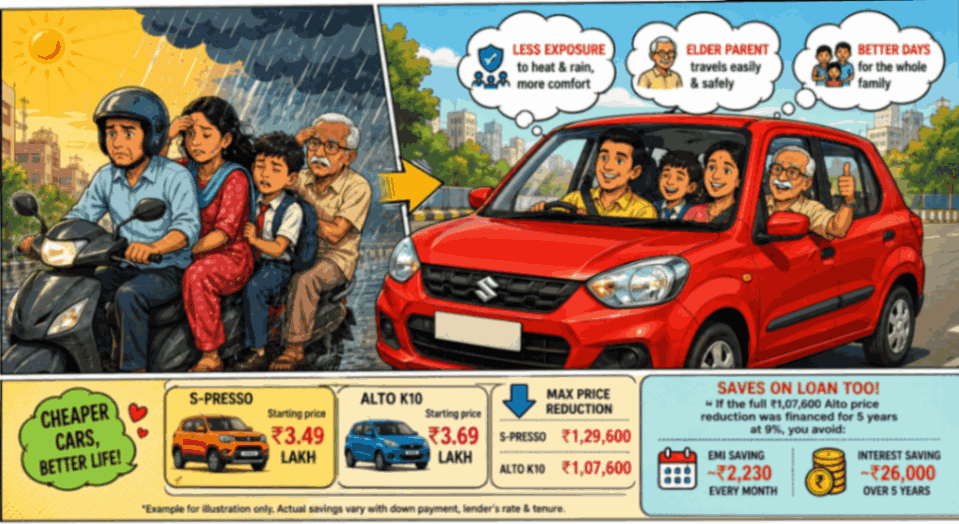
For a household with a single 2-wheeler, a small car can change daily travel. Children are less exposed to heat and rain, and an older parent can travel more easily. Price decides whether that upgrade happens. Maruti reduced the S-Presso’s starting ex-showroom price to ₹3.49 lakh in September 2025 and the Alto K10’s to ₹3.69 lakh. The highest announced reductions were ₹1,29,600 and ₹1,07,600, respectively.
That saving also reduces borrowing. A simple repayment calculation shows why. If the full ₹1,07,600 Alto price reduction had otherwise been financed for 5 years at 9%, the buyer would avoid roughly ₹2,230 in EMI each month and about ₹26,000 in interest over the term. Actual savings will change with the down payment and lender’s rate. LoansJagat’s car loan guidance also points buyers towards income stability, a suitable loan amount and existing debts before applying. The useful number is total repayment, not the EMI displayed in an advertisement.
Takeuchi said cars covered by the 18% GST bracket grew by about 30% during April to July 2026. Vehicles in the 40% bracket recorded nearly 20% growth, based on the figures presented in his SIAM address. He described the outcome in a short line: “The impact of the recent GST reforms has shown the power of affordability.” His argument was not for weaker cars. He asked for a workable balance so that cleaner and safer vehicles remain within reach of Indian families.
Future rules need planned implementation, giving manufacturers and suppliers time to localise new parts. Safety equipment cannot be stripped out to protect a low sticker price. Regulators can publish requirements early, manufacturers can spread development costs across more models, and lenders can show processing fees and total interest before a borrower signs.
Maruti places the Alto and S-Presso in its Mini category. Its July 2026 sales disclosure, released on August 1, 2026, provides the nearest published comparison with Takeuchi’s statement about entry-level demand. The GST conditions came from the GST Council’s 56th meeting recommendations issued on September 3, 2025.
The 114% increase supports Takeuchi’s claim that sales almost doubled, though his speech may have used a slightly different entry-level definition. It also needs perspective. The comparison begins with only 26,344 vehicles, an unusually low base for Maruti’s 2 cheapest cars. Another 2 or 3 quarters of retail demand would provide stronger evidence of a durable recovery than 4 months of wholesale dispatches.
Read Also : Piyush Goyal Slams Opposition Over India’s 7.8% Q1 GDP Row
Small cars did not disappear because of a single tax decision. Prices rose as manufacturers adopted BS-VI emission technology and added required safety equipment. The Ministry of Road Transport and Highways recorded crash standards, anti-lock braking systems, airbags, seat-belt reminders and reverse-parking assistance in a Press Information Bureau release dated September 4, 2020. Their cost is harder to absorb in a ₹4 lakh car than in a ₹15 lakh SUV.
Household preferences also moved upmarket. SIAM’s annual review released on April 15, 2025, said utility vehicles formed 65% of passenger-vehicle sales in FY2024–25, against about 60% a year earlier. Some buyers wanted higher ground clearance, larger cabins and extra features. Others stayed with 2-wheelers or entered the used-car market. The cheapest category was squeezed from 2 sides.
The September 2025 GST change altered that calculation. Petrol, LPG and CNG cars up to 1,200 cc and 4 metres became eligible for 18% GST. Diesel cars qualified with engines up to 1,500 cc and the same length limit. Mid-sized and large cars moved to a flat 40% rate without compensation cess. The revised structure took effect on September 22, 2025, according to the government’s official GST review published on June 30, 2026.
Read Also : Same Bank, Same CIBIL Score, Yet Home Loan Interest Rates May Still Differ
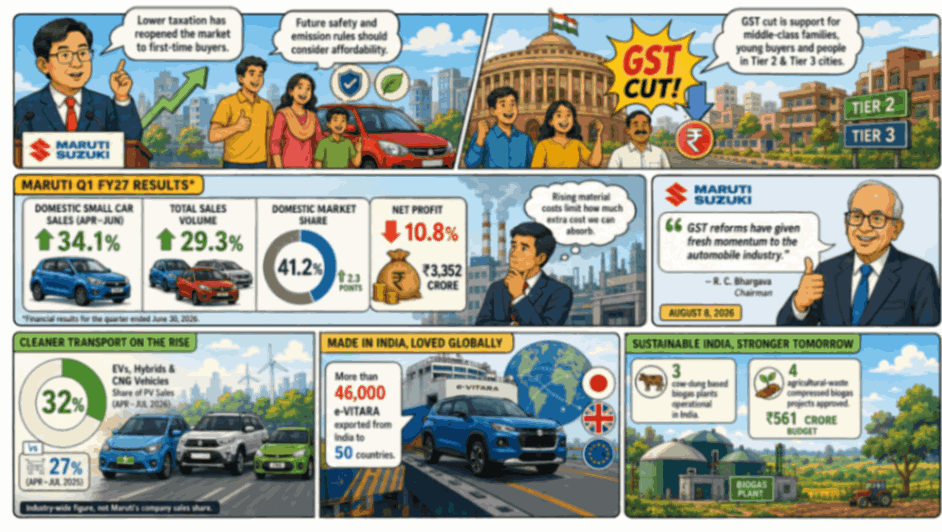
Takeuchi credited lower taxation for reopening the market to first-time buyers. He also asked policymakers to consider affordability when scheduling future safety and emission changes. For Maruti, the argument carries commercial weight. The company has a large presence in hatchbacks, and weaker demand for low-priced cars had contributed to a decline in its passenger-vehicle share before the latest rebound.
Maruti’s official Q1 FY27 results, released on July 31, 2026, showed domestic small-car sales rising 34.1% during April to June. Total sales volume increased 29.3%, while domestic market share reached 41.2%, up by 2.3 points. Profit moved the other way. Net profit fell 10.8% to ₹3,352 crore as material expenses increased. That pressure limits how much extra cost a manufacturer can absorb before revising prices.
The Union government presented the GST cut as support for middle-class households, young buyers and people in Tier 2 and Tier 3 cities. Maruti later passed on the tax benefit and offered additional reductions on selected entry models. Chairman R. C. Bhargava said in the company’s August 8, 2026, annual report release that the reforms had given fresh momentum to the automobile industry.
Cleaner transport formed another part of Takeuchi’s speech. EVs, hybrids and CNG vehicles accounted for around 32% of India’s passenger-vehicle sales during April to July 2026, against about 27% in the same months of 2025. The figure covers the whole Indian industry. It must not be presented as Maruti’s company sales share.
Takeuchi also said more than 46,000 e-Vitara electric vehicles had been exported from India to 50 countries, including Japan, the UK and European markets. Suzuki’s August 26, 2026, release said 3 cow-dung-based biogas plants were operating in India. Maruti has separately approved 4 agricultural-waste compressed biogas projects with a ₹561 crore budget.
The GST reform gave India’s affordable car segment a strong opening. Maruti’s Mini sales more than doubled, entry prices dropped, and some households returned to a purchase they had postponed. The response supports Takeuchi’s affordability argument.
The next test is tougher. Carmakers must hold prices while retaining safety equipment, banks should show the full borrowing cost, and policymakers need realistic schedules for new rules. That could keep first-time buyers in the new-car market after the low-base advantage fades.
Sales of Alto and S-Presso of April to July FY26 were 26,344 units, and increased to 56,391 units of the corresponding FY27 period. The published mini-category increase would be about 114%.
Cars of petrol, LPG or CNG with engine capacity of at most 1,200 cc and length of 4 m are eligible. For diesel cars, the engine capacity can be up to 1,500 cc, provided they also have a length of 4 m.
The price of small cars has been higher due to several factors over the years, such as the installation of emission control equipment, the inclusion of safety features, raw materials becoming expensive, cost of insurance and registrations, among others. GST reduced prices, however, did not remove ownership costs completely.
Since September 20, 2022, manufacturers have revised the ex-showroom prices. Buyers should verify if insurance and showroom discounts offered previously have been removed by dealerships.
From April to July FY26, Alto and S-Presso sales increased by 114% for the comparable FY27 period. Whether the recovery will continue depends on factors such as loan costs, fuel prices, income of the household, and future prices of the cars.









.png&w=3840&q=75)


