
By continuing, you agree to LoansJagat's Credit Report Terms of Use, Terms and Conditions, Privacy Policy, and authorize contact via Call, SMS, Email, or WhatsApp
Disclaimer: The information published on LoansJagat is intended for general informational and educational purposes only and should not be considered financial, legal, or investment advice. Interest rates, loan terms, statistics, and other data may change over time and may vary by lender or source. Please verify the latest information and consult a qualified financial advisor or the respective Bank/NBFC before making any financial decisions.
Subscribe Now
About the author

Arshathul Afia
Arshathul Afia is a journalism graduate and fintech content writer with 4+ years of experience in digital publishing and research-led writing. She has written 200+ articles covering personal finance, lending, banking, digital payments, credit, insurance, and major financial developments in India. At LoansJagat, she focuses on simplifying complex fintech news, RBI updates, loan-related changes, policy developments, and industry trends for everyday readers. Her journalism background helps her approach stories with research, context, and clarity, while her SEO experience ensures content remains discoverable and relevant. She aims to make financial news easier to understand, practical, and useful for readers across India.
Related News
Simplify All Your Loans Into One Affordable EMI

Customers Served

Debt Consolidated

1200+ Reviews

Locations in India
Club all Loans & Credit Card Bills into Single EMI

Quick Apply Loan
Consolidate your debts into one easy EMI.

Takes less than 2 minutes. No paperwork.

10 Lakhs+
Trusted Customers

2000 Cr+
Loans Disbursed

4.7/5
Google Reviews

50+
Banks & NBFCs Offers
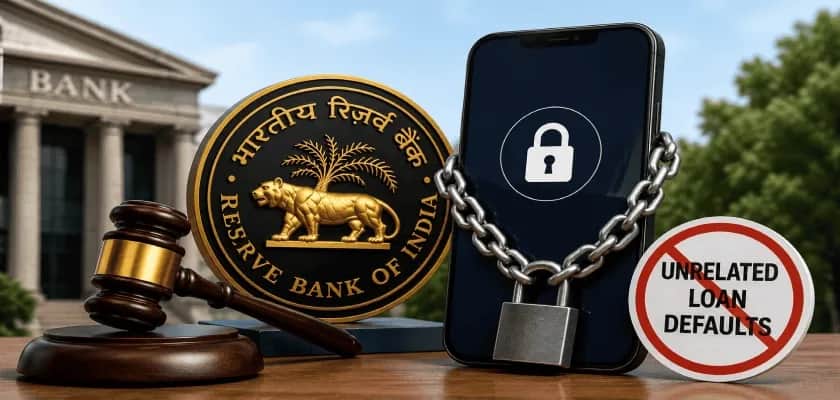
New recovery rules stop lenders from locking unrelated personal devices after loan defaults while allowing limited restrictions on financed gadgets under strict borrower safeguards nationwide.
The Reserve Bank of India issued final loan recovery directions on 6 August 2026 that stop banks and regulated lenders from remotely locking a borrower’s unrelated phone, tablet or laptop. According to the Reserve Bank of India’s official directions, the rules will apply across India from 1 January 2027. They cover commercial banks, small finance banks, regional rural banks, cooperative banks, NBFCs, housing finance companies and other regulated lenders. The change protects borrowers who miss EMIs on personal, home or vehicle loans because those defaults have no direct link with a separately purchased device.
In the short term, the rule can stop a recovery action from cutting off work calls, UPI access or online classes. The longer effect may appear in device-finance agreements, where lenders must explain any restriction clause before signing. Borrowers should not treat this protection as repayment relief. Late charges, credit-report damage and lawful recovery may continue. Only the recovery method has changed.
For an employee using a personal laptop, the change draws a useful boundary. A bank cannot disable that laptop because a car loan EMI was missed. The same protection helps a delivery rider whose phone carries maps, a shopkeeper who accepts digital payments and a student who shares a family device for classes. An unrelated loan gives the lender no right to control that equipment, even when an outside technology provider handles recovery work.
People who buy a phone or laptop through finance receive narrower protection. The lender may restrict that same device if the signed agreement permits it, but the action cannot begin after a single late payment. The borrower must receive notice, see what controls may be applied and retain access to essential communication. Work-related use must remain available. These conditions reduce the chance of a surprise lock, though borrowers still need to read the finance agreement before accepting the loan.
The loan-device connection decides whether remote controls are permitted. The overdue period decides when they may begin. The table below separates an ordinary loan default from a default on the loan used to buy the device.
The 30-day and 60-day points are enforcement thresholds, not free repayment periods. Charges and credit reporting may operate before a device restriction becomes available. After the lender receives the dues, restoration cannot wait until the next working day. The 1-hour period begins from realisation of payment, not when the borrower starts a transfer.
Pankaj Mohindroo, chairman of the India Cellular and Electronics Association, welcomed the final framework after its release. He said regulated restrictions could support affordable device ownership and expand finance for new-to-credit customers, particularly in underserved markets. Consumer advocates had raised a different warning earlier. In September 2025, CashlessConsumer founder Srikanth L told Reuters that device locking could cut users off from employment, education and financial services. The final protection for work use and essential communication responds to part of that concern.
A borrower-level reading points to one fact that can easily get lost: the source of the loan is more important than the missed EMI alone. A personal loan default cannot activate controls on a separate phone. A phone-finance default may do so after the stated stages. The practical response is to check the agreement, preserve every notice and contact the lender before the account reaches 30 days past due. A LoansJagat explainer on the 2026 recovery rules also advises borrowers to verify an agent’s identity and keep recovery communication documented.
Device controls form one part of the recovery framework. Employees and agents may generally call or visit only between 8 am and 7 pm. Lenders must record the time, number and content of recovery calls and preserve them for 6 months. Those records can support complaints about repeated calls or threats.
Before an agency’s first personal visit, the borrower or guarantor must receive its details at least 1 day in advance. Agents need identification and authorisation. Anonymous threats, abuse, social-media shaming and pressure through relatives or colleagues are prohibited. Recovery discussions should remain with the borrower or guarantor.
A borrower facing job loss, illness or an income gap should contact the lender early. The framework asks lenders to offer a process for financial-distress cases before escalation. Approval is not automatic, but written contact can open a repayment discussion.
If the lender restricts the wrong device or delays restoration, the borrower should save screenshots, receipts and complaint numbers. The first complaint goes to the lender’s grievance officer. Rejection, an unsatisfactory reply or no response within 30 days allows escalation to the RBI Ombudsman.
The regulator released draft recovery directions on 12 February 2026. A revised draft followed on 20 May, with comments accepted until 31 May. That proposal allowed restrictions on financed devices after the loan remained overdue for 90 days.
The final version issued on 6 August replaced that waiting period with gradual controls after 30 days and wider contractual controls after 60 days. It also required certification from the device manufacturer or operating-system platform, where offered, to keep untested locking applications away from borrowers.
Banks, NBFCs and technology providers have until 1 January 2027 to adjust contracts and systems. A salesperson’s verbal warning is insufficient. The agreement must permit the restriction and explain its procedure.
The new rules separate loan recovery from control over a borrower’s unrelated digital life. From 1 January 2027, missing a home, car or personal loan EMI will not allow a lender to lock a separately owned phone or laptop. That protection is direct and useful, especially when one device carries work apps, banking access and family contact.
A device bought through finance remains subject to limited controls after default, but the lender must follow the agreement, issue notice and move in stages. Personal data stays outside recovery use. Protected functions remain available. Borrowers still owe the debt, and early contact with the lender remains the safer route when repayment trouble begins.
No. A personal loan default cannot restrict a separately purchased device. The exception covers the financed phone, tablet or laptop.
No. Restrictions require 30 days past due, prior notice and an agreement that expressly permits the action.
No. Incoming calls, SMS, SOS and employment-related access must remain available.
No. The lender cannot access contacts, photographs, call logs, messages or location history through the locking tool.
The borrower should retain the receipt, record the restriction and contact the grievance officer. A lender-caused delay attracts ₹250 per hour.









.png&w=3840&q=75)


