
By continuing, you agree to LoansJagat's Credit Report Terms of Use, Terms and Conditions, Privacy Policy, and authorize contact via Call, SMS, Email, or WhatsApp
The information published on LoansJagat is intended for general informational and educational purposes only and should not be considered financial, legal, or investment advice. Interest rates, loan terms, statistics, and other data may change over time and may vary by lender or source. Please verify the latest information and consult a qualified financial advisor or the respective Bank/NBFC before making any financial decisions.
Subscribe Now
About the author

LoansJagat Team
‘Simplify Finance for Everyone.’ This is the common goal of our team, as we try to explain any topic with relatable examples. From personal to business finance, managing EMIs to becoming debt-free, we do extensive research on each and every parameter, so you don’t have to. Scroll up and have a look at what 15+ years of experience in the BFSI sector looks like.
Related Blog Post
Simplify All Your Loans Into One Affordable EMI

Customers Served

Debt Consolidated

1200+ Reviews

Locations in India
Club all Loans & Credit Card Bills into Single EMI

Quick Apply Loan
Consolidate your debts into one easy EMI.

Takes less than 2 minutes. No paperwork.

10 Lakhs+
Trusted Customers

2000 Cr+
Loans Disbursed

4.7/5
Google Reviews

50+
Banks & NBFCs Offers
Other services mentioned in this article
Key Takeaways
India’s booming digital payments ecosystem may soon witness another regulatory reset.
The Reserve Bank of India (RBI) has released the Draft Master Direction on Prepaid Payment Instruments (PPIs), 2026, inviting comments from industry stakeholders and the public. The proposed rules aim to tighten compliance standards while preparing India’s prepaid payments ecosystem for the next phase of growth.
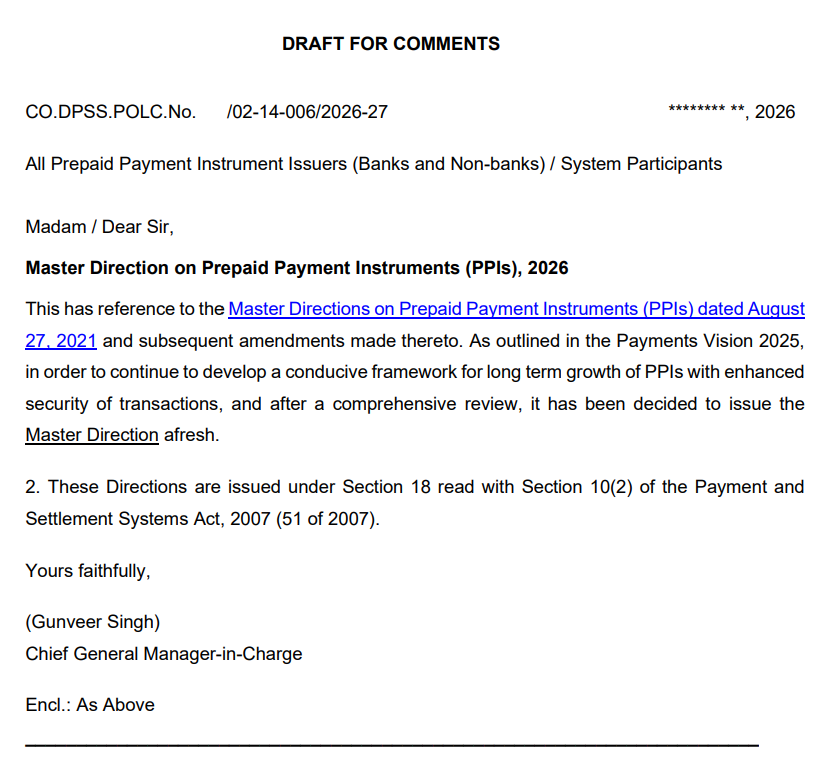
For millions of users, PPIs are nothing but digital wallets, prepaid cards, metro cards and gift vouchers used every day for small-value transactions. Companies operating in this space include major fintech players such as Paytm, PhonePe and Amazon Pay.
The draft direction replaces the older 2021 framework and reflects the central bank’s growing focus on consumer protection, cybersecurity and operational discipline. You can easily understand this from this report by Vinod Kothari Consultants.
According to the draft framework, RBI wants to simplify the classification of PPIs while simultaneously tightening several operational rules.
Read More : No More Approval Queue
Some of the most significant proposals include:
An article from Yahoo Finance indicates that the RBI is trying to reduce misuse risks while bringing operational uniformity across banks and non-bank issuers.
The draft also proposes physical verification of passports and visas before issuing wallets to foreign nationals and NRIs. This move is intended to enable merchant payments through UPI-linked wallets during their stay in India.
India’s digital payment ecosystem has expanded at an extraordinary pace over the last few years.
According to a report from Electronic Payments International, prepaid instruments are now deeply integrated into e-commerce, mobility, transit systems and small-ticket retail payments. However, rapid growth has also increased concerns around fraud, mule accounts, dormant wallets and regulatory arbitrage.
The RBI has repeatedly indicated that financial innovation cannot come at the cost of consumer safety.
The new draft direction appears to follow that philosophy.
Experts from ABC Live, tracking the payments industry believe the central bank is attempting to create a framework that balances innovation with accountability. While large fintech firms may absorb the compliance burden relatively easily, smaller players could face operational challenges due to stricter monitoring and capital requirements.
Suppose a user purchases a prepaid gift card worth ₹15,000 for festival shopping.
Under the proposed framework, that may no longer be possible if the RBI finalises the ₹10,000 limit for gift PPIs. Instead, users may need to either split the amount across multiple instruments or move toward fully KYC-compliant wallets.
Similarly, a tourist arriving in India could potentially receive a temporary UPI-linked wallet after passport verification. That wallet may then be used for merchant payments at restaurants, cabs or retail stores during the visit.
In practical terms, the RBI appears to be encouraging traceable and verified digital transactions while reducing anonymous or lightly regulated wallet activity.
Also Read : RBI clears 99.7% Applications on Time
Fintech Companies May Need To Rework Their Business Models
The proposed framework could significantly impact non-bank PPI issuers.
An article from MEDIANAMA observers believe stricter escrow norms, tighter customer verification and enhanced audit requirements may increase compliance costs for smaller fintech firms.
Some analysts at Ikigai Law also point out that the removal of certain cross-border wallet functionalities may reduce flexibility for international prepaid use cases.
At the same time, stronger regulation may improve customer trust in digital wallets, an area that has faced periodic concerns around fraud and unauthorised transactions.
The RBI has invited public comments on the draft before issuing the final direction. Industry bodies, fintech associations and payment firms are expected to submit detailed feedback in the coming weeks.
The latest draft direction shows that the RBI is no longer regulating digital payments as an emerging sector.
It is regulating them as critical financial infrastructure.
That distinction matters.
India’s digital payments story has already become one of the world’s largest experiments in real-time finance. With prepaid wallets increasingly connected to UPI, transit systems and e-commerce ecosystems, the central bank appears determined to ensure that the next phase of growth is backed by tighter governance and stronger safeguards.
*T&C Apply
For users, the transition may largely remain invisible.
For fintech companies, however, the compliance playbook is about to become much more demanding.
Q1. When will RBI launch its digital wallet?
RBI has already released this in 2022.
Q2. How many people use digital Rupee issues by RBI for daily expenses?
As of early 2026, around 1 to 1.5 crore users are using RBI’s Digital Rupee (e₹), with daily transactions estimated at nearly 8 lakh, though its usage for everyday expenses is still far smaller than UPI.
Related Finance News | |||









.png&w=3840&q=75)



