

By continuing, you agree to LoansJagat's Credit Report Terms of Use, Terms and Conditions, Privacy Policy, and authorize contact via Call, SMS, Email, or WhatsApp
Disclaimer: The information published on LoansJagat is intended for general informational and educational purposes only and should not be considered financial, legal, or investment advice. Interest rates, loan terms, statistics, and other data may change over time and may vary by lender or source. Please verify the latest information and consult a qualified financial advisor or the respective Bank/NBFC before making any financial decisions.
Subscribe Now
About the author

Arshathul Afia
Arshathul Afia is a journalism graduate and fintech content writer with 4+ years of experience in digital publishing and research-led writing. She has written 200+ articles covering personal finance, lending, banking, digital payments, credit, insurance, and major financial developments in India. At LoansJagat, she focuses on simplifying complex fintech news, RBI updates, loan-related changes, policy developments, and industry trends for everyday readers. Her journalism background helps her approach stories with research, context, and clarity, while her SEO experience ensures content remains discoverable and relevant. She aims to make financial news easier to understand, practical, and useful for readers across India.
Related News
Simplify All Your Loans Into One Affordable EMI

Customers Served

Debt Consolidated

1200+ Reviews

Locations in India
Club all Loans & Credit Card Bills into Single EMI

Quick Apply Loan
Consolidate your debts into one easy EMI.

Takes less than 2 minutes. No paperwork.

10 Lakhs+
Trusted Customers

2000 Cr+
Loans Disbursed

4.7/5
Google Reviews

50+
Banks & NBFCs Offers
SBI will halve free other-bank ATM transactions for salary accounts from October 1, while keeping charges and its own ATM rules unchanged for customers nationwide.
Key Highlights
State Bank of India will reduce the free monthly transaction allowance available to its Salary Package Account holders at other banks’ ATMs and Automated Deposit-cum-Withdrawal Machines in India. According to the State Bank of India revised service charges page, the change takes effect on October 1, 2026. The allowance will fall from 10 transactions to 5, covering cash withdrawals and non-financial services together. After the quota ends, a withdrawal will cost ₹23 plus GST, while a non-financial transaction will cost ₹11 plus GST.
The short-term effect will be felt by salaried customers who often use whichever ATM is nearby. A balance enquiry can reduce the quota even when no cash leaves the account. In the longer term, the cut may push customers towards SBI machines, YONO SBI and UPI payments. It does not cover every SBI savings account.
The 5 free uses form a single monthly pool, rather than separate quotas for withdrawals and non-financial activity. A customer who makes 3 withdrawals, checks the balance once and requests 1 mini statement has finished the allowance. The next use can attract a fee.
The table separates the new rule from the facilities SBI has left untouched.
The ₹23 and ₹11 charges are not being increased on October 1. Customers will reach them earlier because SBI is halving the free quota. If a person makes 8 cash withdrawals at non-SBI machines in 1 month, the final 3 would cost ₹69 plus GST. Repeating that pattern for 12 months would produce ₹828 plus GST in charges. That is an account-use calculation based on SBI’s notified tariff, not a projection from the bank.
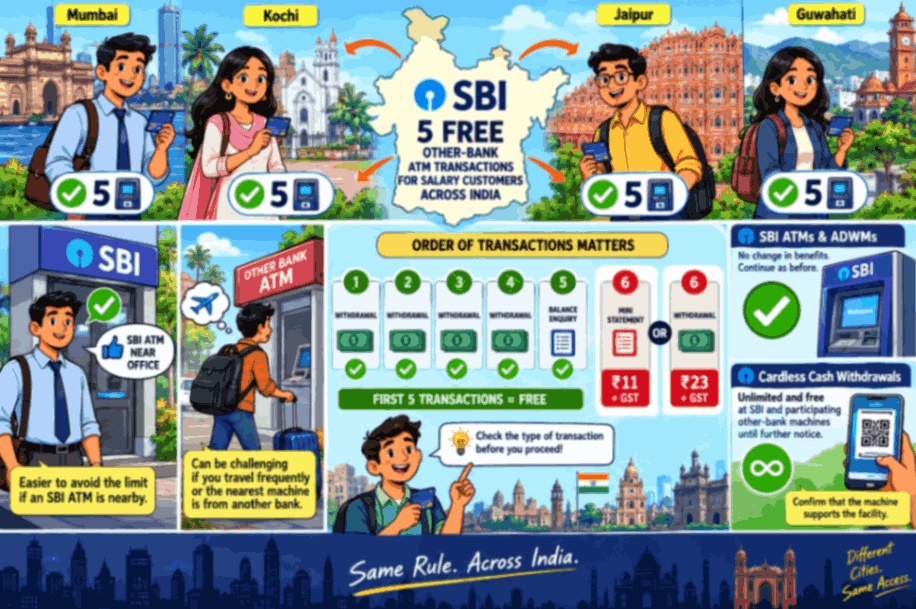
The rule applies throughout India without a separate allowance for large cities and smaller towns. Someone working in Mumbai receives the same 5 free other-bank ATM transactions as a salary customer posted in Kochi, Jaipur or Guwahati. Access will differ in practice, though. A person with an SBI ATM near the office can avoid the restriction more easily than an employee who travels frequently or works where another bank operates the closest machine.
SBI has not changed the applicable benefits at its own ATMs and ADWMs through this notice. Cardless cash withdrawals at SBI and participating other-bank machines also remain unlimited and free until further notice. Customers should confirm that the machine supports the facility before relying on it.
The order of transactions will become important. Suppose a customer makes 4 withdrawals and then checks the balance at another bank’s ATM. Those 5 uses remain free. If the customer requests a mini statement next, SBI can charge ₹11 plus GST. If the 6th transaction is another withdrawal, the applicable fee becomes ₹23 plus GST instead.
A LoansJagat guide on ATM withdrawal limits and transaction charges points to a distinction customers often miss. A daily withdrawal limit controls the amount of cash available through the card, while a monthly free-transaction limit controls how many ATM uses escape a fee. A customer may remain within the daily cash limit and still pay because the free monthly quota has ended.
The simplest response is to keep non-financial activity away from other-bank machines. Customers can check balances through YONO SBI, internet banking or account alerts. They can also plan fewer withdrawals, provided the cash can be carried safely. An SBI machine remains the better choice where available.
For purchases that do not require physical currency, UPI offers another route. The Press Information Bureau statement published on August 8, 2026 records the Ministry of Finance position that users will not face transaction charges for UPI payments. Digital payment cannot replace cash for every household or merchant. Still, it can reduce small, repeated withdrawals that would otherwise eat into the 5 free ATM uses.
Salary Package Account holders previously received unlimited transactions at other banks’ ATMs. SBI changed that arrangement on December 1, 2025, when it introduced a 10-transaction monthly allowance. The bank also fixed the post-quota charge at ₹23 plus GST for cash withdrawal and ₹11 plus GST for a non-financial use.
The October 2026 revision becomes the 2nd reduction in 10 months: unlimited access before December 1, 2025, then 10 free transactions, followed by 5 from October 1, 2026. Regular savings customers do not get another cut under this notice.
SBI attributed its December 2025 tariff revision to an upward change in the ATM interchange fee. The September 2026 notice gives no separate reason for halving the allowance again. It lists the revised quota, effective date and post-quota charges. Claims that the latest decision was taken solely to force digital banking or recover a named cost would go beyond SBI’s published words.
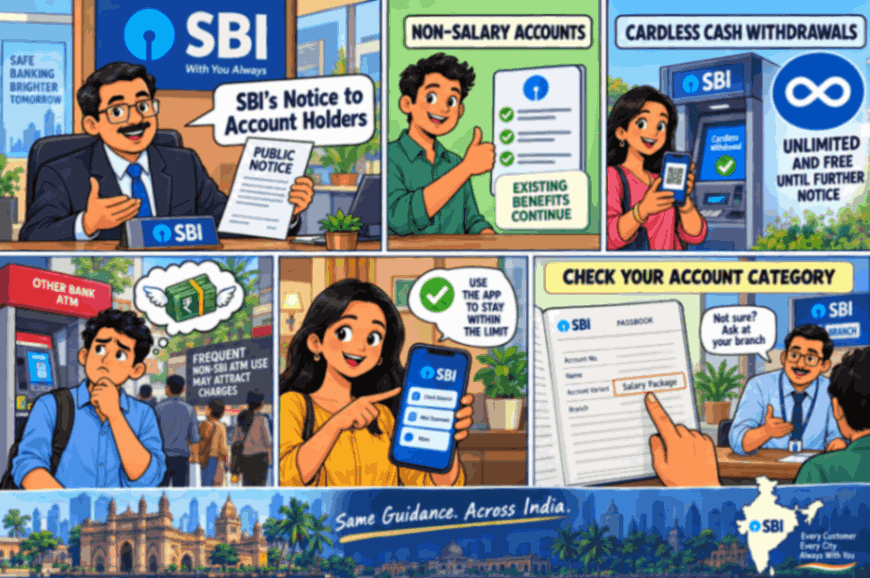
SBI’s public notice is the bank’s direct stakeholder position. It says accounts outside the Salary Package category will retain their existing free allowances and service charges under this revision. The bank also confirms that cardless cash withdrawals will continue to receive unlimited free access until another notice changes the arrangement.
No SBI executive, banker or economist has supplied a public explanation alongside the notice. The customer impact can still be calculated from the tariff. Frequent non-SBI ATM users face a higher chance of paying, while those who move balance checks to the app may stay within the quota.
Account classification deserves attention too. Receiving monthly pay in an SBI account does not automatically prove that the bank has tagged it under a Salary Package. Customers can check the package or variant on the first page of the passbook or account statement. A branch can confirm the classification if the description is missing or unfamiliar.
From October 1, 2026, SBI Salary Package Account holders will receive 5 free transactions each month at other-bank ATMs and ADWMs instead of 10. Withdrawals, balance enquiries and other eligible non-financial services share the same allowance. After it ends, SBI will charge ₹23 plus GST for a cash withdrawal and ₹11 plus GST for a non-financial transaction.
Customers can reduce the chance of a fee by using SBI machines for cash, checking account details through digital channels and watching transaction-count alerts. The change does not reduce the daily withdrawal amount attached to a debit card. It reduces how often a customer can use another bank’s machine without paying. From October onward, the 6th use is the one that needs attention.
Yes. SBI’s 5-transaction allowance combines financial and non-financial activity at other-bank ATMs and ADWMs. A balance enquiry or mini statement can therefore use 1 free transaction even if the customer does not withdraw cash.
The daily withdrawal limit and the monthly free allowance work separately. Once all 5 free other-bank ATM transactions have been used, another cash withdrawal can attract ₹23 plus GST even when the requested amount remains within the debit card’s daily limit.
No. This revision applies to all variants of SBI Salary Package Accounts using other banks’ ATMs or ADWMs in India. SBI states that the existing rules for other account categories will remain unchanged under this particular notice.
SBI has not revised its own ATM and ADWM rules through the September 2026 notice. The cut from 10 to 5 applies only when Salary Package Account holders use SBI debit cards at another bank’s machine.
An ADWM is an Automated Deposit-cum-Withdrawal Machine. It can support cash deposits and withdrawals, depending on the machine and account facility. The new free-transaction rule covers eligible activity at ADWMs operated by other banks in India.









.png&w=3840&q=75)


