
Disclaimer: The information published on LoansJagat is intended for general informational and educational purposes only and should not be considered financial, legal, or investment advice. Interest rates, loan terms, statistics, and other data may change over time and may vary by lender or source. Please verify the latest information and consult a qualified financial advisor or the respective Bank/NBFC before making any financial decisions.
Subscribe Now
About the author

Arshathul Afia is a journalism graduate and fintech content writer with 4+ years of experience in digital publishing and research-led writing. She has written 200+ articles covering personal finance, lending, banking, digital payments, credit, insurance, and major financial developments in India. At LoansJagat, she focuses on simplifying complex fintech news, RBI updates, loan-related changes, policy developments, and industry trends for everyday readers. Her journalism background helps her approach stories with research, context, and clarity, while her SEO experience ensures content remains discoverable and relevant. She aims to make financial news easier to understand, practical, and useful for readers across India.
Related News
Simplify All Your Loans Into One Affordable EMI

Customers Served

Debt Consolidated

1200+ Reviews

Locations in India
Club all Loans & Credit Card Bills into Single EMI

Quick Apply Loan
Consolidate your debts into one easy EMI.

Takes less than 2 minutes. No paperwork.

10 Lakhs+
Trusted Customers

2000 Cr+
Loans Disbursed

4.7/5
Google Reviews

50+
Banks & NBFCs Offers
An ISB survey finds proposed UPI merchant charges could reduce street vendors’ digital payment acceptance, while supplier costs threaten margins despite exemptions for small businesses.
Key Highlights
The Indian School of Business’s Centre for Analytical Finance examined these concerns in UPI Utilisation and MDR Awareness Among Street Vendors. The findings reported on 4 November 2026 describe vendors’ intended responses to the proposed merchant discount rate (MDR), rather than an observed fall in UPI use. Researchers surveyed vendors across 64 urban local bodies between 24 September and 10 October 2026.
ISB’s concern extends beyond the payment a customer makes at a stall. Vendors buy stock from suppliers, and charges on those larger transactions could reach them through higher procurement costs. The researchers warned that a shift towards cash could affect transaction transparency and access to formal credit. For vendors, the immediate pressure would be on earnings.
Nearly 70% of surveyed vendors made supplier payments exceeding ₹2,000 at a time. ISB found that these purchases could expose vendors to indirect costs where suppliers fall within the proposed MDR framework and pass on the expense. An exemption on the vendor’s own receipts would not cover a supplier’s separate transaction.
The survey also found that 10.4% of vendors had faced demands for additional UPI charges from suppliers during the preceding 10 days. Co-author Mohan Ramanath said vendors did not necessarily attribute these demands to MDR. His comments, reported on 4 November 2026, separate existing supplier demands from the proposed levy.
ISB found differences in vendors’ stated willingness to continue accepting UPI. The following figures describe responses to the proposed charges, not actual reductions in digital payments.
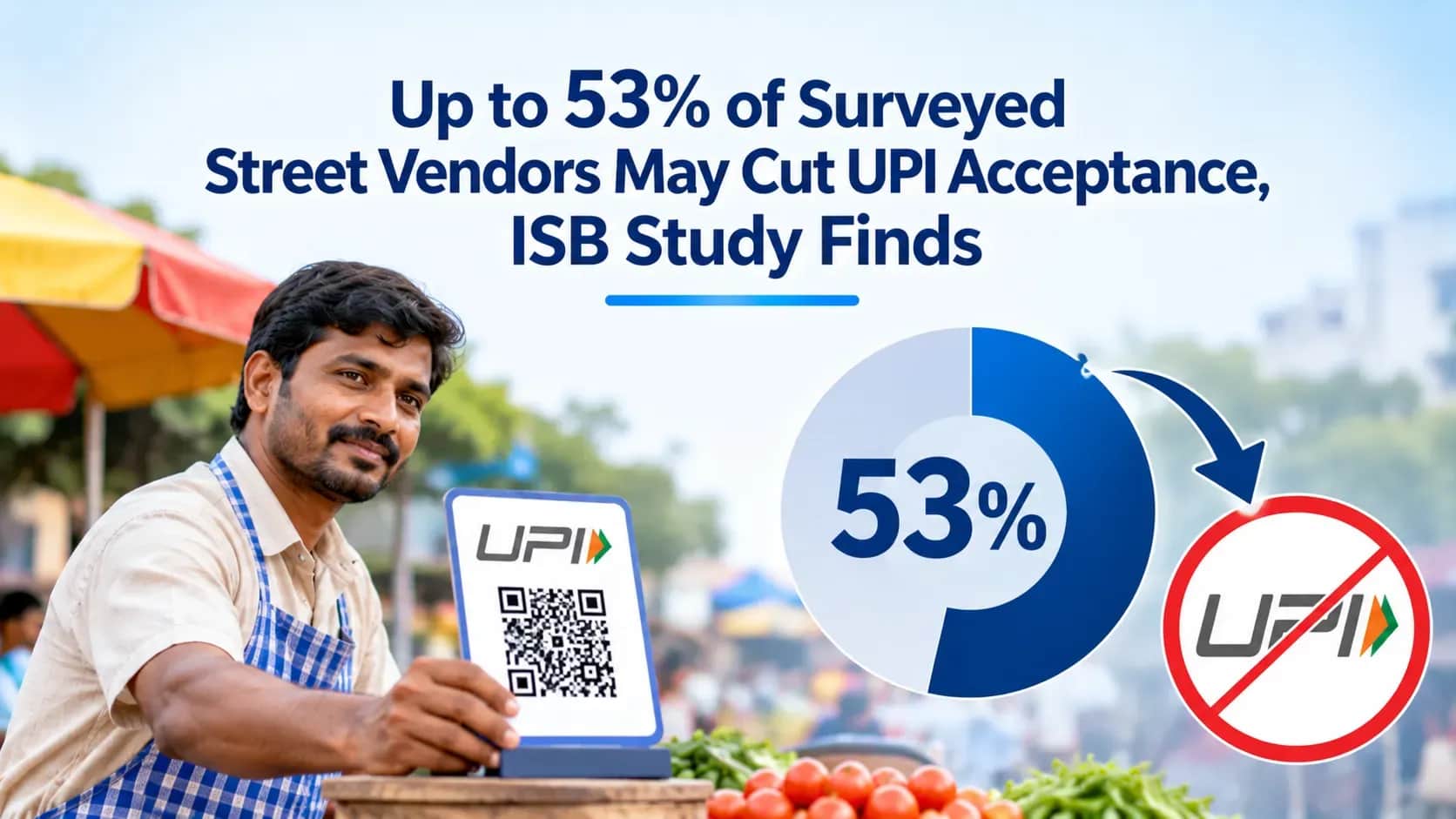
The survey findings published on 4 November 2026 place the highest share in Tier 1 cities. The headline’s 53% therefore refers to that group, rather than all surveyed vendors or all street vendors in India.
The Ministry of Finance’s 15 September 2026 announcement states that MDR is a charge within the merchant payment system. Customers making UPI payments are not supposed to pay it. Banks were advised to prevent merchants from passing MDR directly to customers.
For salaried employees buying from street vendors, ISB’s findings raise a separate concern: vendors may recover higher procurement expenses through retail prices. Such a price increase would differ from adding an MDR surcharge to a customer’s UPI payment. The study describes a possible response, not a measured increase in household spending.
Prasanna Tantri, executive director of ISB’s Centre for Analytical Finance, said UPI cost assessments should also count the benefits of payment data. “We need proper accounting,” he said in comments reported on 4 November 2026. Co-author Anand Sudhakaran drew attention to business-to-business payments, arguing that discussions had focused heavily on customer-to-merchant transactions.
ISB recommended limited pilots before a wider rollout, monitoring supplier demands, customer prices and shifts towards cash. The researchers also sought an independently reviewed assessment of UPI’s operating costs to inform how those costs should be shared.
ISB’s findings distinguish between money a vendor receives from customers and money paid to buy stock. That distinction explains why counting exempt retail transactions alone does not establish whether a vendor avoids additional costs throughout the business.
For vendors seeking formal credit, ISB’s concern about UPI transaction records relates to lenders’ assessment of cash flows. The reported risk is that returning to cash could reduce the digital record available for such assessments.
NPCI deferred implementation on 13 October 2026, moving the original 15 October 2026 start date until after Diwali because of the festive season. The ISB survey took place before that original start date.
ISB’s survey identifies supplier costs as a concern even for vendors exempt on their own receipts. The findings support testing the charges and monitoring payment choices. They do not establish that vendors have already reduced UPI acceptance because of the proposed framework.
ISB found that up to 53% of surveyed vendors across city tiers said they would reduce UPI acceptance if MDR applied. The highest share was among Tier 1 respondents.
ISB reported that suppliers passing on UPI payment costs could put pressure on vendors’ earnings, making cash more attractive for procurement.
The announced framework exempts eligible small merchants receiving up to ₹1 lakh monthly through QR payments under the P2PM category. Suppliers may have a different classification.
The Ministry of Finance says MDR is payable within the merchant payment system. A customer’s purchase exceeding ₹2,000 does not itself create a customer MDR fee.
The ministry advised banks to ensure merchants do not pass MDR directly to customers. It also prohibited UPI application providers from imposing platform fees or hidden charges.
Start your journey today
Apply Now*T&C apply











