
By continuing, you agree to LoansJagat's Credit Report Terms of Use, Terms and Conditions, Privacy Policy, and authorize contact via Call, SMS, Email, or WhatsApp
Disclaimer: The information published on LoansJagat is intended for general informational and educational purposes only and should not be considered financial, legal, or investment advice. Interest rates, loan terms, statistics, and other data may change over time and may vary by lender or source. Please verify the latest information and consult a qualified financial advisor or the respective Bank/NBFC before making any financial decisions.
Subscribe Now
About the author

Arshathul Afia
Arshathul Afia is a journalism graduate and fintech content writer with 4+ years of experience in digital publishing and research-led writing. She has written 200+ articles covering personal finance, lending, banking, digital payments, credit, insurance, and major financial developments in India. At LoansJagat, she focuses on simplifying complex fintech news, RBI updates, loan-related changes, policy developments, and industry trends for everyday readers. Her journalism background helps her approach stories with research, context, and clarity, while her SEO experience ensures content remains discoverable and relevant. She aims to make financial news easier to understand, practical, and useful for readers across India.
Related Blog Post
Simplify All Your Loans Into One Affordable EMI

Customers Served

Debt Consolidated

1200+ Reviews

Locations in India
Club all Loans & Credit Card Bills into Single EMI

Quick Apply Loan
Consolidate your debts into one easy EMI.

Takes less than 2 minutes. No paperwork.

10 Lakhs+
Trusted Customers

2000 Cr+
Loans Disbursed

4.7/5
Google Reviews

50+
Banks & NBFCs Offers
Major lenders are preparing to challenge Subhash Chandra’s repayment plan after ₹6.25 crore was earmarked for creditors against ₹22,006.57 crore in admitted personal-guarantee insolvency claims.
HDFC Bank and LIC Housing Finance are pushing back against the repayment plan approved in the personal insolvency proceedings of Essel Group founder Subhash Chandra. HDFC Bank said on August 27, 2026, that it was exploring an appeal before the National Company Law Appellate Tribunal, or NCLAT. LIC Housing Finance has also indicated that it intends to challenge the outcome. NCLT Judicial Member Nilesh Sharma, acting as the third member following a split decision, backed the plan on August 25, 2026.
The case is being heard through the New Delhi NCLT process and concerns Chandra as a personal guarantor for corporate borrowings. About ₹22,006.57 crore was admitted as claims, while ₹6.25 crore has been earmarked for distribution to Chandra and ₹25 lakh for process costs. For Indian bank customers, there is no immediate change to EMIs, deposits, or retail loan rates. The longer-term effect could be tighter checks when banks accept promoter guarantees for large corporate loans.
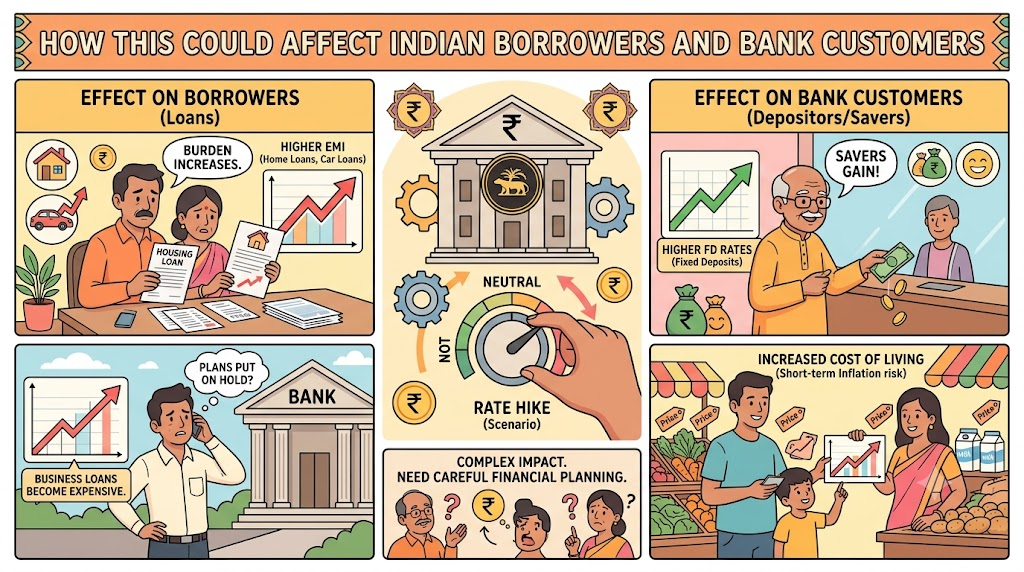
For an ordinary home loan or personal loan customer, the ruling does not alter repayment rules. Its wider impact is on how banks may assess guarantees before sanctioning large business loans. A guarantee helps only when the lender can identify assets and enforce the promise if the company later defaults. If recoverable assets are small compared with the guaranteed exposure, the protection can shrink quickly.
Banks may respond by demanding better documentation, regular checks on guarantor assets and stronger security at the sanction stage. LoansJagat’s borrower-focused reading is direct: anyone signing as a guarantor should treat the signature as a financial liability, not a formality. The same caution applies to promoters guaranteeing company debt and individuals guaranteeing loans for relatives or business partners. The LoansJagat IBC guide explains how creditor claims and insolvency proceedings move through the Code.
Legal professionals following the proceedings have focused on creditor voting, claim verification and the value of the guarantor’s estate. Raheel Patel, partner at Gandhi Law Associates, said in reporting published on August 28 that removing unsupported claims would not create fresh money. The same corpus would instead be divided among creditors whose claims remain eligible.
The practical answer begins before default. Banks can review guarantor assets at sanction, check existing pledges and revisit guarantees when a corporate loan is restructured. Once insolvency starts, lenders are left with enforceable rights and assets they can actually reach. A large guarantee on paper may still produce a small recovery.
For LoansJagat readers, that is the more useful takeaway from the dispute. A large guarantee figure can look reassuring when a loan is sanctioned, but recoverability depends on what stands behind that signature several years later. Banks may now put greater weight on asset verification and updates during the life of a large corporate facility.
The sharpest objection is the gap between admitted claims and Chandra’s proposed distribution. The plan provides ₹6.25 crore for creditors from Chandra, with another ₹25 lakh reserved for insolvency costs. Creditors representing 80.814% of the voting share supported the proposal, while several established lenders voted against it.
HDFC Bank, LIC Housing Finance, Axis Bank, Canara Bank, RBL Bank, IDBI Trusteeship Services and Union Bank of India’s UK operations were among the dissenting creditors. Their objections went beyond the payout. Questions were raised about voting rights of some creditors, the treatment of claims, and whether Chandra’s assets had been examined closely enough.
The main figures are easier to read together:
These numbers need one qualification. The ₹22,006.57 crore figure is the admitted claim pool connected with Chandra’s personal guarantees. It does not automatically mean Chandra personally borrowed ₹22,006.57 crore. Government officials quoted in current reporting have also said the principal borrowers remain liable. Reporting on August 28 said the wider arrangement envisages about ₹1,494 crore from principal borrowers separately from Chandra’s payment.
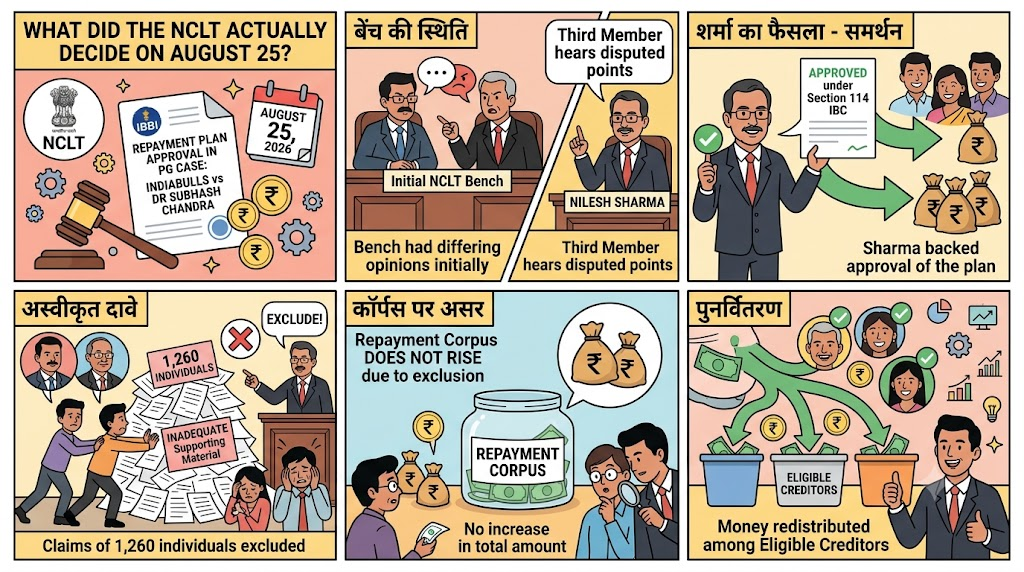
The Insolvency and Bankruptcy Board of India, or IBBI, lists the August 25, 2026 order in Indiabulls Housing Finance Limited vs Dr Subhash Chandra, Company Petition No. (IB)-97(ND)/2022, as an “Approval of Repayment Plan in PG case”. The official IBBI order database also identifies the connected applications considered in the proceedings.
Nilesh Sharma heard the disputed points as the third member because the original NCLT bench had delivered differing opinions. He backed approval under Section 114 of the Insolvency and Bankruptcy Code, while directing exclusion of claims submitted through Anil Kumar and Sunil Jain on behalf of 1,260 individuals because supporting material was inadequate. The repayment corpus did not rise because of that exclusion. It is to be redistributed among eligible creditors.
The National Company Law Tribunal is the adjudicating forum handling the proceedings. Its records identify the dispute under IB-97/ND/2022, which began years before the August 2026 decision and later drew applications from several financial institutions.
The proceeding traces back to a ₹170 crore loan extended by the then Indiabulls Housing Finance to Vivek Infracon. Chandra had provided a personal guarantee linked to that facility. Indiabulls later approached the NCLT under Section 95 of the IBC, beginning the personal insolvency process against him in 2022.
The legal route against personal guarantors has existed since December 1, 2019. The Press Information Bureau, under the Ministry of Corporate Affairs, announced on November 20, 2019 that IBBI had notified regulations for insolvency resolution and bankruptcy proceedings involving personal guarantors to corporate debtors. The PIB release covers applications, creditor claims, meetings and repayment plans.
This distinction is central to the present dispute. A company that borrowed money and a promoter who signed a personal guarantee do not become the same borrower merely because insolvency claims are later filed against the guarantor.
HDFC Bank has confirmed that it opposed and voted against the repayment plan. The bank said its admitted claim represented 3.2% of the total stated amount and that the facility had come to it through the merger with HDFC Ltd. It added that it was exploring an appeal before the NCLAT.
LIC Housing Finance has taken a similarly firm position. Its admitted claim was ₹1,322.39 crore, while the plan allocated about ₹38.09 lakh to it. The company has also stated that the NCLT order does not remove its security interests or recovery rights over secured assets under applicable law. Reports on August 28 said it was preparing an NCLAT challenge and could seek intervention through the National Housing Bank.
Chandra disputes the way the ₹22,006 crore headline has been presented. In his August 27 statement, he said he had not personally borrowed that amount and was involved as a guarantor for loans raised by borrowing entities.
He put claims of lenders objecting to the plan at ₹3,992 crore and referred to earlier settlements and offers from borrower entities. Those figures are Chandra’s stated position, not a separate tribunal finding. That attribution is important because his ₹3,992 crore figure and the ₹22,006.57 crore admitted-claims figure describe different parts of the dispute.
Signing a guarantee creates exposure that can survive long after the original loan is sanctioned. The Press Information Bureau’s November 20, 2019 notification explains why personal guarantors were brought within a dedicated insolvency process linked to corporate debtors.
For banks, legal enforceability and actual recovery are different questions. A valid guarantee can still produce low recovery if the available estate is small. Better checks when a loan is sanctioned, periodic reviews of guarantor assets and closer scrutiny when loans are restructured can reduce that gap.
The same lesson applies on a smaller scale to retail borrowers. Someone agreeing to guarantee a business, vehicle or personal loan should first check the outstanding exposure, duration of the guarantee and circumstances in which the lender can demand repayment.
The Subhash Chandra repayment dispute now has 2 tracks. The approved personal-guarantor plan provides ₹6.25 crore for creditors, while dissenting lenders are considering whether to challenge the result before the NCLAT. HDFC Bank has confirmed that route is under review, and LIC Housing Finance has defended its continuing recovery rights.
The next filing will show how far the banks intend to challenge creditor voting, eligibility and treatment of Chandra’s assets. Until then, the ₹22,006.57 crore figure needs careful wording. It represents admitted guarantee-linked claims in the insolvency proceeding, while Chandra says it should not be presented as his personal borrowing.
For bank customers, the immediate effect is limited. For lenders and anyone signing a guarantee, the warning is closer to home. A signature given when a loan is approved can create financial exposure that continues for years.
It refers to admitted claims in his personal-guarantor insolvency proceedings, not ₹22,006.57 crore shown as direct personal borrowing by Chandra.
Yes. Chandra’s repayment plan does not automatically erase every liability of the corporate borrowers or every separate secured recovery right.
The third member relied on creditor approval, statutory compliance, and the assessed value of Chandra’s personal estate while considering lender objections.
A personal guarantee can expose the guarantor to recovery action after default, subject to guarantee terms, the IBC, and applicable recovery laws.
A guarantor can face repayment demands and legal recovery action. Similar concerns regularly appear in Reddit’s LegalAdviceIndia discussions on loan guarantees.








.png&w=3840&q=75)


