
By continuing, you agree to LoansJagat's Credit Report Terms of Use, Terms and Conditions, Privacy Policy, and authorize contact via Call, SMS, Email, or WhatsApp
Disclaimer: The information published on LoansJagat is intended for general informational and educational purposes only and should not be considered financial, legal, or investment advice. Interest rates, loan terms, statistics, and other data may change over time and may vary by lender or source. Please verify the latest information and consult a qualified financial advisor or the respective Bank/NBFC before making any financial decisions.
Subscribe Now
About the author

Arshathul Afia
Arshathul Afia is a journalism graduate and fintech content writer with 4+ years of experience in digital publishing and research-led writing. She has written 200+ articles covering personal finance, lending, banking, digital payments, credit, insurance, and major financial developments in India. At LoansJagat, she focuses on simplifying complex fintech news, RBI updates, loan-related changes, policy developments, and industry trends for everyday readers. Her journalism background helps her approach stories with research, context, and clarity, while her SEO experience ensures content remains discoverable and relevant. She aims to make financial news easier to understand, practical, and useful for readers across India.
Related Blog Post
Simplify All Your Loans Into One Affordable EMI

Customers Served

Debt Consolidated

1200+ Reviews

Locations in India
Club all Loans & Credit Card Bills into Single EMI

Quick Apply Loan
Consolidate your debts into one easy EMI.

Takes less than 2 minutes. No paperwork.

10 Lakhs+
Trusted Customers

2000 Cr+
Loans Disbursed

4.7/5
Google Reviews

50+
Banks & NBFCs Offers
RBI’s August 2026 draft proposes common loan-pricing rules, 3-month floating-rate resets and tighter spread controls, aiming to make borrowing costs easier to compare across India.
There is no immediate EMI change for an existing borrower. Over time, faster benchmark resets could reduce the wait before a lower benchmark reaches an eligible floating loan. The reverse can happen as well. If the benchmark rises, a higher rate may reach the borrower sooner, so the 3-month cycle should not be read as a promise of cheaper credit.
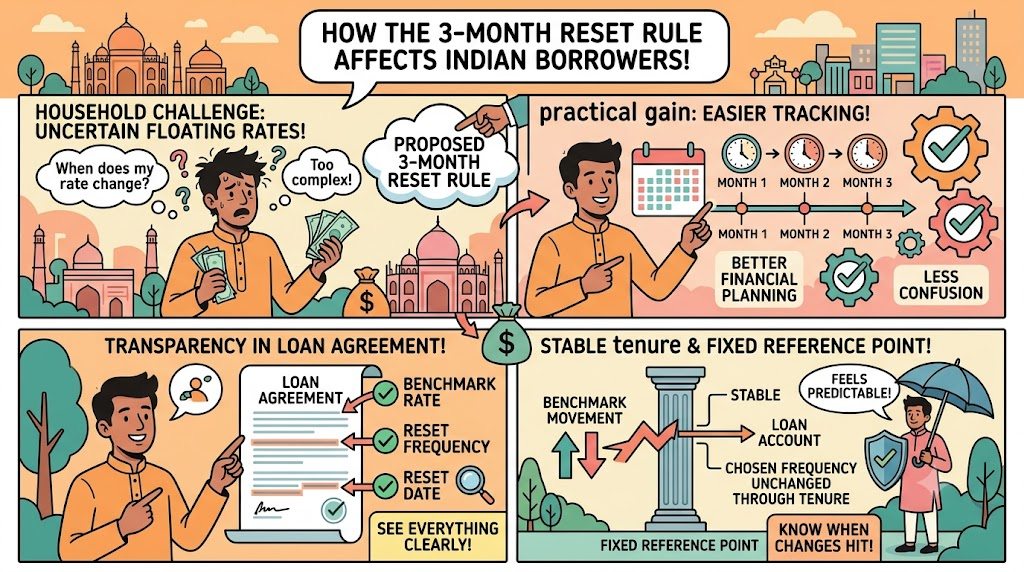
For households, easier tracking is the practical gain. A floating-rate borrower should be able to see the benchmark, reset frequency, and reset date in the loan agreement. Under the proposal, most covered floating benchmarks would reset within a maximum of 3 months, and the chosen frequency would generally remain unchanged through the loan tenure. That gives the customer a fixed reference point for checking when a benchmark movement should reach the account.
Quarterly resetting, however, is not entirely new for bank customers. External benchmark-linked bank loans have already been required to reset at least once in 3 months. The 2026 proposal reaches wider by trying to harmonise pricing rules across more lender categories. The scale is large. A Press Information Bureau release dated 5 May 2026 said personal loans formed 33% of overall bank credit and grew 16.2% during FY 2025-26.
A customer comparing 2 loan offers needs more than the advertised rate. The final cost also depends on the benchmark, lender spread, reset timing, fees and whether a rate change alters EMI or tenure. The draft puts more focus on these parts.
The spread rule can affect a long-tenure loan years after sanction. The credit-risk premium may change when the borrower’s credit profile changes and the lender completes a review. Other spread parts generally face a 3-year restriction on revision, though some lender categories receive exemptions. That gives borrowers a better trail for checking why their rate changed.
Vijendra Singh Shekhawat, CEO of Choice Finserv, said in August 2026 that the benefit for home-loan customers is mainly timing and pricing visibility rather than a lower rate from day 1. That distinction is useful. A 3-month reset does not reduce a loan rate by itself. It decides how quickly a movement in the chosen benchmark can flow into the contracted rate.
Sarika Grover, co-founder of LoansJagat, has also cautioned that the proposal should not be treated as an automatic fall in borrowing costs. Borrowers can respond by comparing the benchmark, spread, APR, reset date, and total remaining interest before accepting a loan or refinancing. A lower EMI can come from a longer tenure, which may raise total interest paid. A LoansJagat borrower analysis published in August 2026 also notes that faster transmission works both ways.
A simple borrower test helps. Before signing, the customer should ask: What benchmark is this loan linked to? What spread is being added today? On what date can the rate change next? Those 3 answers reveal more than a promotional “starting from” rate.
Read Also : ITR Filing Deadline August 31, 2026 for Non-Audit Business Taxpayers
The proposal follows earlier lending reforms. The Department of Financial Services records that new floating personal and retail bank loans, including housing and auto loans, and floating loans to micro and small enterprises have used specified external benchmarks from 1 October 2019. These can include the policy repo rate and specified Government of India Treasury Bill yields published by Financial Benchmarks India Private Limited.
Before that shift, customers could have loans tied to systems such as Base Rate or MCLR depending on when the account was sanctioned. The current proposal does not replace the idea of benchmark-linked lending. It tries to place more lender categories and more pricing components under a common structure.
Borrower protection changed again in 2023. Akashvani News, then News On AIR, reported on 19 August 2023 that lenders had been asked to communicate the effect of floating-rate resets and give individual borrowers applicable choices around EMI, tenure and switching to a fixed rate under the lender’s policy. DD News reported on 5 August 2026 that the repo rate remained at 5.25%. The new loan-pricing draft came 7 days later.
Lenders will watch how tightly the final framework restricts spread changes and how provisions differ by institution type. The draft does not apply every requirement identically. Base Layer NBFCs, smaller cooperative banks and some rural cooperative banks receive exemptions from parts of the 3-month reset and spread-revision rules. Customers therefore need to identify the lender category before assuming every provision applies in the same form.
Existing borrowers also need to watch migration. Benchmark-linked loans are proposed to move by 1 April 2029. Borrower consent would be required, migration should not attract a separate fee, and the starting migrated rate should not be higher merely because the account moved. Before agreeing, a customer should ask for the new benchmark, spread, EMI, tenure and total remaining repayment in writing.
Read Also : EPFO and Insurer Investments in REITs and InvITs: ₹1.2 Lakh Crore Opportunity
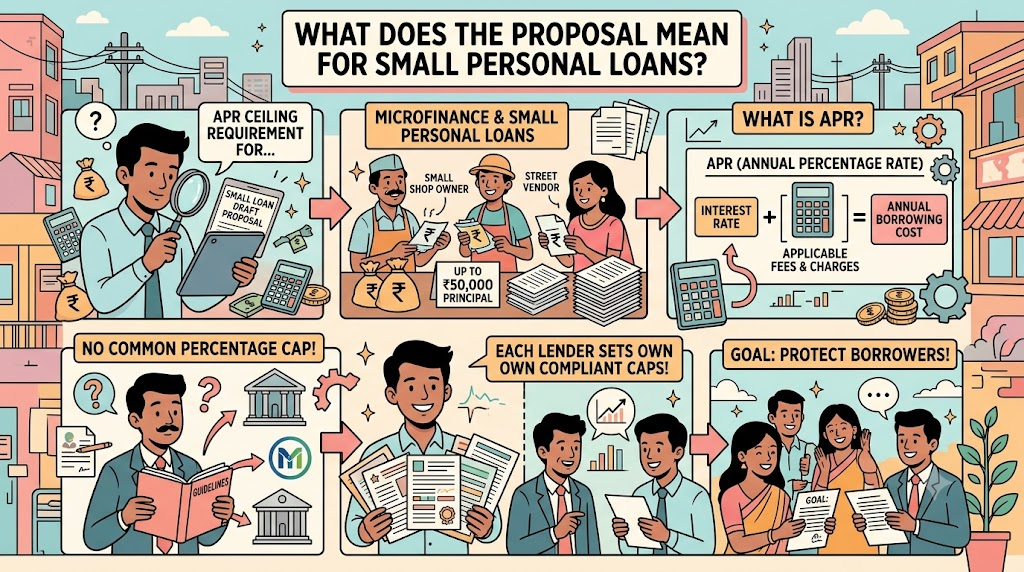
The draft proposes an APR ceiling requirement for microfinance loans and small-value personal loans where principal does not exceed ₹50,000. APR covers the interest rate along with applicable fees and charges used to calculate annual borrowing cost. The proposal does not set one common percentage cap for every lender.
For short-duration credit, that difference is useful. A low monthly rate can look cheap while charges raise the annual cost. Comparing APR alongside the headline rate gives borrowers a better basis for checking competing offers.
The August 2026 proposal is a loan-pricing and comparison reform, not a rate-cut announcement. For many commercial-bank customers already on external benchmarks, quarterly resets are familiar. The broader change is the attempt to standardise how lenders describe the benchmark, spread, reset date, and other pricing parts across a wider group of institutions.
For borrowers, that can make loan shopping less dependent on one advertised number. A customer comparing 2 offers should look beyond the starting rate and ask what can change, when it can change, and why. Over a 10-year or 20-year loan, that visibility can be more useful than a small difference in the opening rate.
No. The proposal concerns floating-rate resets. Fixed-rate loans continue under their contracted terms during the fixed period.
No. It speeds benchmark transmission. Borrowing costs can fall or rise depending on the benchmark, spread, and reset date.
Not always. The benchmark, contracted reset date, spread, and repayment setup decide when any benefit reaches the borrower.
Check the benchmark, reset date, and loan agreement first, then ask the lender for the revised rate calculation.
No. Existing benchmark-linked loans have a proposed 1 April 2029 migration deadline, and borrower consent would be required.








.png&w=3840&q=75)


