
By continuing, you agree to LoansJagat's Credit Report Terms of Use, Terms and Conditions, Privacy Policy, and authorize contact via Call, SMS, Email, or WhatsApp
Disclaimer: The information published on LoansJagat is intended for general informational and educational purposes only and should not be considered financial, legal, or investment advice. Interest rates, loan terms, statistics, and other data may change over time and may vary by lender or source. Please verify the latest information and consult a qualified financial advisor or the respective Bank/NBFC before making any financial decisions.
Subscribe Now
About the author

Arshathul Afia
Arshathul Afia is a journalism graduate and fintech content writer with 4+ years of experience in digital publishing and research-led writing. She has written 200+ articles covering personal finance, lending, banking, digital payments, credit, insurance, and major financial developments in India. At LoansJagat, she focuses on simplifying complex fintech news, RBI updates, loan-related changes, policy developments, and industry trends for everyday readers. Her journalism background helps her approach stories with research, context, and clarity, while her SEO experience ensures content remains discoverable and relevant. She aims to make financial news easier to understand, practical, and useful for readers across India.
Related Blog Post
Simplify All Your Loans Into One Affordable EMI

Customers Served

Debt Consolidated

1200+ Reviews

Locations in India
Club all Loans & Credit Card Bills into Single EMI

Quick Apply Loan
Consolidate your debts into one easy EMI.

Takes less than 2 minutes. No paperwork.

10 Lakhs+
Trusted Customers

2000 Cr+
Loans Disbursed

4.7/5
Google Reviews

50+
Banks & NBFCs Offers
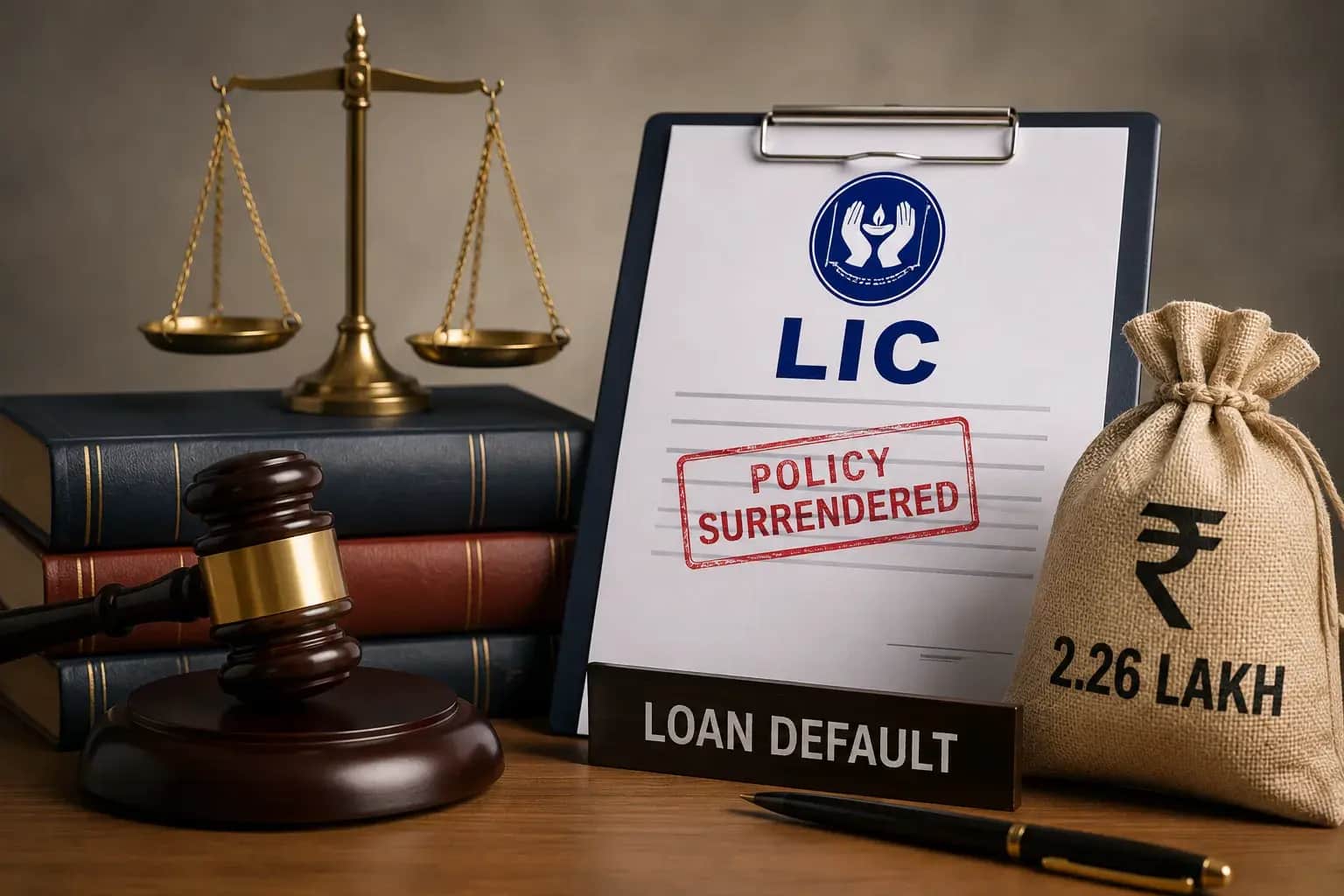
NCDRC has upheld LIC’s action on an assigned policy, showing borrowers that loan default can trigger surrender without fresh consent where assignment gives that power.
The National Consumer Disputes Redressal Commission has found no deficiency in service by LIC after an assigned life insurance policy was surrendered at IDBI Bank’s request following non-payment of a loan. The order, reported on August 27, 2026 and dated August 2, 2026, arose from Amar Singh’s dispute in Sonepat, Haryana. His LIC policy carried a ₹5 lakh sum assured, while the surrender value sent to the bank was ₹2,26,325. Singh said he had never agreed to surrender the policy.
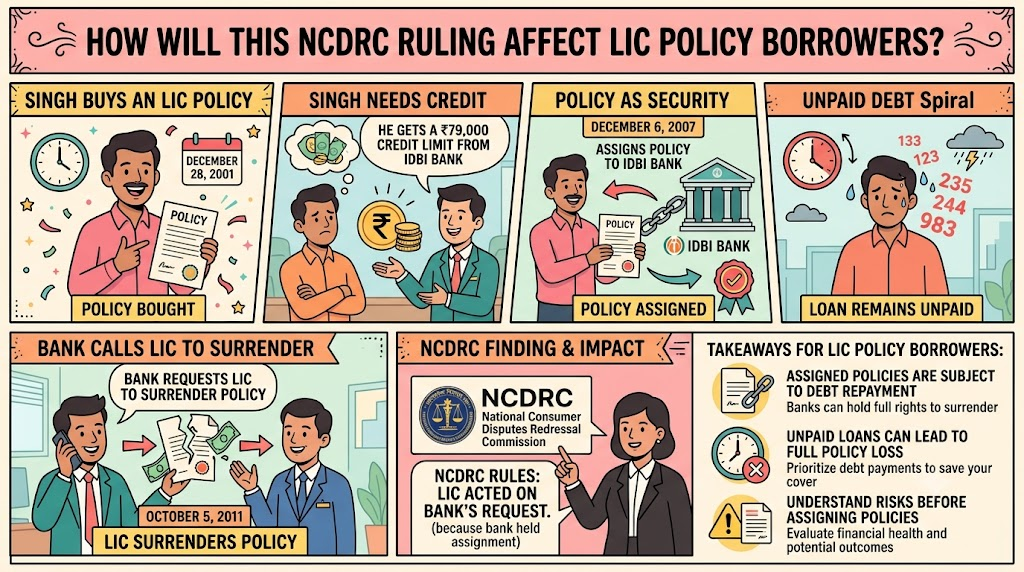
Singh bought the LIC policy on December 28, 2001. He later received a ₹79,000 credit limit from IDBI Bank and assigned the policy to the bank on December 6, 2007. LIC surrendered it on October 5, 2011, after the loan remained unpaid. According to the reported NCDRC findings, LIC acted on the bank’s request because the bank held the assignment.
For Indian borrowers, the useful part is practical. A customer should ask who can request surrender after assignment, what event triggers that step, whether the loan contract promises prior notice, and how the policy will be reassigned after repayment. Eligible life insurance policies can support borrowing, but the conditions attached to that security need the same attention as the interest rate or sanctioned amount.
For policies assigned today, Section 38 of the Insurance Act, 1938 is the starting point. The current text published by the Department of Financial Services says an assignment can be made through an endorsement or separate instrument. Section 38(8), subject to the assignment terms, allows an absolute assignee to surrender a policy without taking the assignor’s consent. A qualifying conditional assignee does not get that surrender right.
Singh’s assignment was executed in 2007, before Section 38 was substituted through the 2015 insurance-law amendment. The present section also says rights and remedies linked to assignments made before that change are not affected by the amended provision. So the NCDRC result should not be reduced to a claim that every bank can surrender every LIC policy without warning. The assignment wording, loan contract, and any notice or promise can alter the position. Borrowers should keep copies of those papers until the lender formally releases its interest.
The policy was due to mature on December 8, 2026, but surrender happened in 2011. Singh wanted restoration, not merely payment of the surrender proceeds.
The sequence shows why a small credit facility eventually produced a long consumer dispute.
The final direction did not allow IDBI Bank to retain the money indefinitely. The reported order says the ₹2,26,325 remained in a suspense account because Singh had closed his accounts before a cheque could be encashed. NCDRC ordered release with accrued interest within 1 month. Failure to comply would attract 6% annual interest on the outstanding amount.
The Sonepat District Consumer Commission initially sided with Singh on February 4, 2015. It told LIC to reinstate the policy and directed the bank to refund ₹2,26,325 to LIC with 9% interest from October 5, 2011, plus ₹10,000 towards mental agony and litigation costs. LIC appealed.
On September 21, 2016, the Haryana State Consumer Commission removed the order against the insurer. It held that the bank controlled the policy after assignment and LIC did not have to issue Singh a separate notice before acting on the assignee’s instruction. Singh then moved the NCDRC, which agreed that LIC had not committed a service deficiency in processing the surrender.
A separate 2015 NCDRC decision adds an important limit. In Paulose John and another versus HDFC Bank, the bank had a right to deal with a pledged LIC policy, but its own communication promised reasonable notice before securities were sold or redeemed. No notice was given. NCDRC treated that failure as a deficiency in service. The lesson is narrower than a blanket no-notice rule: assignment can transfer strong rights, while a lender may still have to follow notice terms it expressly accepted.
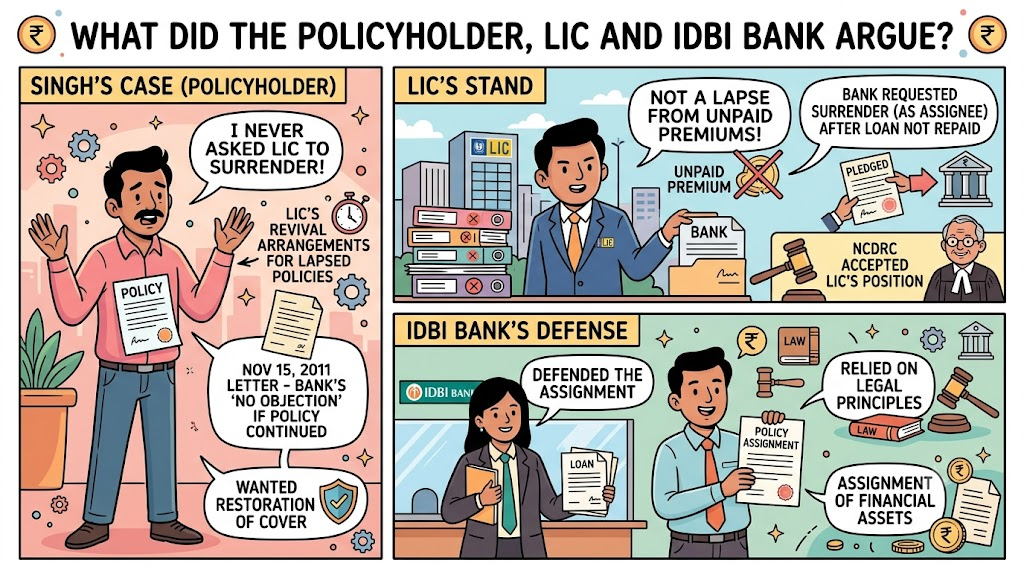
Singh said he had never asked LIC to surrender the policy. His counsel also referred to LIC’s revival arrangements for lapsed policies and a November 15, 2011 letter in which the bank reportedly had no objection if the policy continued. He wanted restoration of the cover.
LIC said this was not a lapse caused by unpaid premiums. Its case was that the bank, as assignee, requested surrender after the loan was not repaid. NCDRC accepted LIC’s position on its own role. IDBI Bank’s counsel defended the assignment and relied on legal principles concerning assignment of financial assets.
For borrowers, the sharper question remains what rights the signed documents transfer and what notice, if any, the lender promises before enforcement. Those 2 details may become far more important than the borrower expects when the loan is taken.
The surrender value should be checked first. LoansJagat’s April 16, 2026 surrender value guide explains that the amount depends on policy type, premium history, and policy terms, and an early exit can produce a lower payout than holding the policy to maturity. In Singh’s case, the policy carried a ₹5 lakh sum assured, while its 2011 surrender value was ₹2,26,325. Sum assured and surrender value are different figures.
That difference deserves attention before a borrower signs an assignment. A person may look at a ₹5 lakh policy and assume a similar amount protects the loan or remains available if something goes wrong. That is not how surrender works. The value available on an early exit can be much lower, depending on the contract and timing.
Borrowers should also ask for the loan outstanding, assignment status, enforcement clause, and release process in writing. After repayment, the policyholder should seek proof that the lender has released its interest and completed any required reassignment.
If a bank or insurer appears to have acted outside the agreed terms, the National Consumer Helpline, run by the Department of Consumer Affairs, accepts pre-litigation grievances. Its official portal lists 1915 as the toll-free helpline and also provides online, WhatsApp, and app-based channels. A consumer can later approach the appropriate consumer commission if the grievance remains unresolved.
A final borrower test is repayment capacity. A loan can keep the policy running while cash is raised, but default may expose the assigned policy to enforcement. The customer should compare the money needed with the policy value placed at risk.
The NCDRC ruling gives borrowers a direct warning about using life insurance as loan security. Singh’s policy was assigned to IDBI Bank, the loan remained unpaid, and LIC acted on the bank’s surrender request. NCDRC found no deficiency in LIC’s conduct, while directing the bank to release the surrender proceeds lying in its suspense account.
The ruling does not mean every lender can ignore every notice clause. Assignment can transfer major policy rights, but the signed terms still decide how those rights operate. Anyone taking a loan against an LIC policy should check the assignment, default trigger, surrender power, and reassignment process before taking the money. Those documents may decide whether the policy survives a later repayment problem.
A valid assignment may give the lender that right, but the assignment terms and any promised notice requirement must be checked first.
The proceeds can be applied according to the lender’s rights and outstanding dues. Any balance must be handled under the applicable terms.
Yes, eligible policies may support loans. A Reddit discussion on LIC policies also raised this option, but interest and repayment risk remain.
Surrender eligibility depends on the specific plan and its terms. Policyholders should check the policy bond before assuming an early payout is available.
Consumers can first use the National Consumer Helpline and, where required, approach the appropriate consumer commission for formal redress.








.png&w=3840&q=75)


