

By continuing, you agree to LoansJagat's Credit Report Terms of Use, Terms and Conditions, Privacy Policy, and authorize contact via Call, SMS, Email, or WhatsApp
Disclaimer: The information published on LoansJagat is intended for general informational and educational purposes only and should not be considered financial, legal, or investment advice. Interest rates, loan terms, statistics, and other data may change over time and may vary by lender or source. Please verify the latest information and consult a qualified financial advisor or the respective Bank/NBFC before making any financial decisions.
Subscribe Now
About the author

Arshathul Afia
Arshathul Afia is a journalism graduate and fintech content writer with 4+ years of experience in digital publishing and research-led writing. She has written 200+ articles covering personal finance, lending, banking, digital payments, credit, insurance, and major financial developments in India. At LoansJagat, she focuses on simplifying complex fintech news, RBI updates, loan-related changes, policy developments, and industry trends for everyday readers. Her journalism background helps her approach stories with research, context, and clarity, while her SEO experience ensures content remains discoverable and relevant. She aims to make financial news easier to understand, practical, and useful for readers across India.
Related Blog Post
Simplify All Your Loans Into One Affordable EMI

Customers Served

Debt Consolidated

1200+ Reviews

Locations in India
Club all Loans & Credit Card Bills into Single EMI

Quick Apply Loan
Consolidate your debts into one easy EMI.

Takes less than 2 minutes. No paperwork.

10 Lakhs+
Trusted Customers

2000 Cr+
Loans Disbursed

4.7/5
Google Reviews

50+
Banks & NBFCs Offers
Non-audit business and professional taxpayers must file AY 2026-27 returns by 31 August 2026, or face late fees, interest, and restricted loss carry-forward after the deadline.
Government of India has now issued a notification to business and professional taxpayers to file Income Tax returns for Assessment Year 2026-27 who are eligible to file but have not yet been audited. The return will be due for Financial Year 2025-26. Depending on their form and audit status, the reminder includes proprietors, freelancers, firms, specified partners, and some trusts. The alert is documented in an entry dated: 13.08.2026 on the Department's official e-campaign page. Later, the messages were changed to ITR-3, ITR-4, ITR-5, and ITR-7.
It gives a small business a month to reconcile the records for the invoices, bank deposits, GST records, TDS credits, and expenses. The risk occurs when a taxpayer mistakenly thinks that 31 August applies to all non-audit returns. For most salary earners (ITR-1 / ITR-2), the deadline was 31 July 2026. If a wrong reading occurs, the filing may be late, and there could be losses that you will not be able to carry over for future tax periods due to interest or restrictions.
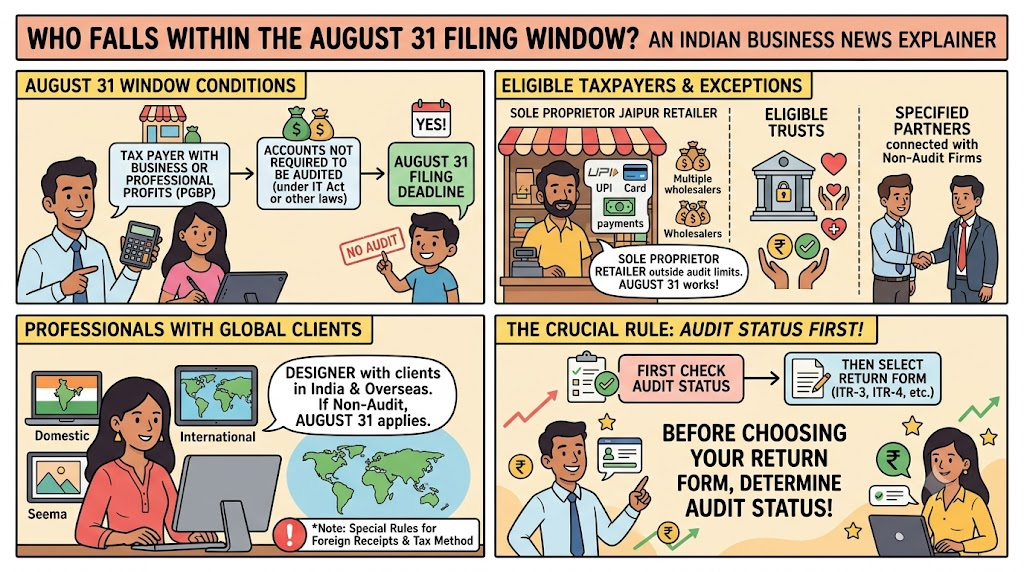
The August deadline applies where a taxpayer has profits or gains from business or profession, but the accounts do not require an audit under the Income-tax Act or another applicable law. Eligible trusts are included. The revised provisions also cover specified partners connected with non-audit firms. Audit status comes first, even before the return form is selected.
Consider a Jaipur retailer operating as a sole proprietor. The shop records card sales, UPI collections, cash receipts, and purchases from several wholesalers. If the business falls outside audit requirements, the proprietor may use the August date. A Hyderabad designer with domestic and overseas clients may also qualify, but foreign receipts and the chosen tax method still require attention.
ITR-3 generally serves individuals and Hindu Undivided Families with business or professional income who cannot use ITR-4. The shorter ITR-4 is available to eligible resident individuals, HUFs and firms other than LLPs using presumptive taxation. ITR-5 covers several firms, LLPs, associations, and similar entities. Specified trusts and institutions may need ITR-7.
The table places the main groups beside their AY 2026-27 filing position. Taxpayers still need the notified form instructions.
Foreign assets, directorships, certain capital gains and other disclosures can make ITR-4 unavailable even where a taxpayer uses presumptive taxation. Filing the shorter form merely because it looks easier is a poor shortcut. The portal may flag a defect later, or the return may omit a schedule that the taxpayer was required to complete.
The practical benefit lies in reconciliation. Business income seldom appears in 1 tidy certificate. A Pune consultant may receive fees through a current account, UPI and 2 online platforms, with TDS appearing under separate entries. Those amounts must be checked against Form 26AS, AIS and the books. Copying every bank credit into turnover may overstate receipts or conflict with the GST return.
Filed ITRs also carry weight when self-employed people seek credit because lenders often examine declared income where salary slips are unavailable. A return does not secure approval by itself. Still, inconsistent figures can delay the assessment of a home loan, business loan, or working-capital request. LoansJagat’s guide to common income-tax notices recommends matching a tax communication with AIS, Form 26AS, the submitted return, and payment records. The same exercise before filing can catch a missing TDS credit or an unexplained receipt. The editorial reading is direct: the extra month helps only when taxpayers use it to inspect the records, not postpone the work.
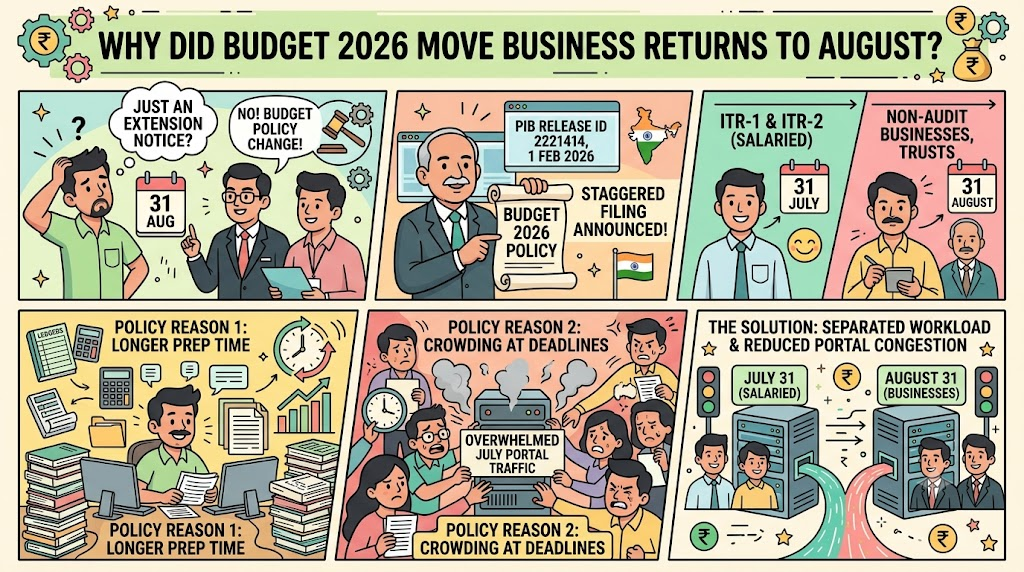
The date came from the staggered filing calendar announced in Budget 2026. It was not created by an extension notice issued near 31 August. The Press Information Bureau published Release ID 2221414 on 1 February 2026. That release said ITR-1 and ITR-2 would continue with the 31 July deadline, while non-audit business cases and trusts would receive time until 31 August.
The Union Budget portal’s memorandum added the policy reasoning. Businesses, specified partners and trusts often need longer to prepare books. Under the earlier schedule, those returns crowded around the July date used for simpler salary filings. The revised calendar separates part of that workload and may reduce concentrated portal traffic.
The change is introduced in Explanation 2 to Section 139(1) of the Income-tax Act, 1961, for AY 2026-27. A similar structure is provided for Tax Year 2026-27 in the Income-tax Act, 2025 (Act). The same structure is presented for Tax Year 2026-27 in the Income-tax Act, 2025 (Act) under Section 263(1)(c) of the Act. The overlap may appear messy. The new tax-year framework applicable to income earned in the tax year 2025-26 has been implemented from 1st April 2026, but it is noted that the 1961 Act is still in operation for income earned in FY 2025-26 and reported under AY 2026-27.
The Income Tax Department has coined the tagline “Be the tax hero who files on time.” Tax experts have been focused on the paperwork aspects of that message. In a report published in Business Standard on 25 August 2026, Neeraj Agarwala, senior partner of Nangia & Co., was quoted. Some common mistakes, he said, were using the wrong ITR form, failure to reconcile receipts, and failure to adhere to the loss-reporting deadlines. The "solution" is practical: synchronize books with bank entries, GST, TDS, Form 26AS, and AIS before uploading the data.
Partner tax, Grant Thornton Bharat, Richa Sawhney said that taxpayers who are using regular business reporting should keep the following records: Invoices and bills, bank statements, client contracts, and records of purchased assets. Deepashree Shetty (BDO India) highlighted the issue of GST collected separately. This can be added to gross receipts in a haphazard manner, which may lead to a mismatch. So, a sensible filing sequence should begin with checking the eligibility of the forms, then verify the forms were received, check for deductions, pay self-assessment tax, and then review supporting papers. It is a regular job. Avoid missing it, and the problems begin.
Provided the assessment is done prior to 31 December 2026, a belated return for the financial year 2026-27 can be filed till 31 December 2026. The late fee is ₹1000 if the total income is less than ₹5 lakh and ₹5000 for other cases under Section 234F of the Income Tax Act. Interest may be charged on the unpaid tax. This adds to the costs to an existing self-assessment taxpayer but does not provide any filing advantage.
Loss treatment is another worry. For the most part, business, capital, and speculative losses must be reported within the original due date for the following year if the taxpayer desires to be allowed a carryover of the loss. The losses from house properties are differentiated from the losses in unabsorbed depreciation. There needs to be verification as well. The e-verification / ITR-V is to be done within 30 days from the date of notification No. 2/2024 dated 31 March 2024. Uploaded returns that have not been verified may be considered not filed.
The non-audit business taxpayers who are eligible to avail this facility have been given more time, until 31 August 2026, as compared to the last date of 15 August 2026 for the salaried ITR-1 and ITR-2 filers. The date is informative, but too small. The eligibility for the income type and form remains the criterion for deciding its application despite its audit status.
Taxpayers should be looking for 4 jobs near the deadline: they should reconcile receipts, pay the balance of tax, upload the right return, and verify it. An extension hasn't yet been announced. A checked filing minimizes correspondence later that you do not need to deal with, and preserves your eligible losses. A checked filing not only helps avoid correspondence you don't need to deal with later, but it also preserves eligible losses.
It may be necessary for eligible non-audit business and professional taxpayers, specified trusts, and certain trusts to file ITR-3, ITR-4, ITR-5, or ITR-7.
For AY 2026-27, eligible non-audit business cases and trusts have been moved to a separate schedule of 31 August for inclusion in Budget 2026.
Section 234F gives a ₹1,000 benefit for income up to ₹5 Lakh. Late filers (other than the above) may be liable for ₹5,000.
Most salaried taxpayers who did not have any business income were supposed to file ITR-1 or ITR-2 by 31 July 2026. It is not reopened in August.
ITR-4 can be used by a freelancer only when all the conditions of the presumptive tax and the form are satisfied. ITR-3 may be required for foreign assets or for certain disclosures that are excluded.








.png&w=3840&q=75)


