By continuing, you agree to LoansJagat's Credit Report Terms of Use, Terms and Conditions, Privacy Policy, and authorize contact via Call, SMS, Email, or WhatsApp
Disclaimer: The information published on LoansJagat is intended for general informational and educational purposes only and should not be considered financial, legal, or investment advice. Interest rates, loan terms, statistics, and other data may change over time and may vary by lender or source. Please verify the latest information and consult a qualified financial advisor or the respective Bank/NBFC before making any financial decisions.
Subscribe Now
About the author

LoansJagat Team
‘Simplify Finance for Everyone.’ This is the common goal of our team, as we try to explain any topic with relatable examples. From personal to business finance, managing EMIs to becoming debt-free, we do extensive research on each and every parameter, so you don’t have to. Scroll up and have a look at what 15+ years of experience in the BFSI sector looks like.
Related News
Simplify All Your Loans Into One Affordable EMI

Customers Served

Debt Consolidated

1200+ Reviews

Locations in India
Club all Loans & Credit Card Bills into Single EMI

Quick Apply Loan
Consolidate your debts into one easy EMI.

Takes less than 2 minutes. No paperwork.

10 Lakhs+
Trusted Customers

2000 Cr+
Loans Disbursed

4.7/5
Google Reviews

50+
Banks & NBFCs Offers
Other services mentioned in this article
Key Insights
As of April 7, 2026, the USD/INR rate traded around 93.09, with analysts warning of a slide toward 100 if geopolitical tensions rise further.
India's forex reserves dropped over $40 billion in four weeks to March 27, 2026, falling to $688 billion from a record $728.49 billion set in February.
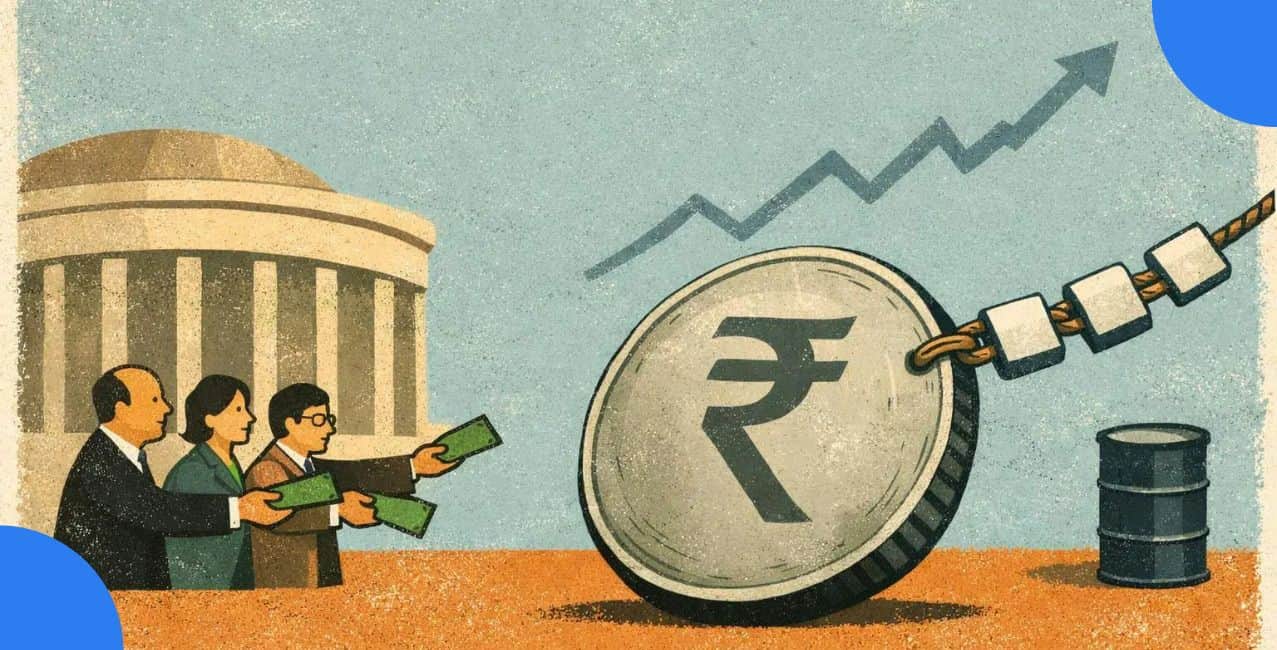
The RBI now faces a difficult question. To attract more foreign money, should the central bank itself take on the currency risk that investors want to avoid?
Historically, as seen in 2013, the RBI offered banks a concessional swap rate of 3.5% per annum on FCNR-B deposits, well below the market hedging cost of 6-7% at the time.
This effectively transferred currency risk from banks to the RBI and brought in $26 billion through NRI deposits and $8 billion in foreign borrowings.
In the short term, such a move could stabilise the rupee and boost reserves.
But over the longer term, if the rupee weakens further, the RBI bears those losses directly, raising questions about fiscal cost and policy sustainability.
The table below summarises the key data points explaining why pressure on the RBI to act is growing rapidly right now.
Despite net FPI outflows, the RBI's April 2026 Bulletin noted that FDI grew strongly and that India remains an attractive destination for greenfield projects.
External vulnerability indicators are described as contained, and reserves are adequate. The reserves buffer is real, but its rate of erosion is a genuine concern.
For households, a weaker rupee translates directly into higher costs. As oil is priced in dollars, a combination of high energy prices and a weaker rupee creates imported inflation.
The RBI's inflation target of 4% faces significant operational challenges in this environment.
This hits transport costs, LPG prices, and everyday goods, squeezing household budgets most among lower-income families.
RBI Governor Malhotra said on April 8, 2026, that FPI flows are expected to improve, particularly in technology and financial services.
He noted that long-term investors will continue to see value in India, while short-term money will move in and out.
For retail investors in equity and debt markets, this message offers measured reassurance without dismissing the near-term volatility.
Analysts caution that reviving the FCNR-B scheme at current global interest rates would be far more expensive for the RBI than in 2013.
The higher cost could make this a financially burdensome measure. Critics also note that FCNR-B addresses a symptom and not the root cause.
The deeper issue remains India's structural trade deficit and dependence on imported energy.
*T&C Apply
These steps aim to give exporters more flexibility while strengthening dollar inflows organically over time.
Building on structural reforms rather than one-time inflow schemes is what most economists recommend for a lasting fix.
The RBI has the tools to attract foreign inflows, but absorbing currency risk comes at a real cost. A balanced approach combining structural reforms, targeted NRI incentives, and careful reserve management will be key to protecting India's external stability in the near term.
If the economy is “stronger than ever,” why has the rupee steadily weakened under BJP rule?
The Indian rupee's weakening against the dollar, despite high economic growth is driven by structural factors rather than a weak economy.
What are the factors that contribute to the rupee's failure? What are the steps taken by the RBI?
The Indian rupee's depreciation (often hitting record lows, such as near ₹90 per USD in late 2025) is primarily driven by a strong US dollar, heavy foreign portfolio investor (FPI) outflows, rising crude oil prices, and a widened trade deficit.
Related Finance News | |||









.png&w=3840&q=75)



