
By continuing, you agree to LoansJagat's Credit Report Terms of Use, Terms and Conditions, Privacy Policy, and authorize contact via Call, SMS, Email, or WhatsApp
Disclaimer: The information published on LoansJagat is intended for general informational and educational purposes only and should not be considered financial, legal, or investment advice. Interest rates, loan terms, statistics, and other data may change over time and may vary by lender or source. Please verify the latest information and consult a qualified financial advisor or the respective Bank/NBFC before making any financial decisions.
Subscribe Now
About the author

Arshathul Afia
Arshathul Afia is a journalism graduate and fintech content writer with 4+ years of experience in digital publishing and research-led writing. She has written 200+ articles covering personal finance, lending, banking, digital payments, credit, insurance, and major financial developments in India. At LoansJagat, she focuses on simplifying complex fintech news, RBI updates, loan-related changes, policy developments, and industry trends for everyday readers. Her journalism background helps her approach stories with research, context, and clarity, while her SEO experience ensures content remains discoverable and relevant. She aims to make financial news easier to understand, practical, and useful for readers across India.
Related News
Simplify All Your Loans Into One Affordable EMI

Customers Served

Debt Consolidated

1200+ Reviews

Locations in India
Club all Loans & Credit Card Bills into Single EMI

Quick Apply Loan
Consolidate your debts into one easy EMI.

Takes less than 2 minutes. No paperwork.

10 Lakhs+
Trusted Customers

2000 Cr+
Loans Disbursed

4.7/5
Google Reviews

50+
Banks & NBFCs Offers
Other services mentioned in this article
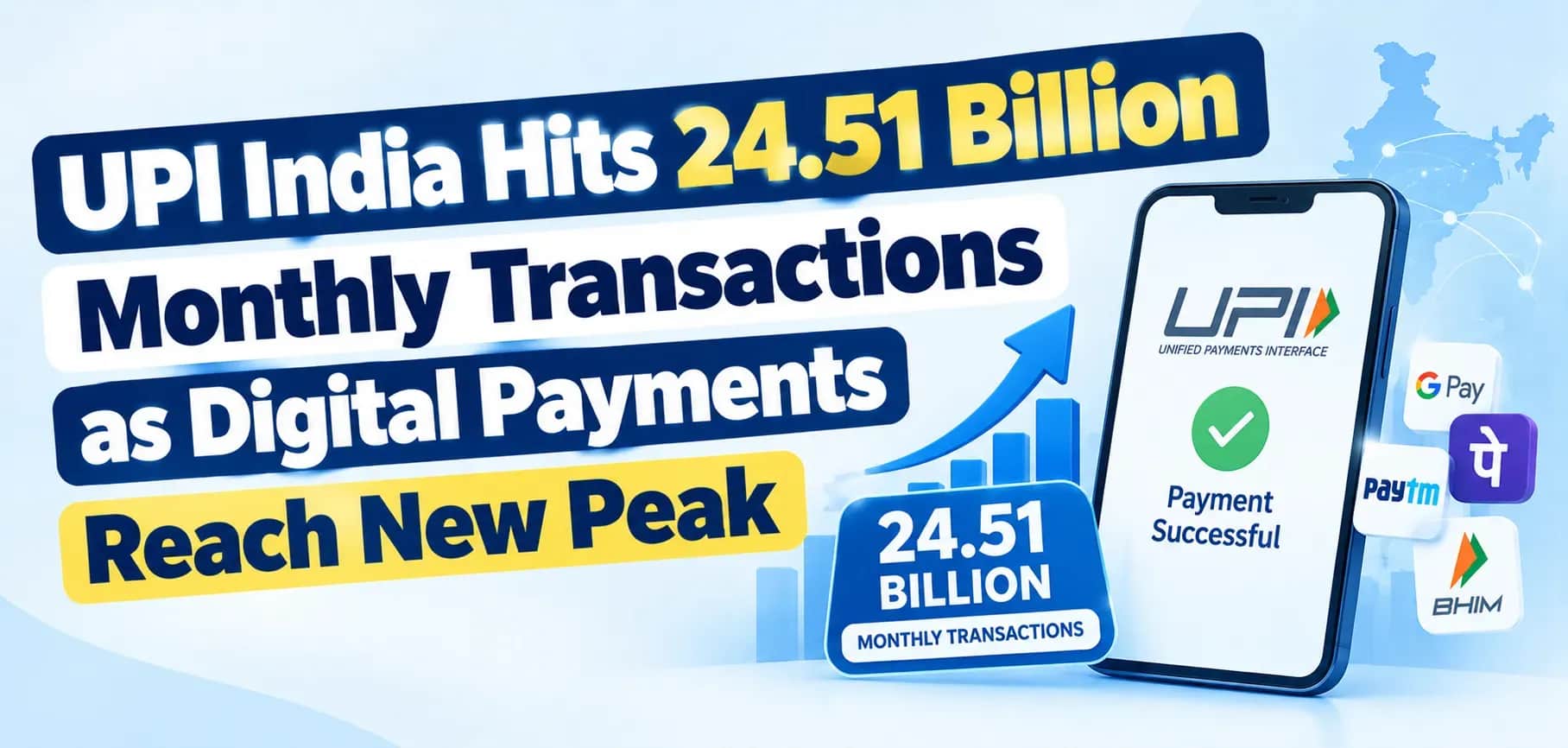
UPI handled a record 24.51 billion transactions in August 2026. Indian customers used the system for payment and transfer services. Transactions include personal payments, bill payments, and payments for goods and services.
Key Highlights
India’s Unified Payments Interface recorded its highest monthly volume in August 2026. Official monthly UPI data shows 24.51 billion transactions, carrying ₹29.82 lakh crore through 752 banks. These were payments made on banking apps, third-party apps and the QR codes found at shops across India.
The immediate gain is easy to spot. More customers can pay without cash, a card machine or the recipient’s account details. But bigger traffic brings bigger headaches when something fails. A delayed reversal can hold up a household’s grocery money. A short outage can leave a shopkeeper waiting at the counter, while impersonation scams and fake payment messages keep changing shape.
August broke July's record. The volume of transactions soared from 23.66 billion to 24.51 billion. Though the value of the transactions was 29.88 lakh crore rupees in July and only 29.82 lakh crore rupees in August. Thus, the number of payments made by Indians increased but the overall worth of the payments made by them diminished.
That movement points to frequent use for smaller purchases. A person paying for tea, a bus ticket and vegetables creates 3 transactions, though the combined spend may remain modest. Similar payment behaviour, repeated through the day by millions of users, can push volume higher without producing an equal rise in value.
Bank participation also grew. UPI had 741 live banks in July and 752 in August. A sender using 1 participating app can pay a recipient using another, provided both bank accounts are linked to the network. Customers do not need to download the same app or open an account with the same bank.
The monthly comparison appears below. The August numbers are available in the official product data, while the July position was published by the Ministry of Finance on 24 August 2026.
For a merchant, transaction count can be more revealing than the rupee total. A pharmacy may handle dozens of low-value scans during an evening rush. Each payment still requires processing, confirmation and a record. When traffic rises, banks and payment apps must handle more authorisation requests, more reversals and, inevitably, more complaints.
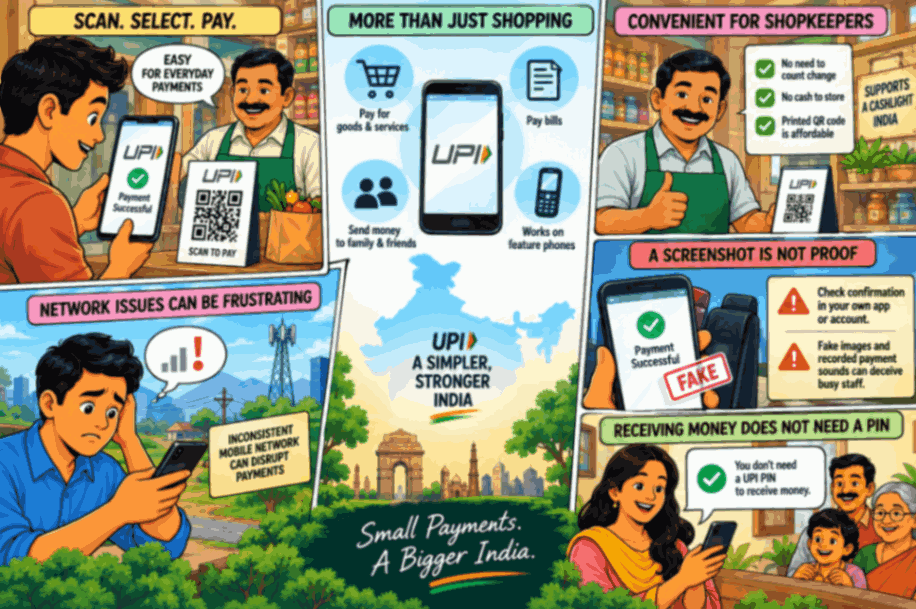
Currently, customers can scan a code, select a bank account and pay with just a touch of a button. Because of this, customers can not only pay for goods and services, they can also pay their bills and even send money to family and friends. Users of feature phones can also use UPI to make payments. However, because of the inconsistent mobile network in India, using the service can still be very irritating.
Shopkeepers avoid counting change and storing cash at the counter. A printed QR code also costs less to adopt than a card terminal. Still, a payment screenshot is not proof that money arrived. Sellers need to check the confirmation in their own app or account because fake images and recorded payment sounds are used to deceive busy staff. Customers have a separate rule to remember: receiving money does not require a UPI PIN.
The International Monetary Fund published Growing Retail Digital Payments: The Value of Interoperability on 25 June 2025. Its authors, Alexander Copestake, Divya Kirti and Maria Soledad Martinez Peria, described UPI as the world’s largest retail fast-payment system by volume. Their study found that interoperability aided adoption. People could choose an app and still pay users of other participating apps.
Funding, however, cannot be separated from service quality. The merchant-payment FAQ published by the Department of Financial Services on 15 September 2026 says customer payments and person-to-person transfers will remain free after 15 October 2026. Selected merchant payments above ₹2,000 will carry a 0.4% merchant discount rate, within the notified categories and caps. Regulators will need to check that merchants do not add this charge to a buyer’s bill.
The fee gives payment firms a transaction-linked income stream for processing and technology costs. Users should see a return for that money through fewer failures, quicker reversals and support that can be reached without several transfers between a bank and an app provider.
The first pilot involved 21 banks in April 2016. Public use began on 25 August 2016, and the BHIM app followed that December. UPI crossed 1 billion monthly transactions in October 2019. It reached 5 billion in March 2022.
Additions came gradually. UPI AutoPay gave users a way to approve recurring bills and subscriptions. UPI Lite shortened the payment process for small purchases. Credit Line on UPI arrived in 2023, while UPI Circle followed in 2024. The latter allows an account holder to authorise another person to make payments under an approved arrangement.
The government’s 10-year review, published on 24 August 2026, shows how far usage travelled. Annual volume rose from 1.78 crore transactions in FY 2016-17 to 24,162 crore in FY 2025-26. During FY 2025-26, UPI formed 84% of India’s digital payment volume. Its share of global real-time payment volume stood at 49% in 2025, according to the same release.
UPI had also reached 11 countries by August 2026, but the service is not identical across them. Some markets accept merchant payments. Others have remittance connections, and a few provide both. The domestic version available to an Indian bank customer should not be assumed to exist in full across all 11 countries.
Prime Minister Narendra Modi marked UPI’s 10th anniversary on 25 August 2026. “The sheer scale and reach of UPI are something every Indian must be proud of,” he said in an official statement released on the anniversary. His remarks linked the payment network with India’s wider digital public infrastructure programme.
Sohini Rajola, Executive Director for Growth at NPCI called UPI “the world’s largest real-time payment system” on 16 February 2026. Her statement accompanied the extension of UPI One World to overseas delegates at the India AI Impact Summit 2026. Eligible visitors could make merchant payments without an Indian bank account or Indian mobile number.
The LoansJagat view is that the August record needs to be read alongside failed-payment resolution and refund time. A huge monthly number looks impressive. It offers little comfort, though, to a family waiting for grocery money to return after an unsuccessful transfer. Nor does it help a shopkeeper who cannot reach the right support team during working hours. LoansJagat has also covered how the rules taking effect on 15 October keep customer payments free while charging selected larger merchant transactions.
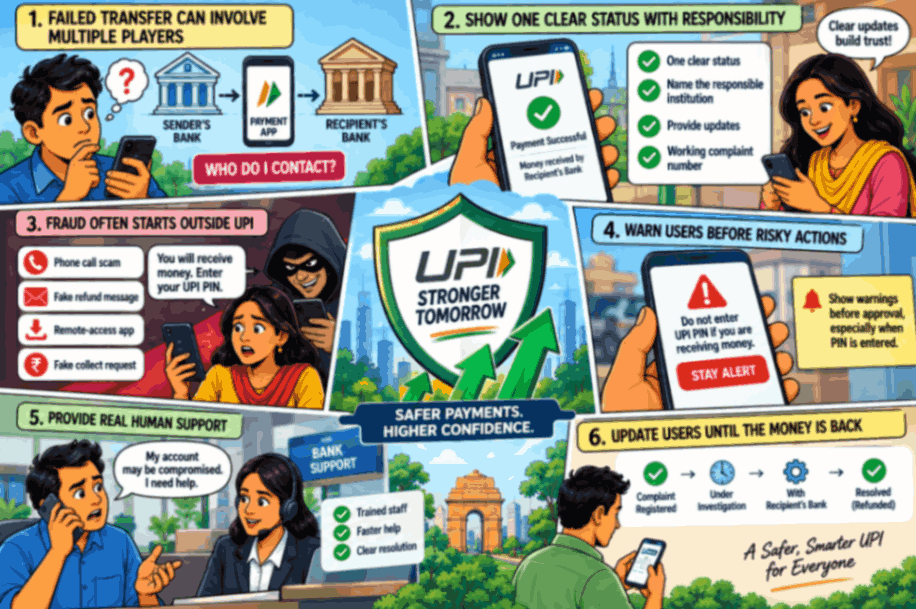
A failed transfer can involve the sender’s bank, the recipient’s bank and the payment app. Customers often do not know which organisation has the complaint. Banks and apps should display 1 status, name the responsible institution and provide updates until the money reaches the recipient or returns to the sender. A complaint number that works would help too.
Fraud needs a different response. Many incidents begin outside the payment system with a phone call, fake refund message, remote-access app or collect request. Warnings should appear before approval, particularly when someone enters a PIN after being told that money is being received. Banks also need human support for customers whose accounts may have been compromised. Automated menus are rarely enough at that point.
UPI’s August record grew through ordinary payments, including shop purchases, bills and transfers between families. The total value did not rise with the transaction count. That detail shows how often Indians now reach for UPI when the amount itself is small.
Heavy use will keep testing the network. Customers need free access and faster reversals. Merchants need predictable charges, accurate confirmation and a support route that works during business hours. Payment providers, meanwhile, need funds for servers, fraud checks and service staff. How those needs are handled will decide whether higher volume also produces a better payment experience.
UPI processed 24.51 billion transactions worth ₹29.82 lakh crore through 752 participating banks during August 2026.
Yes. Customer payments and person-to-person transfers remain free under the framework published on 15 September 2026.
Network interruptions, bank server delays or processing timeouts may debit money before confirmation reaches the recipient’s bank.
UPI uses bank authentication, but customers must reject unknown collect requests, inspect payment details and protect their PIN.
No. The PIN authorises money leaving the account. An ordinary incoming payment does not require it.









.png&w=3840&q=75)


