
By continuing, you agree to LoansJagat's Credit Report Terms of Use, Terms and Conditions, Privacy Policy, and authorize contact via Call, SMS, Email, or WhatsApp
Disclaimer: The information published on LoansJagat is intended for general informational and educational purposes only and should not be considered financial, legal, or investment advice. Interest rates, loan terms, statistics, and other data may change over time and may vary by lender or source. Please verify the latest information and consult a qualified financial advisor or the respective Bank/NBFC before making any financial decisions.
Subscribe Now
About the author

Arshathul Afia
Arshathul Afia is a journalism graduate and fintech content writer with 4+ years of experience in digital publishing and research-led writing. She has written 200+ articles covering personal finance, lending, banking, digital payments, credit, insurance, and major financial developments in India. At LoansJagat, she focuses on simplifying complex fintech news, RBI updates, loan-related changes, policy developments, and industry trends for everyday readers. Her journalism background helps her approach stories with research, context, and clarity, while her SEO experience ensures content remains discoverable and relevant. She aims to make financial news easier to understand, practical, and useful for readers across India.
Related News
Simplify All Your Loans Into One Affordable EMI

Customers Served

Debt Consolidated

1200+ Reviews

Locations in India
Club all Loans & Credit Card Bills into Single EMI

Quick Apply Loan
Consolidate your debts into one easy EMI.

Takes less than 2 minutes. No paperwork.

10 Lakhs+
Trusted Customers

2000 Cr+
Loans Disbursed

4.7/5
Google Reviews

50+
Banks & NBFCs Offers
India’s new UPI merchant fee may create a ₹27,000 crore annual pool by FY28, with SBI leading issuing-bank gains under the final framework, analysts estimate.
Key Highlights
The Department of Financial Services announced the final framework in New Delhi on 15 September 2026. Eligible commercial merchants will pay 0.4% on P2M transactions above ₹2,000 from 15 October. Banks, payment applications and processing partners will share the fee, creating a permanent funding route for payment infrastructure.
Eligible merchants face a fresh cost on digital sales. Retail groups fear that shops with thin margins may favour cash for larger bills or trim offers. Customers remain protected from a direct fee, but banks must stop MDR from returning as a checkout surcharge.
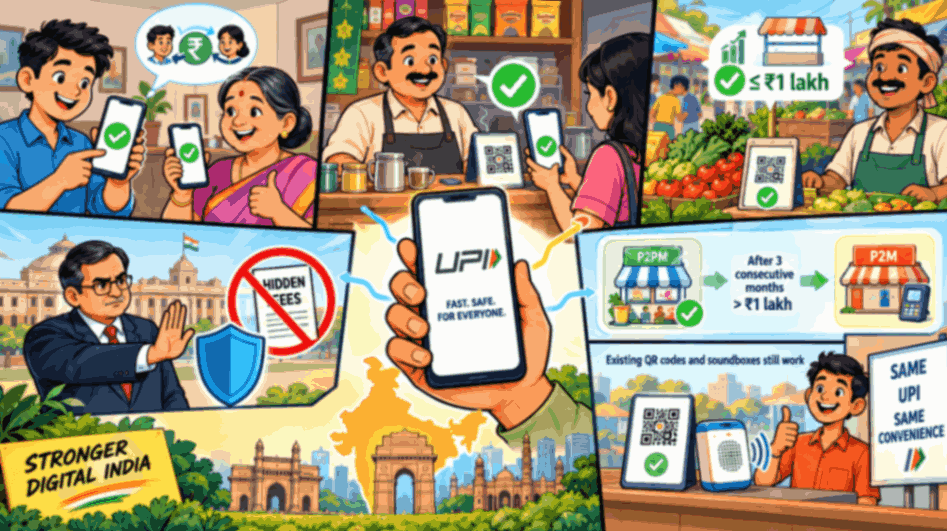
Most daily users should see no change. Sending money to family, paying a friend or moving funds between personal bank accounts will remain free at every permitted value. Merchant payments up to ₹2,000 also carry zero MDR. The government has barred UPI applications from adding platform fees or hidden charges, and an eligible merchant cannot pass the MDR directly to the buyer.
Small sellers receive broader protection through the P2PM category. A qualifying vendor receiving up to ₹1 lakh each month through a UPI QR account can continue with zero MDR, even if 1 payment crosses ₹2,000. A merchant can move to regular P2M classification after collections exceed ₹1 lakh monthly for 3 consecutive months. Existing QR codes and soundboxes still work.
Bernstein analysts, including Pranav Gundlapalle, estimate that the structure could produce nearly ₹27,000 crore in annual revenue by FY28 and close to ₹20,000 crore in ecosystem profit. Banks may retain around 60% of that profit. Pine Labs chief executive Amrish Rau said payment companies need continuing spending on infrastructure, cybersecurity and customer service. Vishwas Patel, Chairman of the Payments Council of India, described MDR as a sustenance fee.
Also Read: Hero Motors IPO
Retail representatives disagree. Kumar Rajagopalan, Chief Executive of the Retailers Association of India, warned that sellers may prefer cash when festive purchases cross ₹2,000. Zerodha Chief Executive Nithin Kamath questioned how brokers could absorb a fee when customers transfer money but do not trade. Banks should classify merchants correctly, itemise deductions and act against unauthorised UPI charges.
The Department of Financial Services issued the 10-page document “Merchant Discount Rate (MDR) on Select UPI (P2M) Transactions” on 15 September 2026. It identifies the payer, protected categories, special rates and implementation date. The table below uses that official framework.
The government says roughly 96% of merchant transactions will remain unaffected. That figure refers to the number of transactions, not their combined value. Payments above ₹2,000 made up 67% of merchant-payment value in August, even though they represented only 4% of P2M volume. This difference helps explain why a narrow fee can still generate a large revenue pool.
A UPI payment passes through several participants. The issuing bank holds the customer’s account and sends the money. A payer PSP bank connects the application to UPI, while the acquiring bank handles the merchant’s receipt. Applications and aggregators may also receive a portion.
SBI has a large base of savings accounts used for outgoing UPI payments. Bernstein estimates that the bank could capture about 25% of an ₹8,000 crore issuer pool, implying a possible annual share near ₹2,000 crore. That is a brokerage projection, not guidance from SBI. Actual income will depend on eligible merchant value and the final allocation among participants.
Axis Bank and Yes Bank stand out for another reason. Both support substantial UPI traffic as PSP banks, giving them access to processing income that may exceed their share of ordinary deposits or loans. Bernstein estimates that the policy could lift banking-system profit by around 3%, though gains may be concentrated among a small group of issuing, acquiring and PSP banks.
The LoansJagat view is that the bank with the largest total UPI volume will not automatically earn the most. Personal transfers remain outside MDR, so eligible merchant traffic and each bank’s role in the payment chain will decide the final result. That distinction prevents SBI’s projected issuer gain from being confused with the overall ranking across every UPI role.
India made MDR zero on prescribed RuPay debit-card and BHIM-UPI payments in January 2020. Shops could adopt QR payments without losing part of each sale. Government incentives later paid participating institutions for certain low-value merchant transactions.
On 24 March 2025, the Union Cabinet approved a ₹1,500 crore incentive scheme for FY2024-25. Eligible payments up to ₹2,000 received by small merchants earned payment participants a 0.15% incentive, while sellers paid zero MDR. The Ministry of Finance release said acquiring banks would share it with issuer banks, PSP banks and application providers.
The Ministry of Finance’s “UPI completes 10 glorious years” review, released on 30 April 2026, recorded 24,161.69 crore transactions worth about ₹314 lakh crore during FY2025-26. It counted 703 live banks by March 2026.
Parliament amended the Payment and Settlement Systems Act during the 2026 Monsoon Session. Notification S.O. 5067(E), dated 14 September 2026, protected RuPay debit-card payments and UPI transactions up to ₹2,000. The final framework followed on 15 September.
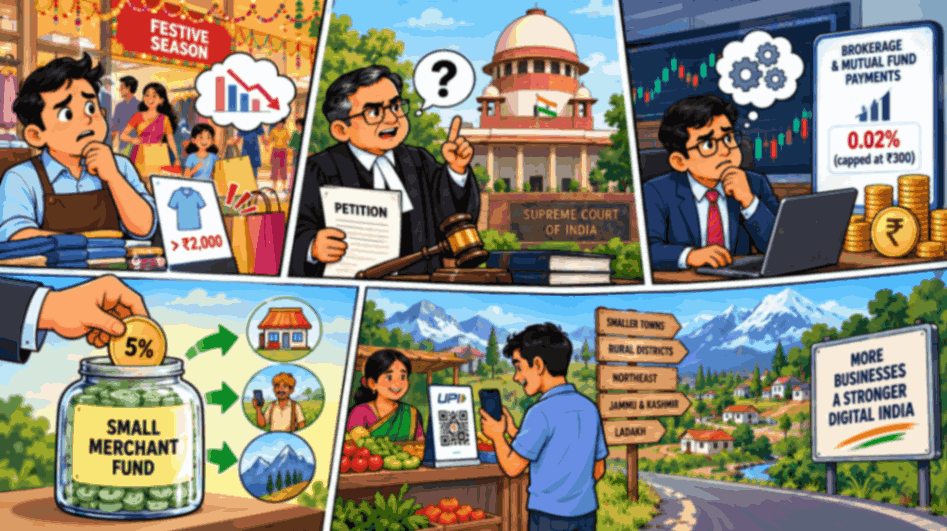
Retail groups argue that October is a difficult starting point because festival purchases often cross ₹2,000. Apparel sellers and organised retailers are already watching consumer demand and operating margins. A public-interest petition filed in the Supreme Court on 16 September challenged the legal basis and safeguards behind the change. The court had not taken up the plea when it was reported on 17 September.
Capital-market businesses have a separate concern. Broker and mutual-fund payments attract 0.02% MDR, capped at ₹300. A broker may receive customer funds even when the customer later decides not to place a trade, yet the processing cost has already arisen. The government has used a lower rate for this category, but brokers still want operational details before 15 October.
The policy also creates a small-merchant fund using 5% of MDR collections. It will support onboarding and UPI acceptance in smaller towns, rural districts, the Northeast, Jammu and Kashmir, and Ladakh. Its operating rules remain pending, so no fixed rupee allocation can yet be stated.
The 15 October framework creates a direct source of income for banks and payment companies while keeping customers, personal transfers and most merchant transactions outside MDR. SBI may lead the issuer-bank gains, while Axis Bank, Yes Bank and institutions with large PSP or acquiring operations could benefit through different parts of the payment chain.
The ₹27,000 crore figure remains Bernstein’s FY28 projection. It is not government revenue guidance or an assured bank profit. Merchant behaviour, exempt transactions, account classification and commercial allocation will shape the final earnings. For customers, the rule is simpler: the price displayed by the merchant should remain the price paid through UPI.
No. The merchant pays MDR on an eligible transaction. The customer should pay only the displayed purchase price.
Not automatically. MDR depends on merchant classification. A qualifying P2PM seller receiving up to ₹1 lakh monthly retains zero MDR.
The merchant-funded MDR is shared through the payment chain. SBI may gain as the issuing bank for a large number of payer accounts.
No. The standard calculation reaches the ₹300 cap at ₹75,000, so a qualifying ₹1 lakh payment also carries ₹300.
No prescribed MDR applies to automated recurring mandates for bills, subscriptions and recurring investments under the announced framework.









.png&w=3840&q=75)


