
By continuing, you agree to LoansJagat's Credit Report Terms of Use, Terms and Conditions, Privacy Policy, and authorize contact via Call, SMS, Email, or WhatsApp
Disclaimer: The information published on LoansJagat is intended for general informational and educational purposes only and should not be considered financial, legal, or investment advice. Interest rates, loan terms, statistics, and other data may change over time and may vary by lender or source. Please verify the latest information and consult a qualified financial advisor or the respective Bank/NBFC before making any financial decisions.
Subscribe Now
About the author

Arshathul Afia
Arshathul Afia is a journalism graduate and fintech content writer with 4+ years of experience in digital publishing and research-led writing. She has written 200+ articles covering personal finance, lending, banking, digital payments, credit, insurance, and major financial developments in India. At LoansJagat, she focuses on simplifying complex fintech news, RBI updates, loan-related changes, policy developments, and industry trends for everyday readers. Her journalism background helps her approach stories with research, context, and clarity, while her SEO experience ensures content remains discoverable and relevant. She aims to make financial news easier to understand, practical, and useful for readers across India.
Related News
Simplify All Your Loans Into One Affordable EMI

Customers Served

Debt Consolidated

1200+ Reviews

Locations in India
Club all Loans & Credit Card Bills into Single EMI

Quick Apply Loan
Consolidate your debts into one easy EMI.

Takes less than 2 minutes. No paperwork.

10 Lakhs+
Trusted Customers

2000 Cr+
Loans Disbursed

4.7/5
Google Reviews

50+
Banks & NBFCs Offers
India’s new UPI MDR starts on 15 October, charging eligible merchants 0.4% above ₹2,000 while customers and qualifying small vendors remain protected from direct fees.
Key Highlights
India will introduce a Merchant Discount Rate on selected person-to-merchant UPI payments from 15 October 2026. According to the Ministry of Finance announcement dated 15 September 2026, regular commercial merchants will pay 0.4% on qualifying transactions above ₹2,000. Customers, P2P transfers and eligible small vendors remain exempt.
The short-term impact will fall on larger shops, online sellers and service companies accepting higher-value payments across India. Buyers will still authorise only the billed amount, but some businesses may reduce cashback or revise general pricing. The government says MDR revenue will fund payment infrastructure, fraud controls, cybersecurity and customer support.
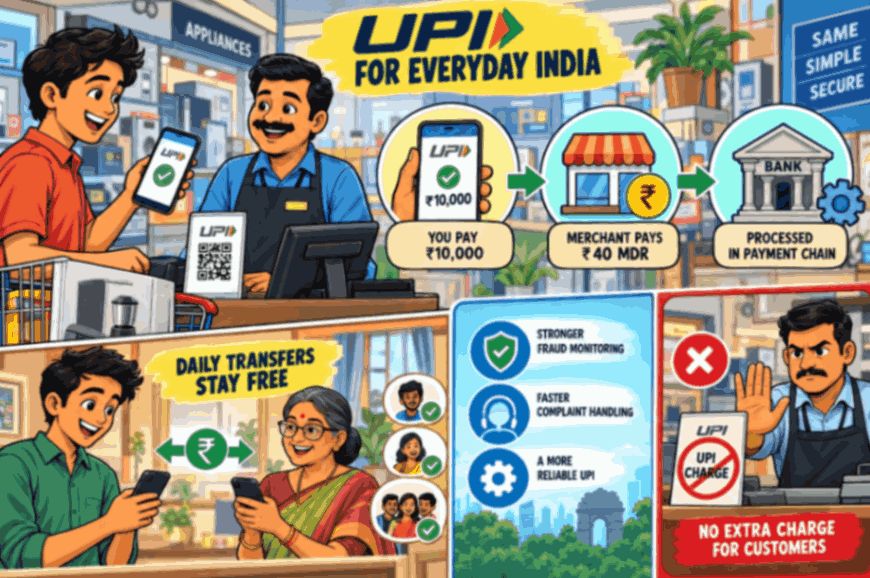
For an ordinary customer, the payment screen should look the same. A buyer purchasing an appliance for ₹10,000 will approve a ₹10,000 UPI payment. The merchant will pay ₹40 as MDR within the payment chain. The customer should not see ₹40 added to the bill, and UPI applications cannot introduce a platform fee or hidden payment charge.
Daily transfers also stay untouched. Sending money to parents, paying a friend, splitting a restaurant bill or moving funds between personal bank accounts will remain free. The amount does not change that rule. Government analysis says about 96% of P2M transactions will remain outside MDR because they are within ₹2,000 or covered by small-merchant protection.
The positive side is easy to miss. A customer still gets instant bank-to-bank payments without paying a user fee, while payment companies receive revenue from a narrow commercial category. That money can support fraud monitoring and faster complaint handling. The risk appears when a merchant quietly adds a “UPI charge” at checkout, which the framework does not permit.
NPCI says UPI needs regular investment in server capacity, encryption, fraud detection and customer support. Its policy document dated 15 September records 2,451 crore transactions worth ₹29.9 lakh crore in August 2026. Such volume creates a daily workload for banks, payment service providers and apps, even when the user pays nothing.
Pine Labs chief executive Amrish Rau backed MDR as a funding route for technology, reliability and fraud prevention in comments reported on 15 September. Congress leader Rahul Gandhi raised the opposite concern. He argued that businesses could shift the expense to buyers through prices or surcharges.
Banks can deal with that concern through basic checks. Merchant statements should identify each deduction, while payment apps should allow buyers to report a separate UPI fee from the transaction page. Acquiring banks can also warn merchants that MDR forms part of their payment-acceptance expense and cannot appear as an extra customer charge.
LoansJagat views the likely customer impact as indirect rather than immediate. Large sellers may trim payment offers before risking a visible surcharge that buyers could dispute. Small businesses crossing the P2PM limit may face tighter margins on high-ticket sales, so their banks must explain the account reclassification before deductions begin.
Also Read: Hero Motors IPO
The ₹2,000 figure does not decide every case by itself. The receiver’s merchant category, payment type and account classification also affect the charge. A local vendor operating under P2PM protection can receive a payment above ₹2,000 without automatically entering the 0.4% bracket.
The following table reflects the official MDR FAQs issued on 15 September 2026.
MDR is not a tax collected by the government or NPCI. Banks, payment service providers and application operators share the charge for processing and maintaining the payment service. The buyer does not pay it.
Education payments fall under a specialised category. The official document refers to flat or capped charges for school fees, university payments and entrance examinations, but it does not give a single rate for every institution. Schools and colleges should follow the category instructions sent by their acquiring banks.
Street vendors and neighbourhood shops can operate under the Person-to-Person-Merchant category. A qualifying vendor receiving up to ₹1 lakh per month through UPI QR codes will continue with zero MDR. A single receipt above ₹2,000 does not remove that protection.
Banks and payment providers will monitor inward credits. If UPI receipts cross ₹1 lakh per month for 3 consecutive months, they can move the account into the regular P2M category. The merchant would then pay 0.4% on eligible payments above ₹2,000.
GST registration does not decide whether a small merchant receives P2PM protection. Existing QR stands and soundboxes will also continue working. Vendors do not need to replace them or visit a bank branch merely because the MDR framework has changed.
India made MDR zero on RuPay debit cards and BHIM-UPI payments in January 2020 through changes to Section 10A of the Payment and Settlement Systems Act, 2007, and Section 269SU of the Income-tax Act, 1961. Merchants could accept bank-linked UPI payments without losing a part of each sale.
The government later funded payment participants through incentives. On 19 March 2025, the Cabinet approved a ₹1,500 crore scheme for low-value BHIM-UPI payments during FY 2024-25. The programme offered a 0.15% incentive on eligible payments up to ₹2,000 received by small merchants. Payments above ₹2,000 still had zero MDR, though they received no incentive.
Parliament amended the payment law in August 2026. The change allowed the government to protect chosen electronic payment categories while permitting charges on others. A notification dated 14 September then protected RuPay debit-card transactions and UPI payments up to ₹2,000 from direct or indirect fees.
Public debate had begun before NPCI announced the final rate. A LoansJagat report dated 11 September 2026 covered Ashok Lahiri’s view that UPI could not stay free forever. The final 0.4% rate, ₹300 ceiling and 15 October implementation date had not been released when he spoke.
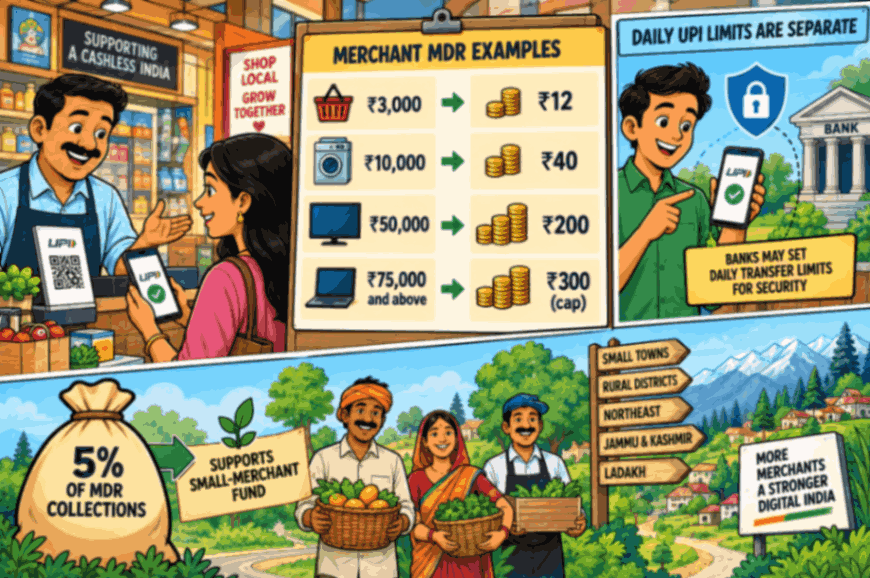
A general merchant will pay ₹12 on a ₹3,000 transaction, ₹40 on ₹10,000 and ₹200 on ₹50,000. A payment of ₹75,000 reaches the ₹300 ceiling. A ₹1 lakh transaction also carries ₹300 rather than ₹400.
Daily UPI limits are separate from MDR. Banks may restrict the amount a customer can transfer each day as part of fraud controls. Those limits do not create a customer charging tier.
An amount equal to 5% of total MDR collections will support a dedicated small-merchant fund. The money is intended for merchant onboarding and payment expansion in smaller towns, rural districts, the Northeast, Jammu and Kashmir, and Ladakh.
The 15 October framework keeps UPI free for customers while introducing a limited merchant-funded model. Regular P2M establishments will pay 0.4% above ₹2,000, essential sectors receive lower charges, and small vendors retain protection.
Enforcement will decide how buyers experience the change. Banks must stop separate UPI surcharges, explain merchant classifications before deductions begin and provide a simple complaint path when a checkout price changes because of the payment mode.
MDR is the processing charge paid by a merchant for accepting an eligible digital payment. From 15 October, the general UPI rate will be 0.4% above ₹2,000, capped at ₹300.
No. The customer should pay only ₹5,000. The general merchant pays ₹20 as MDR within the payment system and cannot add it as a separate UPI fee.
No. UPI apps cannot impose platform fees or hidden charges on ordinary UPI payments. P2P transfers and the customer side of merchant payments remain free.
Merchants cannot add MDR to a UPI bill, though some may revise general prices or reduce offers. Banks should investigate visible UPI surcharges.
No, if the vendor remains in the eligible P2PM category. Monthly QR receipts and account classification decide the exemption, not 1 unusually large payment.









.png&w=3840&q=75)


