

By continuing, you agree to LoansJagat's Credit Report Terms of Use, Terms and Conditions, Privacy Policy, and authorize contact via Call, SMS, Email, or WhatsApp
Disclaimer: The information published on LoansJagat is intended for general informational and educational purposes only and should not be considered financial, legal, or investment advice. Interest rates, loan terms, statistics, and other data may change over time and may vary by lender or source. Please verify the latest information and consult a qualified financial advisor or the respective Bank/NBFC before making any financial decisions.
Subscribe Now
About the author

Arshathul Afia
Arshathul Afia is a journalism graduate and fintech content writer with 4+ years of experience in digital publishing and research-led writing. She has written 200+ articles covering personal finance, lending, banking, digital payments, credit, insurance, and major financial developments in India. At LoansJagat, she focuses on simplifying complex fintech news, RBI updates, loan-related changes, policy developments, and industry trends for everyday readers. Her journalism background helps her approach stories with research, context, and clarity, while her SEO experience ensures content remains discoverable and relevant. She aims to make financial news easier to understand, practical, and useful for readers across India.
Related News
Simplify All Your Loans Into One Affordable EMI

Customers Served

Debt Consolidated

1200+ Reviews

Locations in India
Club all Loans & Credit Card Bills into Single EMI

Quick Apply Loan
Consolidate your debts into one easy EMI.

Takes less than 2 minutes. No paperwork.

10 Lakhs+
Trusted Customers

2000 Cr+
Loans Disbursed

4.7/5
Google Reviews

50+
Banks & NBFCs Offers
Other services mentioned in this article
A proposed payment law change has revived the UPI MDR debate, though regular users and small merchants still face no new UPI charge today right now.
UPI charges have not returned for normal users, but the MDR debate has opened again after proposed payment-law changes raised the possibility of merchant-side fees on select digital transactions. The issue involves the centre, banks, payment firms, merchants and UPI users across India. The concern is mostly around higher-value merchant payments, not daily person-to-person transfers or small QR payments at local shops.
The short-term impact is confusion. A buyer paying through a QR code may worry about extra charges, while a shopkeeper may not know whether to accept UPI for larger bills. In the long run, a fee on large merchants could change discounts, payment offers or checkout behaviour. The negative side is public fear. UPI grew because it felt simple, instant and free for everyday use. Any unclear fee rule can hurt that habit.
The latest debate started after reports said a proposed payment-law change could allow the government to bring back MDR on selected digital payments. MDR means Merchant Discount Rate, a fee paid by a merchant for accepting digital payments through banks or payment processors. In UPI’s current standard form, that merchant fee is zero.
The key point is simple. No new customer charge has been announced for regular UPI users. A person paying a vegetable seller, cab driver, chemist or small restaurant through UPI is not facing a fresh fee today. The debate is mainly about whether large merchants should pay a small processing cost on higher-value UPI payments in the future.
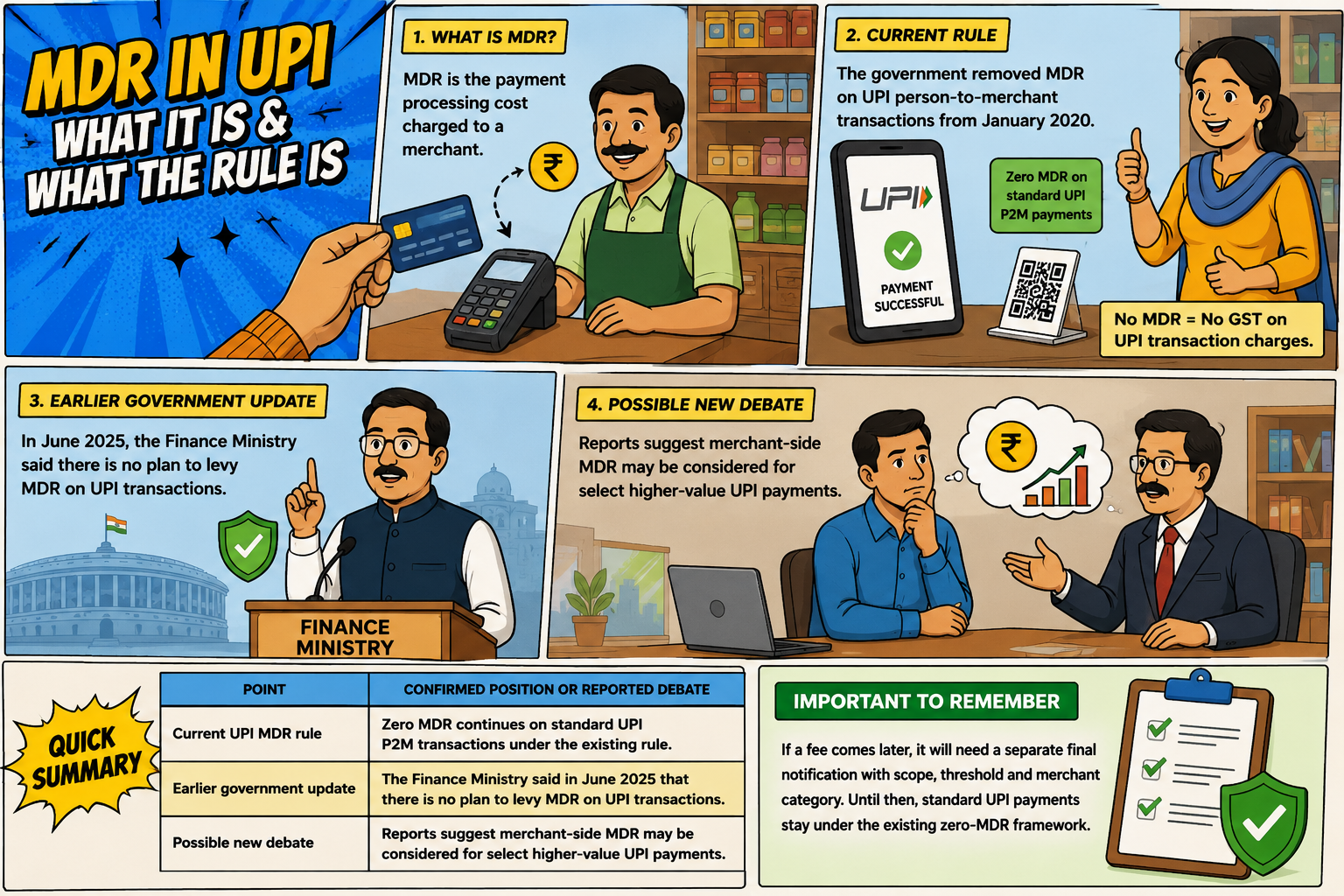
MDR is the payment processing cost charged to a merchant. In card payments, many businesses already know this cost. In UPI, the government removed MDR on person-to-merchant transactions from January 2020 to support digital payments across India.
The current rule keeps standard UPI P2M payments under zero MDR. A PIB Ministry of Finance release dated April 18, 2025, said MDR on UPI P2M transactions was removed from January 2020. The same release also said GST does not apply to such UPI transaction charges because no MDR is charged on UPI.
That is the rule users should remember. If a fee comes later, it will need a separate final notification with scope, threshold and merchant category. Until then, standard UPI payments stay under the existing zero-MDR framework.
A quick look at the official position and recent debate helps separate confirmed facts from speculation.
The table shows why readers should not treat the headline as a direct fee warning for every UPI user. The current rule and the possible future debate are 2 different things.
For most Indians, nothing changes immediately. A student paying for food, a family buying medicines, a customer paying a plumber or a worker sending money home through UPI should see the same payment flow. No extra charge has been noted for normal UPI use.
The concern may arise in larger payments. If MDR is allowed for big merchants, large retailers, online platforms, hospitals, electronics stores and branded outlets may review payment offers. Some may absorb the cost. Some may reduce cashback. A few may push users towards cards, wallets or net banking. That would not be a direct UPI user charge, but the cost can still travel through pricing and offers.
Payment companies and banks have often argued that digital payment systems need money for technology, fraud checks, uptime, customer support and settlement infrastructure. Their argument is that zero MDR gives users free payments but leaves payment firms with limited income from UPI transactions.
Users and small merchants look at it differently. For them, UPI works because it is quick and cost-free. A tea seller or street vendor cannot negotiate payment costs like a large retailer. That difference should guide the rule. A fair solution would keep person-to-person transfers free, protect small merchants, cap any fee for large businesses, and stop shops from adding a separate UPI charge to the bill.
The previous public update was firm. Akashvani News reported on June 12, 2025, that the Finance Ministry had called claims about MDR on UPI transactions false, baseless and misleading. It also said the government remained committed to promoting UPI-led digital payments.
Before this fresh debate, the government had supported the payment ecosystem through incentives instead of merchant charges. A PIB Cabinet release dated March 24, 2025,said the centre approved a ₹1,500 crore incentive scheme for FY 2024-25 for low-value BHIM-UPI P2M transactions. It covered eligible small-merchant payments up to ₹2,000 and gave a 0.15% incentive while keeping zero MDR.
For borrowers, the direct loan impact is limited. A personal loan EMI, home loan EMI or credit repayment does not become costlier only because MDR is discussed for merchant UPI transactions. That link is often misunderstood.
The indirect impact may show up in bill payments and online purchases. If large merchants lose zero-cost payment acceptance on some UPI payments, they may reduce payment-linked offers. A borrower using UPI for utility bills, insurance renewal, education fees or online shopping may see fewer discounts in some cases. That is why LoansJagat’s view is useful here: the final notification must define merchant size, payment value and user protection in plain terms, not leave it vague for checkout counters.
The government has to protect UPI adoption while also keeping the payment network financially workable. India’s QR payment culture depends on trust. If users hear that UPI is becoming chargeable, many may wrongly shift back to cash for bigger payments.
At the same time, banks and payment processors cannot run large payment rails without cost. Fraud checks, technical upgrades, settlements, bank integrations and dispute handling require money. The better route would be targeted pricing, not a broad charge. Small sellers should stay protected. Regular users should not face a payment-screen shock. Large merchants can carry more responsibility if the final rule is narrow.
UPI MDR has not returned for normal users. The current rule still keeps standard UPI P2M transactions under zero MDR, and daily QR payments continue as before. The new debate is about a possible future fee for selected merchant payments, mainly where large businesses and higher-value transactions are involved.
The final test will be the wording of the rule, if the government brings one. It should protect regular users, small merchants and low-value payments first. UPI became a daily habit because it was simple and free at the counter. Any MDR comeback has to keep that trust intact.
No. Standard UPI P2M payments remain under zero MDR as of August 5, 2026.
No final rule has added charges for regular users paying through standard UPI apps.
MDR is a merchant-side fee paid for accepting digital payments through a payment network.
Shops should not add extra UPI fees unless a final rule permits any recovery method.
UPI payments are better than the older payment model because they move money instantly from one bank account to another without cash, card machines or long bank details. A user only needs a mobile number, QR code or UPI ID. For small shops, this cuts the need for loose change and card terminals. For customers, it makes daily payments faster, traceable and easier to manage.









.png&w=3840&q=75)


