By continuing, you agree to LoansJagat's Credit Report Terms of Use, Terms and Conditions, Privacy Policy, and authorize contact via Call, SMS, Email, or WhatsApp
Disclaimer: The information published on LoansJagat is intended for general informational and educational purposes only and should not be considered financial, legal, or investment advice. Interest rates, loan terms, statistics, and other data may change over time and may vary by lender or source. Please verify the latest information and consult a qualified financial advisor or the respective Bank/NBFC before making any financial decisions.
Subscribe Now
About the author

Arshathul Afia
Arshathul Afia is a journalism graduate and fintech content writer with 4+ years of experience in digital publishing and research-led writing. She has written 200+ articles covering personal finance, lending, banking, digital payments, credit, insurance, and major financial developments in India. At LoansJagat, she focuses on simplifying complex fintech news, RBI updates, loan-related changes, policy developments, and industry trends for everyday readers. Her journalism background helps her approach stories with research, context, and clarity, while her SEO experience ensures content remains discoverable and relevant. She aims to make financial news easier to understand, practical, and useful for readers across India.
Related News
Simplify All Your Loans Into One Affordable EMI

Customers Served

Debt Consolidated

1200+ Reviews

Locations in India
Club all Loans & Credit Card Bills into Single EMI

Quick Apply Loan
Consolidate your debts into one easy EMI.

Takes less than 2 minutes. No paperwork.

10 Lakhs+
Trusted Customers

2000 Cr+
Loans Disbursed

4.7/5
Google Reviews

50+
Banks & NBFCs Offers
Other services mentioned in this article
The Centre may restore UPI MDR for large merchants on payments above ₹2,000, potentially raising business costs while keeping customers and small sellers largely protected.
Key Highlights
The Centre is considering bringing back the Merchant Discount Rate, or MDR, on UPI payments received by large businesses across India. The Economic Times reported on 16 July 2026 that the proposal was in its final stages and awaiting government approval. Businesses with an annual turnover of around ₹1 crore to ₹1.5 crore could be covered when an individual merchant payment crosses ₹2,000. The reported MDR range is 5 to 7 basis points, or 0.05% to 0.07%.
The proposal does not introduce a confirmed customer charge. Large retailers, hospitals, airlines, hotels and online sellers may pay the fee as a processing expense. Over the next few months, such businesses could review discounts or payment offers. Over a longer period, MDR revenue may help banks and payment companies pay for transaction processing, fraud checks, settlements and complaint handling.
Most customers may not notice an immediate change while scanning a QR code. The reported plan places the fee on the business receiving the payment. Person-to-person transfers, payments to small sellers and everyday low-value purchases are expected to remain outside the proposed charge.
The indirect effect needs closer attention. A hotel could absorb the fee without changing its room rate. An online seller may reduce a UPI discount. A large electronics shop could revise prices across all payment modes rather than show a separate charge. Customers would not see MDR on the payment screen, but they could still pay through smaller discounts or revised prices.
There are possible benefits for users, too. Payment companies spend money every time a transaction passes through bank servers, security systems and settlement channels. A limited merchant fee may support faster complaint handling, better fraud screening and fewer payment failures. That benefit depends on how the revenue is used.
Small merchants require protection. A tea stall, local grocery shop or roadside vendor often accepts hundreds of small UPI payments during a working day. Even a tiny fee on each payment can reduce earnings. Keeping such sellers outside MDR may prevent them from asking customers to pay in cash.
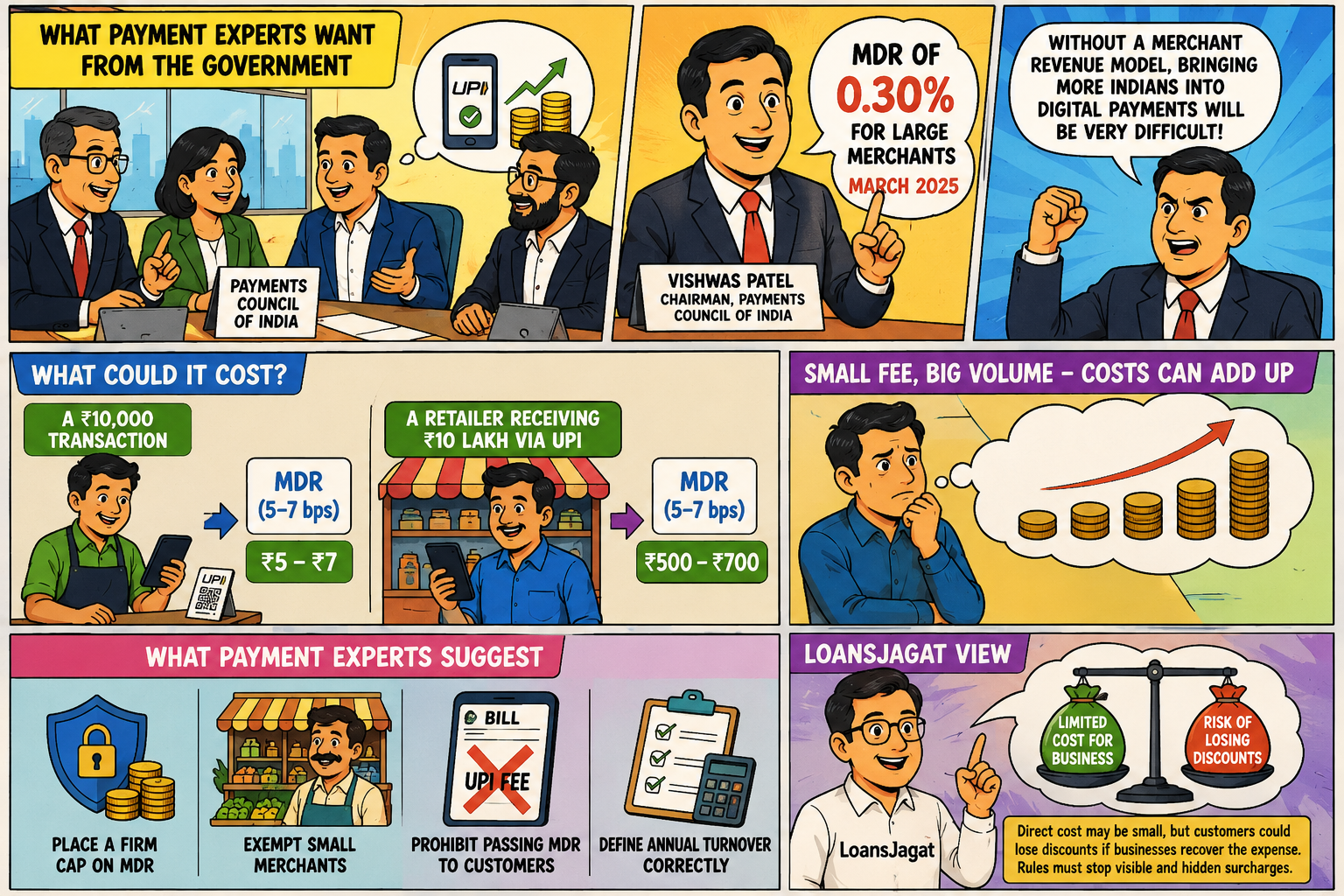
Payment companies have asked the government for a revenue route on large commercial transactions. The Payments Council of India proposed a 0.30% MDR for large merchants in March 2025. Vishwas Patel, Chairman of the council, later said that bringing more Indians into digital payments would become difficult without a merchant revenue model.
The rate reported in July 2026 is much lower. At 5 to 7 basis points, a qualifying ₹10,000 transaction would cost the merchant ₹5 to ₹7. A retailer receiving ₹10 lakh through eligible UPI payments would pay between ₹500 and ₹700. The expense appears small per transaction, though it can accumulate for businesses processing thousands of payments.
A useful solution would place a firm cap on MDR, exempt smaller sellers and prohibit merchants from adding a separate UPI fee to customer bills. The government must also define annual turnover properly. Total business sales and UPI receipts are different figures, and using the wrong test could bring smaller establishments into the paid category.
A LoansJagat explanation of Merchant Discount Rate describes MDR as a charge paid by merchants to payment service participants. LoansJagat’s analysis is that the direct cost may remain limited for each sale, but consumers could lose discounts when large businesses try to recover the expense. A rule preventing visible and hidden customer surcharges would reduce that risk.
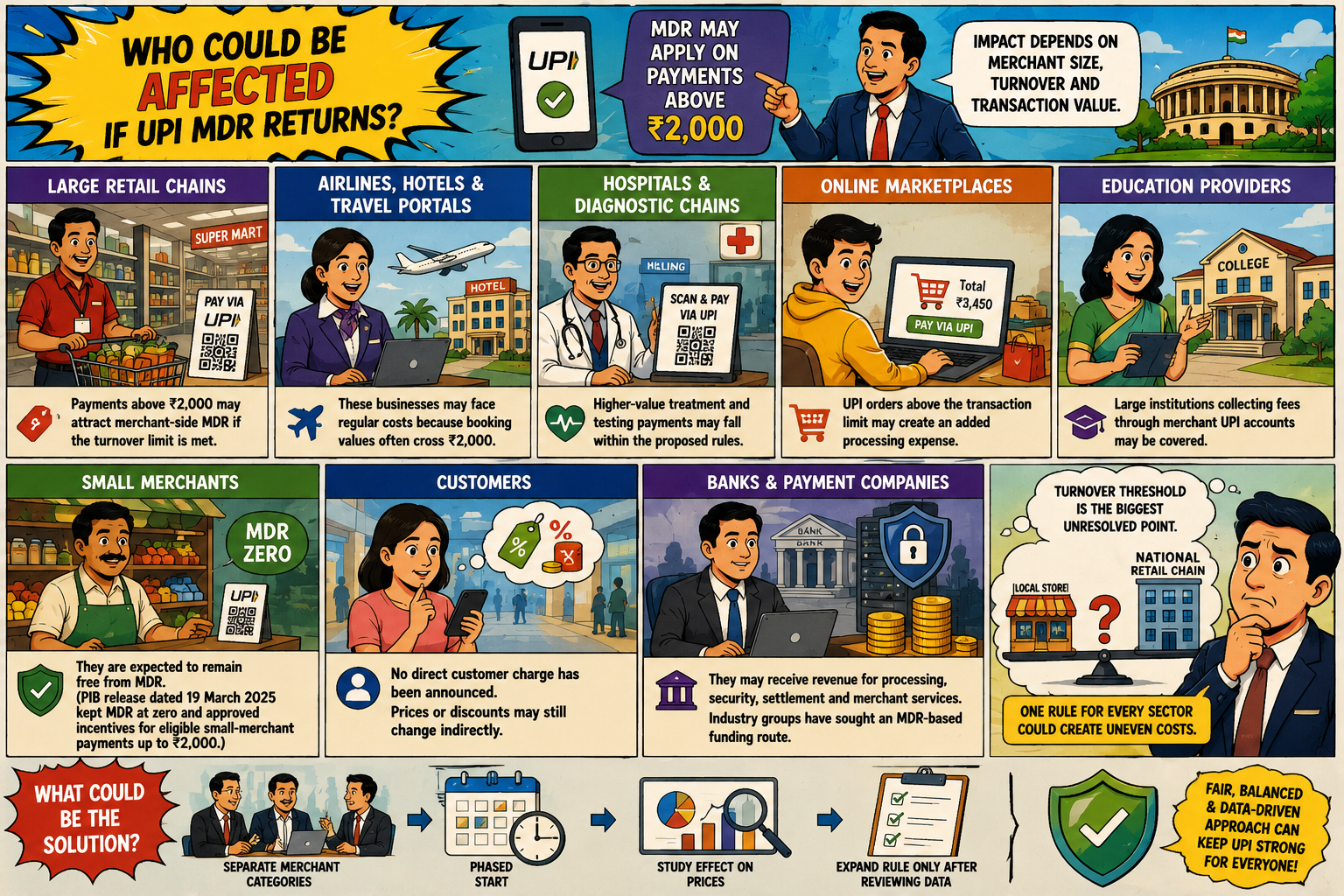
The proposal does not affect every UPI payment in the same way. The merchant’s size, annual turnover and transaction value may decide whether MDR applies.
The table explains the likely impact based on the proposal reported on 16 July 2026 and the existing government policy for low-value merchant payments.
The turnover threshold remains one of the largest unresolved points. A business earning ₹1 crore in yearly sales may not have the same profits as a national retail chain. Healthcare, grocery and travel companies also operate with different margins. One turnover rule for every sector could create uneven costs.
The government could address this through separate merchant categories or a phased start. It could first cover the largest enterprises, study the effect on prices and expand the rule only after reviewing transaction data.
The government removed MDR on prescribed UPI and RuPay debit card payments from January 2020. Instead of charging merchants, it began supporting payment participants through incentive schemes. The policy helped small sellers accept QR payments without losing part of each sale.
On 19 March 2025, the Union Cabinet approved a ₹1,500 crore scheme for low-value person-to-merchant UPI transactions during FY 2024-25. It offered a 0.15% incentive on eligible payments of up to ₹2,000 received by small merchants. Large merchants received no incentive, though their UPI MDR also remained zero.
Payment companies continued to seek a separate fee for large businesses. Reuters reported on 29 April 2025 that an MDR of 0.20% to 0.30% had been suggested for large-merchant UPI payments. The Payments Council of India also wrote to the Prime Minister’s Office seeking a 0.30% rate.
Fresh reports appeared in June 2025, suggesting MDR could apply to higher-value UPI payments. The Finance Ministry rejected those claims. An Akashvani News report published on 12 June 2025 at 7:43 AM quoted the ministry as calling the speculation false, baseless and misleading.
The July 2026 proposal is therefore a new policy discussion. The earlier denial applied to reports circulating in June 2025. It does not confirm or reject the plan now awaiting approval.
UPI now handles both tiny retail payments and high-value commercial transactions. A Press Information Bureau release published on 30 April 2026, Release ID 2257087, said UPI processed 24,162 crore transactions in FY 2025-26. It also found that 86% of merchant transactions were below ₹500.
That transaction pattern supports a graded fee. Most everyday purchases happen far below the reported ₹2,000 cut-off. A charge aimed at large merchants and higher-value bills could produce industry revenue while leaving routine QR payments untouched.
The risk lies in classification. A small restaurant could cross the turnover limit without earning high profits. A hospital may process large payments because medical bills are expensive, not because its margins are wide. The final policy must account for these differences before imposing one charge across sectors.
The Economic Times reported on 16 July 2026 that 3 people aware of the discussions confirmed active examination of MDR for large merchants. One person said industry participants had made several representations due to the growing volume of digital payments. The report added that smaller sellers and payments below the selected limit would probably remain exempt.
Industry representatives argue that zero MDR gives payment companies little direct income from UPI processing. Banks, acquiring institutions and app providers still pay for technology, staff, cybersecurity and dispute services. They want large businesses to contribute a small amount towards those expenses.
Merchants may raise different concerns. Retailers could object to a turnover threshold that ignores profitability. Hospitals and education providers may seek sector-specific relief. E-commerce companies may ask for one rate across payment apps so that customers are not pushed towards a particular platform.
For customers, the strongest safeguard would be a written ban on passing MDR directly or indirectly through a separate UPI charge. The government could also require businesses to display the same product price across UPI, cash and debit card payments.
The possible return of UPI MDR does not mean every QR payment will carry a fee. The proposal reported in July 2026 targets large merchants, possibly those with annual turnover above ₹1 crore to ₹1.5 crore, when payments cross ₹2,000.
Customers and small sellers are expected to remain protected. Still, indirect costs may appear if large businesses reduce offers or revise prices.
The final notification must answer 4 points: who qualifies as a large merchant, which payments attract MDR, what maximum rate applies and whether businesses can recover the charge from customers. Until the government publishes those rules, the 5 to 7 basis-point rate remains a proposal, not an active UPI fee.
What is UPI MDR?
UPI MDR is a processing fee paid by a merchant to banks and payment service participants.
Has the government introduced UPI MDR?
No. The government is examining the proposal, but no final notification has been issued.
Will customers pay a fee on UPI payments?
No direct customer fee has been proposed. Businesses may still review prices or payment discounts.
Which merchants may have to pay MDR?
Reports point to businesses with ₹1 crore to ₹1.5 crore annual turnover receiving payments above ₹2,000.
Will small shops have to pay UPI MDR?
Small merchants are expected to remain exempt, particularly for routine low-value person-to-merchant payments.
What could the UPI MDR rate be?
The reported rate is 5 to 7 basis points, equal to 0.05% to 0.07%.










.png&w=3840&q=75)


