
By continuing, you agree to LoansJagat's Credit Report Terms of Use, Terms and Conditions, Privacy Policy, and authorize contact via Call, SMS, Email, or WhatsApp
Disclaimer: The information published on LoansJagat is intended for general informational and educational purposes only and should not be considered financial, legal, or investment advice. Interest rates, loan terms, statistics, and other data may change over time and may vary by lender or source. Please verify the latest information and consult a qualified financial advisor or the respective Bank/NBFC before making any financial decisions.
Subscribe Now
About the author

Arshathul Afia
Arshathul Afia is a journalism graduate and fintech content writer with 4+ years of experience in digital publishing and research-led writing. She has written 200+ articles covering personal finance, lending, banking, digital payments, credit, insurance, and major financial developments in India. At LoansJagat, she focuses on simplifying complex fintech news, RBI updates, loan-related changes, policy developments, and industry trends for everyday readers. Her journalism background helps her approach stories with research, context, and clarity, while her SEO experience ensures content remains discoverable and relevant. She aims to make financial news easier to understand, practical, and useful for readers across India.
Related News
Simplify All Your Loans Into One Affordable EMI

Customers Served

Debt Consolidated

1200+ Reviews

Locations in India
Club all Loans & Credit Card Bills into Single EMI

Quick Apply Loan
Consolidate your debts into one easy EMI.

Takes less than 2 minutes. No paperwork.

10 Lakhs+
Trusted Customers

2000 Cr+
Loans Disbursed

4.7/5
Google Reviews

50+
Banks & NBFCs Offers
From 15 October 2026, selected UPI merchant payments above ₹2,000 face 0.4% MDR, while customers, P2P transfers and most merchant transactions remain free across India.
India’s UPI payment rules change on 15 October 2026, but ordinary users are not getting a new transaction fee. The new framework introduces a 0.4% Merchant Discount Rate, or MDR, on specified person-to-merchant payments above ₹2,000. The merchant side pays it. P2P transfers remain free, merchant payments up to ₹2,000 stay outside the new charge, and about 96% of P2M transactions are expected to remain unaffected, according to the official Finance Ministry release dated 15 September 2026.
For a buyer, a ₹10,000 standard bank-account UPI purchase should still debit ₹10,000. The ₹40 MDR belongs on the merchant side in a standard eligible transaction. The possible longer-term effect is indirect. Larger businesses may review discounts or offers as payment acceptance becomes costlier. Customers can also continue to see convenience, booking or service fees at checkout, but those are separate from the new UPI MDR.
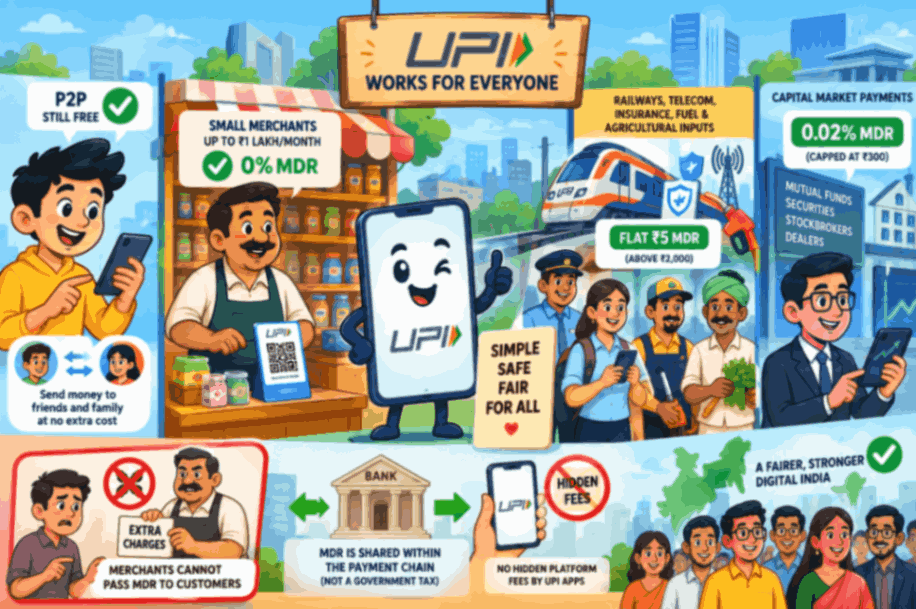
MDR is shared inside the merchant-payment chain and is not a tax collected by the government. Banks have been advised to stop merchants from passing it directly to customers. UPI app providers are also prohibited from adding hidden platform fees under this framework. Individuals continue to have free P2P use without a monthly quota tied to the MDR framework.
Small merchants get extra protection. Businesses receiving up to ₹1 lakh a month through qualifying UPI QR transactions under the P2PM category continue with 0% MDR. Railways, telecom, insurance, fuel and agricultural inputs face a flat ₹5 MDR on eligible payments above ₹2,000. Capital-market payments covering mutual funds, securities, stockbrokers and dealers attract 0.02%, capped at ₹300. The same 15 September official release sets out these rates.
PhonePe founder and CEO Sameer Nigam said on 16 September that around 96% of transactions would remain free and argued that limited MDR on larger merchant payments could help payment companies recover operating costs and continue investing in UPI. His argument centres on charging a relatively small portion of merchant payments while routine payments stay outside the fee.
Zerodha founder Nithin Kamath raised a different issue for brokers. He said a broker may incur a UPI cost when a client moves money into a trading account even if no trade follows. Unused funds can create another cost issue when money moves back and later returns to the account. For households, the response is simpler: compare the bill with the final payable amount and read the label beside any extra fee before approval.
MDR alone cannot tell a customer which method costs less. Credit cards also carry merchant acceptance costs, yet the buyer may see no separate MDR line. A platform may instead add a convenience fee. Net banking can be free in one payment flow and carry a fixed checkout fee somewhere else.
The official railway booking payment schedule shows this difference in a real payment flow. Several listed options show NIL for regular UPI. The same schedule lists ₹10 plus applicable taxes for net-banking transactions under several providers, while domestic credit-card charges can be percentage-based. Those are charges for that booking system, not standard rates for every merchant in India.
The final screen can therefore tell a customer more than the payment logo. One merchant may absorb processing costs while another adds a booking fee across several methods.
LoansJagat had flagged this distinction before the final September rate was announced. Its earlier analysis said customers were more likely to feel merchant costs indirectly through fewer offers, lower cashback or revised pricing than through a government-imposed UPI user fee. That view remains useful after the October framework: compare the final amount paid, not just the headline MDR.
A convenience fee and MDR are different. MDR belongs to the merchant-payment arrangement. A convenience fee may be charged by a booking or service platform under its own disclosed terms. A customer can therefore choose UPI, pay no direct UPI transaction fee, and still see a separate service charge.
For example, if a ₹2,500 booking becomes ₹2,520 on the last screen, the added ₹20 needs to be read for what it is. If the platform calls it a booking or convenience fee, that does not make it the new 0.4% UPI MDR. The government has said app providers cannot impose hidden UPI charges under the new framework.
The new framework follows more than 6 years of 0% MDR treatment for prescribed UPI merchant payments. A government clarification published on 18 April 2025 referred to the Gazette Notification dated 30 December 2019, under which MDR on prescribed P2M UPI payments was removed from January 2020. That policy lowered merchant acceptance costs as QR payments spread.
The next major update came on 8 August 2026. The government said consumers would continue to face no UPI transaction charge, P2P transfers would stay free, and any future MDR would cover only a limited set of merchant payments above a threshold. Parliament had also passed the Taxation and Other Laws (Amendment) Bill, 2026, creating the legal route for a selective framework.
On 15 September, the 0.4% MDR structure was announced ahead of its 15 October start. An official government news bulletin published on 15 September 2026 separately confirmed that P2P transactions would remain free regardless of value and that small merchants within the protected category would retain 0% MDR.
LoansJagat’s August coverage belongs to the earlier stage of that story, when a merchant fee was still being discussed rather than fixed at 0.4%. The position is now different. The ₹2,000 threshold, ₹300 cap and lower rates for specified categories have been announced.
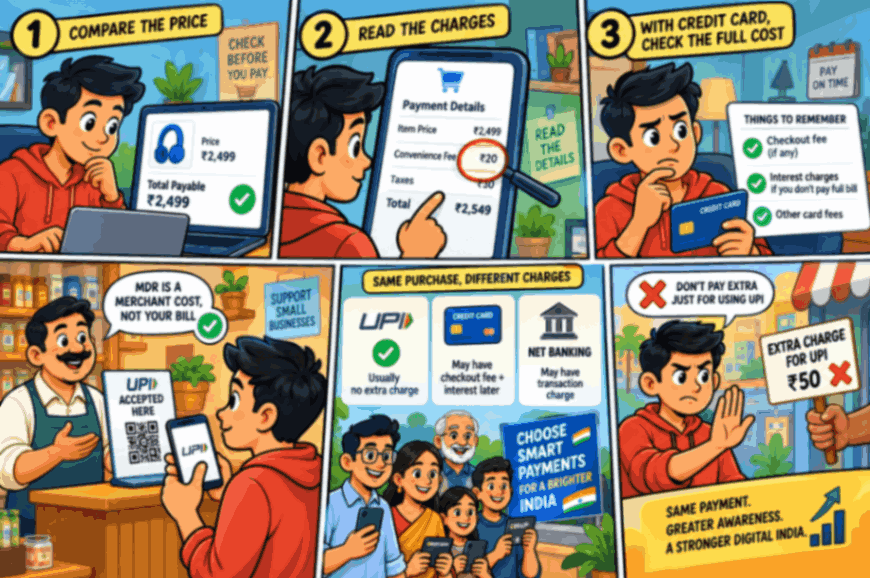
A buyer can make 3 quick checks. First, compare the original price with the last payable amount. Second, read the description of any additional charge. Third, where a credit card is used, separate a checkout fee from the later cost of borrowing. A card purchase may show no extra transaction charge and still become expensive if the outstanding balance attracts finance charges.
Customers should also avoid treating every merchant processing cost as their own bill. Under the announced UPI framework, the new MDR belongs on the merchant side. If a seller asks for extra money merely for accepting UPI, the buyer should ask what the charge represents before paying. The same approach helps when comparing card surcharges, booking fees and net-banking charges.
There is no single cheapest method at every checkout. Standard bank-account UPI stays a ₹0 direct transaction-fee option for customers under the 15 October framework, even where an eligible merchant pays 0.4% MDR. Credit cards may also show no direct payment fee, but separate convenience charges and borrowing costs can change the total. Net banking may carry no fee in one flow and a fixed gateway charge in another.
The useful comparison is the final amount shown before authorisation. UPI MDR, credit-card processing costs and net-banking checkout fees come from different parts of the payment chain. Reading that last line before paying can prevent a merchant charge from being mistaken for a customer fee.
No. The 0.4% MDR applies to specified merchant transactions above ₹2,000 and is borne on the merchant side. P2P transfers remain free.
No. In a standard eligible transaction, ₹40 represents the merchant-side MDR. The buyer’s UPI payment remains ₹10,000 unless a separate disclosed fee applies.
Yes, on some platforms. The official railway booking schedule lists NIL for regular UPI under several providers, while several net-banking options show ₹10 plus applicable taxes.
No. MDR is a merchant-payment cost. A convenience fee is a separate customer-facing charge connected to a booking or service and should be identified before payment.
For specified P2M payments under the new framework, the merchant side pays the MDR. A current Reddit discussion asks the same question because users often confuse merchant cost with the buyer’s debit.









.png&w=3840&q=75)


