
By continuing, you agree to LoansJagat's Credit Report Terms of Use, Terms and Conditions, Privacy Policy, and authorize contact via Call, SMS, Email, or WhatsApp
Disclaimer: The information published on LoansJagat is intended for general informational and educational purposes only and should not be considered financial, legal, or investment advice. Interest rates, loan terms, statistics, and other data may change over time and may vary by lender or source. Please verify the latest information and consult a qualified financial advisor or the respective Bank/NBFC before making any financial decisions.
Subscribe Now
About the author

Arshathul Afia
Arshathul Afia is a journalism graduate and fintech content writer with 4+ years of experience in digital publishing and research-led writing. She has written 200+ articles covering personal finance, lending, banking, digital payments, credit, insurance, and major financial developments in India. At LoansJagat, she focuses on simplifying complex fintech news, RBI updates, loan-related changes, policy developments, and industry trends for everyday readers. Her journalism background helps her approach stories with research, context, and clarity, while her SEO experience ensures content remains discoverable and relevant. She aims to make financial news easier to understand, practical, and useful for readers across India.
Related News
Simplify All Your Loans Into One Affordable EMI

Customers Served

Debt Consolidated

1200+ Reviews

Locations in India
Club all Loans & Credit Card Bills into Single EMI

Quick Apply Loan
Consolidate your debts into one easy EMI.

Takes less than 2 minutes. No paperwork.

10 Lakhs+
Trusted Customers

2000 Cr+
Loans Disbursed

4.7/5
Google Reviews

50+
Banks & NBFCs Offers
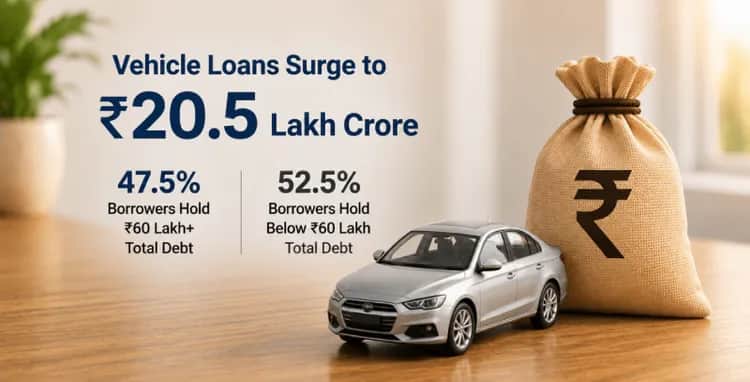
Vehicle borrowing has expanded across India, but rising total debt exposure now forces lenders and families to look beyond the affordability of 1 monthly EMI.
The expansion gives families and small businesses wider access to vehicles without an upfront cash purchase. The warning lies in the other loans attached to the same borrower. Several EMIs reduce the money left for household costs, while a job loss or medical bill can lead to missed dues and a damaged credit record.
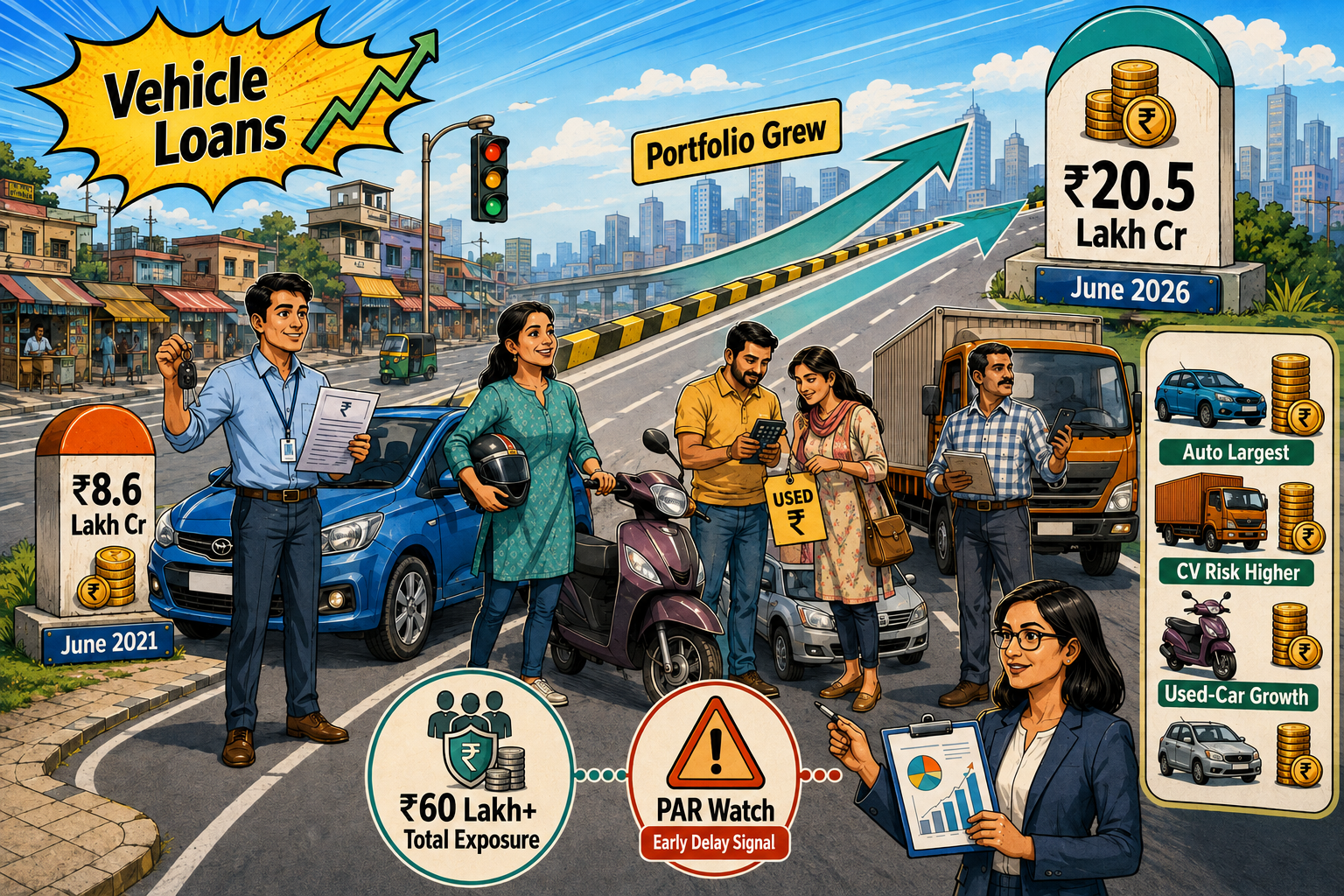
CRIF’s 4 reported categories rose from a combined ₹8.6 lakh crore in June 2021 to around ₹20.5 lakh crore in June 2026. Auto loans formed the largest part at ₹9.9 lakh crore, followed by commercial vehicle loans at ₹7.4 lakh crore. 2-wheeler loans stood at ₹1.9 lakh crore, while used-car loans reached ₹1.3 lakh crore.
Vehicle finance remained 11.4% of total retail credit in both 2021 and 2026. Vehicle loans grew quickly, but the wider retail-credit base expanded too. The sharper change happened inside the category, where used-car and commercial vehicle finance gained ground.
The central numbers are presented together below. They show portfolio growth and repayment risk, while avoiding the false claim that every high-exposure customer is struggling.
PAR 31 to 90 refers to loan amounts overdue for 31 to 90 days. It acts as an early warning, not a final default figure. Auto loans recorded a lower 2.1% in this bucket, while commercial vehicle loans showed the highest early delay at 4.1%. Later-stage repayment stress remained lower across the categories.
The ₹60 lakh figure needs careful reading. CRIF measured the borrower’s full retail exposure, which may include a home loan, personal loan, credit-card balance and more than 1 vehicle loan. It does not mean the car or bike loan itself is worth ₹60 lakh. Housing finance may account for a large share among borrowers who own property.
Consider a household with ₹42 lakh left on a home loan, an ₹8 lakh car loan, ₹6 lakh in personal credit and ₹4 lakh across other accounts. Its exposure reaches ₹60 lakh. A dual-income family may repay it comfortably, while the same total can strain 1 salary. Formal finance can still help a nurse, delivery worker or trader preserve working cash. Trouble begins when the showroom EMI excludes fuel, insurance, maintenance and existing dues.
Used-car finance grew from roughly ₹40,000 crore in June 2021 to ₹1.3 lakh crore in June 2026, a 26.2% CAGR. Its borrower base expanded 2.4 times. CRIF also found that 75% of recent used-car originations came from new-to-product customers. They were new to used-car loans, though many could already hold other forms of credit.
Price is one reason. A pre-owned car usually requires a smaller purchase budget than a new model, bringing more buyers within reach of an EMI. Formal dealers, digital vehicle checks and faster loan processing have also moved transactions away from cash and informal borrowing. The vehicle may be cheaper, but the finance does not always follow that pattern.
A previous LoansJagat comparison of used-car finance and new-car loans read the numbers from the borrower’s side. Its analysis found that a lower sticker price can still produce a costly loan after interest, fees, insurance and repairs. The useful test is total repayment against the vehicle’s likely working life, not merely this month’s instalment.
Risk has moved alongside growth. Used-car borrowers with at least 2 active loans within the segment increased from 4.8% to 6.7% over 5 years. Early-stage delinquency stood at 3.1%, while the 91-to-180-day bucket remained at 1%. At the same time, unsecured consumption-credit exposure among these borrowers fell from 10.8% in June 2024 to 9.2% in June 2026, suggesting more selective lending.
CRIF asked lenders to conduct deeper credit-bureau checks as multiple-loan borrowing increased. Its proposed response was more detailed screening by product, ticket size, location, repayment record and total exposure. A customer applying for a family car should not be assessed like a transport operator financing a third working vehicle. Their cash flows and reasons for borrowing differ.
ICRA’s January 14, 2026 thematic report reached a related view. It expected pre-owned assets to exceed 41% of NBFC vehicle-loan books by March 2027, compared with 34% in March 2020. The rating agency said used-vehicle asset quality remained weaker, although returns after adjusting for risk were healthy. It called for tighter asset-quality control as lenders moved further into pre-owned financing.
The fix starts before sanction. Lenders can verify active accounts, value an older vehicle conservatively and check whether income supports the combined EMI. Early contact after a missed payment may prevent a 31-day delay from becoming a longer default. Borrowers also need the final repayment amount, foreclosure charges and late-payment costs in writing.
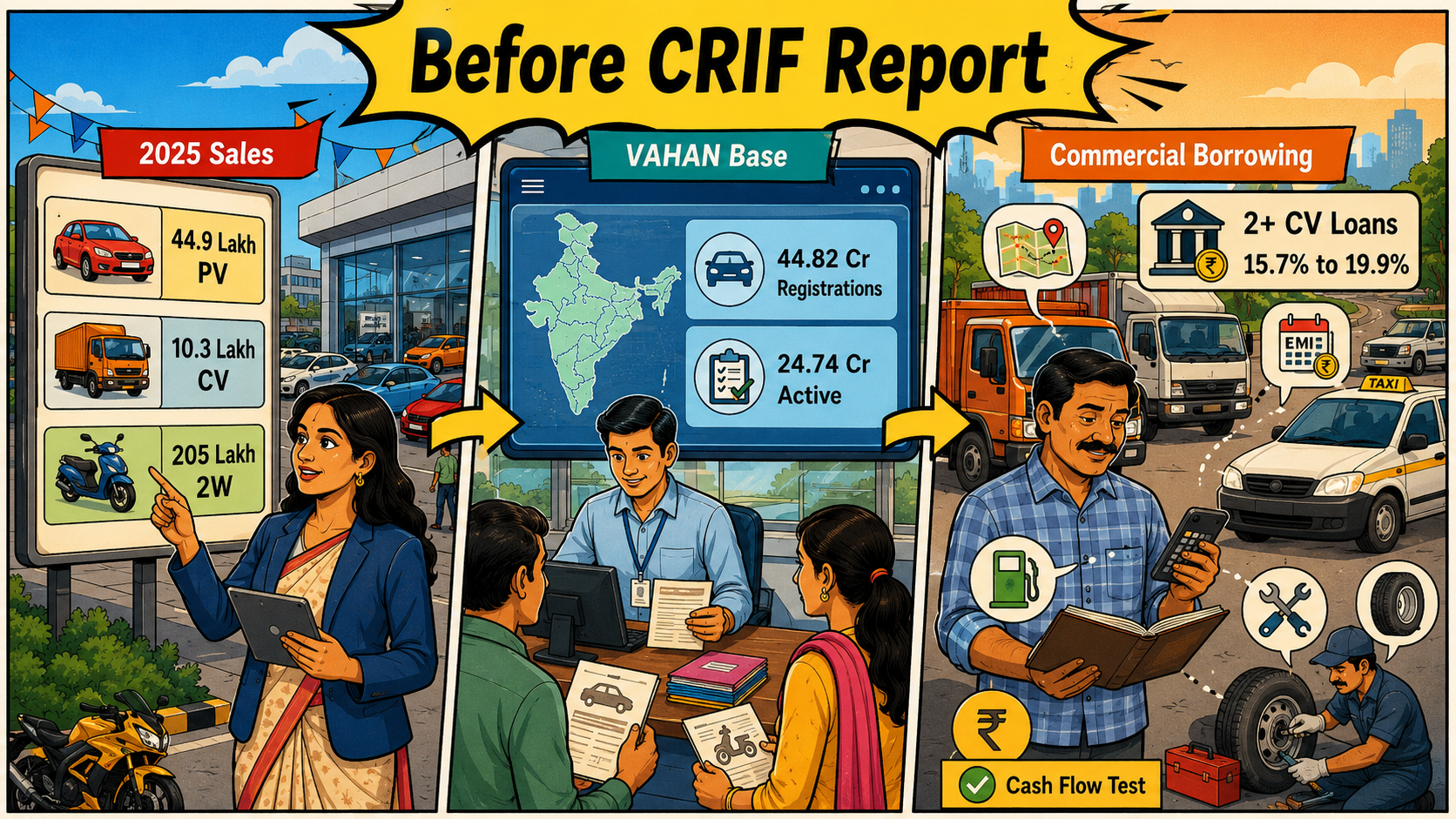
Vehicle demand had expanded before CRIF released its August findings. The Press Information Bureau published Ministry of Heavy Industries data on February 10, 2026, showing 44.9 lakh passenger vehicle sales, 10.3 lakh commercial vehicle sales and 205 lakh 2-wheeler sales during January to December 2025. The ministry attributed the figures to the Society of Indian Automobile Manufacturers.
The Ministry of Road Transport and Highways’ VAHAN public dashboard displayed 44.82 crore registrations and 24.74 crore active vehicle records when accessed on August 20, 2026. This base supports replacement purchases, used-car transfers, insurance and finance beyond the biggest cities.
Commercial borrowing had also widened. CRIF found that borrowers with at least 2 active commercial vehicle loans rose from 15.7% in June 2021 to 19.9% in June 2026. That figure cannot be read like household debt. A taxi owner or freight operator may finance several earning vehicles. The better test is whether route income, fuel costs, repairs and loan payments leave enough monthly cash.
The first step is to total every monthly repayment, including cards converted into EMIs. The next calculation should add fuel, annual insurance divided by 12, expected servicing and a repair allowance. A buyer who can pay the showroom EMI but cannot cover these running costs has chosen an unaffordable vehicle or an unsuitable tenure.
Used-car buyers need 2 extra checks. The loan should not run far beyond the vehicle’s dependable working years, and the financed value should match an independent inspection. A long tenure may make the monthly figure look lighter. It can also leave the buyer paying interest while facing major repair bills on an ageing car.
India’s ₹20.5 lakh crore vehicle-finance portfolio shows how strongly credit now supports personal travel, gig work and commercial transport. The growth has opened formal borrowing to more used-car and 2-wheeler buyers. It has also created a larger group of customers carrying several active obligations.
The 47.5% figure is a prompt for a complete affordability check, not proof that half of vehicle borrowers are in trouble. Income, assets, EMI burden and repayment history decide that. Families should price the full ownership cost, while lenders need to judge the borrower’s entire credit record before approving 1 more loan.
No. It includes total reported retail exposure, such as housing, personal, card and vehicle credit.
Used-car loans recorded the fastest 5-year growth at 26.2% between June 2021 and June 2026.
No. Repayment ability also depends on income, assets, existing EMIs and the borrower’s payment record.
It lowers the monthly instalment but raises total interest and can outlast the car’s dependable working period.
Yes. Every EMI and regular vehicle expense should be included before a buyer signs the new loan.









.png&w=3840&q=75)


