By continuing, you agree to LoansJagat's Credit Report Terms of Use, Terms and Conditions, Privacy Policy, and authorize contact via Call, SMS, Email, or WhatsApp
The information published on LoansJagat is intended for general informational and educational purposes only and should not be considered financial, legal, or investment advice. Interest rates, loan terms, statistics, and other data may change over time and may vary by lender or source. Please verify the latest information and consult a qualified financial advisor or the respective Bank/NBFC before making any financial decisions.
Subscribe Now
About the author

LoansJagat Team
‘Simplify Finance for Everyone.’ This is the common goal of our team, as we try to explain any topic with relatable examples. From personal to business finance, managing EMIs to becoming debt-free, we do extensive research on each and every parameter, so you don’t have to. Scroll up and have a look at what 15+ years of experience in the BFSI sector looks like.
Related News
Simplify All Your Loans Into One Affordable EMI

Customers Served

Debt Consolidated

1200+ Reviews

Locations in India
Club all Loans & Credit Card Bills into Single EMI

Quick Apply Loan
Consolidate your debts into one easy EMI.

Takes less than 2 minutes. No paperwork.

10 Lakhs+
Trusted Customers

2000 Cr+
Loans Disbursed

4.7/5
Google Reviews

50+
Banks & NBFCs Offers
Other services mentioned in this article
Key Takeaways
India’s banking sector has seen crises before. But every time a co-operative bank shuts its doors, the shock travels beyond balance sheets.
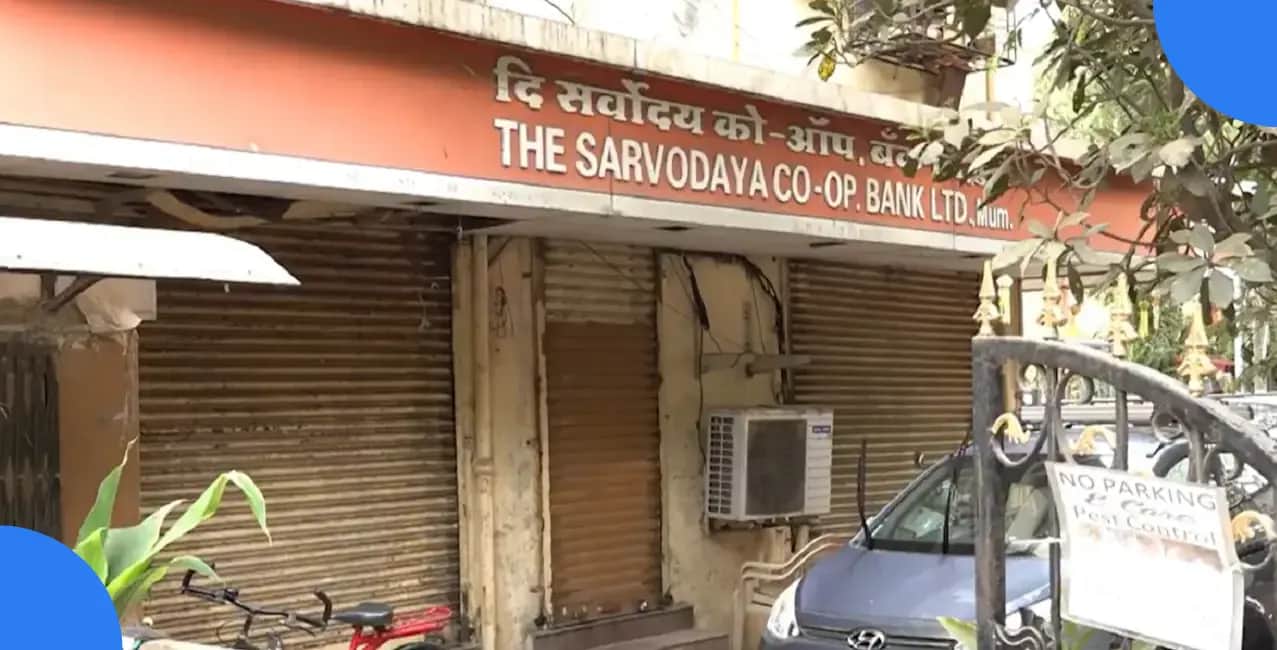
This week, the RBI revoked the licence of Mumbai-based Sarvodaya Co-operative Bank, effectively ending its banking operations from May 12, 2026. The central bank cited inadequate capital, weak earning prospects and non-compliance with provisions of the Banking Regulation Act as the primary reasons behind the action.
For depositors, the announcement triggered a familiar fear: “Will my money come back?”
The RBI attempted to calm nerves quickly. According to an article by the Business Standard, about 98.36% of depositors are eligible to receive the full amount of their insured deposits from DICGC. The insurance cover remains capped at ₹5 lakh per depositor.
Yet beneath the reassurance lies a much deeper story about India’s co-operative banking sector, one that continues to oscillate between community banking ideals and systemic financial weakness.
The RBI’s order was not sudden.
Regulators had already placed the bank under “All Inclusive Directions,” a restrictive framework generally imposed on financially stressed banks. Such directions typically limit lending, withdrawals and operational flexibility while regulators assess the institution’s viability.
The final decision came after RBI concluded that the bank lacked both sufficient capital and future earning potential to continue functioning safely.
The central bank also noted that allowing the bank to continue operations would adversely affect public interest and depositor welfare.
In practical terms, Sarvodaya Co-operative Bank can no longer accept deposits, process repayments or carry out regular banking business.
The Maharashtra Registrar of Co-operative Societies has now been asked to initiate winding-up proceedings and appoint a liquidator.
This is where the DICGC mechanism becomes critical.
The Deposit Insurance and Credit Guarantee Corporation, a wholly owned RBI subsidiary, insures bank deposits up to ₹5 lakh per depositor across savings accounts, current accounts and fixed deposits combined.
According to RBI disclosures, DICGC had already paid ₹26.72 crore toward insured deposits of Sarvodaya Co-operative Bank as of March 31, 2026.
Here is a simplified breakdown of the situation:
The important detail often missed by depositors is that the ₹5 lakh insurance limit applies per depositor, not per account.
If an individual has multiple accounts in the same bank, the combined insured amount still remains capped at ₹5 lakh.
That distinction becomes painfully relevant during bank failures.
Urban co-operative banks were originally created to serve local communities and small businesses that mainstream commercial banks often ignored.
In theory, they represented decentralised finance with a social purpose.
In reality, many of them evolved into politically influenced institutions struggling with weak governance, poor risk management and excessive concentration of loans.
Sarvodaya Co-operative Bank is hardly an isolated case.
Over the past decade, India has witnessed multiple co-operative banking collapses and regulatory interventions. The sector has repeatedly battled issues related to capital adequacy, insider lending and operational transparency.
The RBI has steadily tightened supervision after major crises such as the PMC Bank episode exposed systemic vulnerabilities within the sector.
₹5 lakh
*T&C Apply
But regulation alone cannot repair governance failures embedded deep within the co-operative structure.
A weak co-operative bank often resembles a cracked dam.
From the outside, everything appears stable. Customers continue depositing money. Branches function normally. Interest gets credited on time.
But internally, pressure keeps building.
Bad loans accumulate quietly. Capital buffers erode slowly. Compliance gaps widen. Earnings weaken.
Then comes the tipping point.
And once confidence disappears, regulators are left with only two options — rescue or closure.
In the case of Sarvodaya Co-operative Bank, RBI appears to have concluded that revival was no longer commercially or institutionally feasible.
That decision may sound harsh, but regulators often argue that delaying closure only deepens depositor losses.
The RBI’s recent actions reflect a broader regulatory shift.
The central bank has increasingly adopted a zero-tolerance approach toward weak financial institutions that fail to meet prudential norms.
The objective is clear: prevent another large-scale depositor panic.
After past banking crises damaged public trust, regulators now prefer faster intervention rather than prolonged uncertainty.
The emphasis is no longer merely on keeping institutions alive.
It is on protecting the financial system’s credibility.
This is also why deposit insurance has become central to RBI’s communication strategy during such crises.
The message regulators want to send is straightforward: depositors may face inconvenience, but most small savers will not lose their money.
That remains the real challenge.
Every cancelled licence chips away at public confidence in smaller financial institutions.
For millions of middle-class depositors, a bank is not just a financial intermediary. It is a symbol of security.
When that symbol collapses, even insured compensation cannot fully repair the psychological damage.
The Sarvodaya Co-operative Bank episode may eventually fade from headlines.
But it reinforces an uncomfortable reality.
India’s co-operative banking sector still carries structural weaknesses that periodic regulatory crackdowns alone may not fully resolve.
Until governance standards improve fundamentally, depositors will continue asking the same question every time another co-operative bank stumbles:
“Is my money truly safe?”
Does RBI fines Sarvodaya Co-operative Bank ₹2 lakh for KYC norms violation?
Yes, RBI imposed a ₹2 lakh penalty for KYC norm violations (in 2021).
How safe is Suryodaya co-operative bank?
It is RBI-regulated and DICGC-insured up to ₹5 lakh, so generally safe, but risk is slightly higher than large banks.









.png&w=3840&q=75)



