
By continuing, you agree to LoansJagat's Credit Report Terms of Use, Terms and Conditions, Privacy Policy, and authorize contact via Call, SMS, Email, or WhatsApp
Disclaimer: The information published on LoansJagat is intended for general informational and educational purposes only and should not be considered financial, legal, or investment advice. Interest rates, loan terms, statistics, and other data may change over time and may vary by lender or source. Please verify the latest information and consult a qualified financial advisor or the respective Bank/NBFC before making any financial decisions.
Subscribe Now
About the author

Arshathul Afia
Arshathul Afia is a journalism graduate and fintech content writer with 4+ years of experience in digital publishing and research-led writing. She has written 200+ articles covering personal finance, lending, banking, digital payments, credit, insurance, and major financial developments in India. At LoansJagat, she focuses on simplifying complex fintech news, RBI updates, loan-related changes, policy developments, and industry trends for everyday readers. Her journalism background helps her approach stories with research, context, and clarity, while her SEO experience ensures content remains discoverable and relevant. She aims to make financial news easier to understand, practical, and useful for readers across India.
Related News
Simplify All Your Loans Into One Affordable EMI

Customers Served

Debt Consolidated

1200+ Reviews

Locations in India
Club all Loans & Credit Card Bills into Single EMI

Quick Apply Loan
Consolidate your debts into one easy EMI.

Takes less than 2 minutes. No paperwork.

10 Lakhs+
Trusted Customers

2000 Cr+
Loans Disbursed

4.7/5
Google Reviews

50+
Banks & NBFCs Offers
Other services mentioned in this article
Uttar Pradesh is offering affordable, long-term agricultural loans to farmers and is launching a cooperative taxi service for the local population. The move will allow farmers and transport workers greater control over their income.
Key Highlights
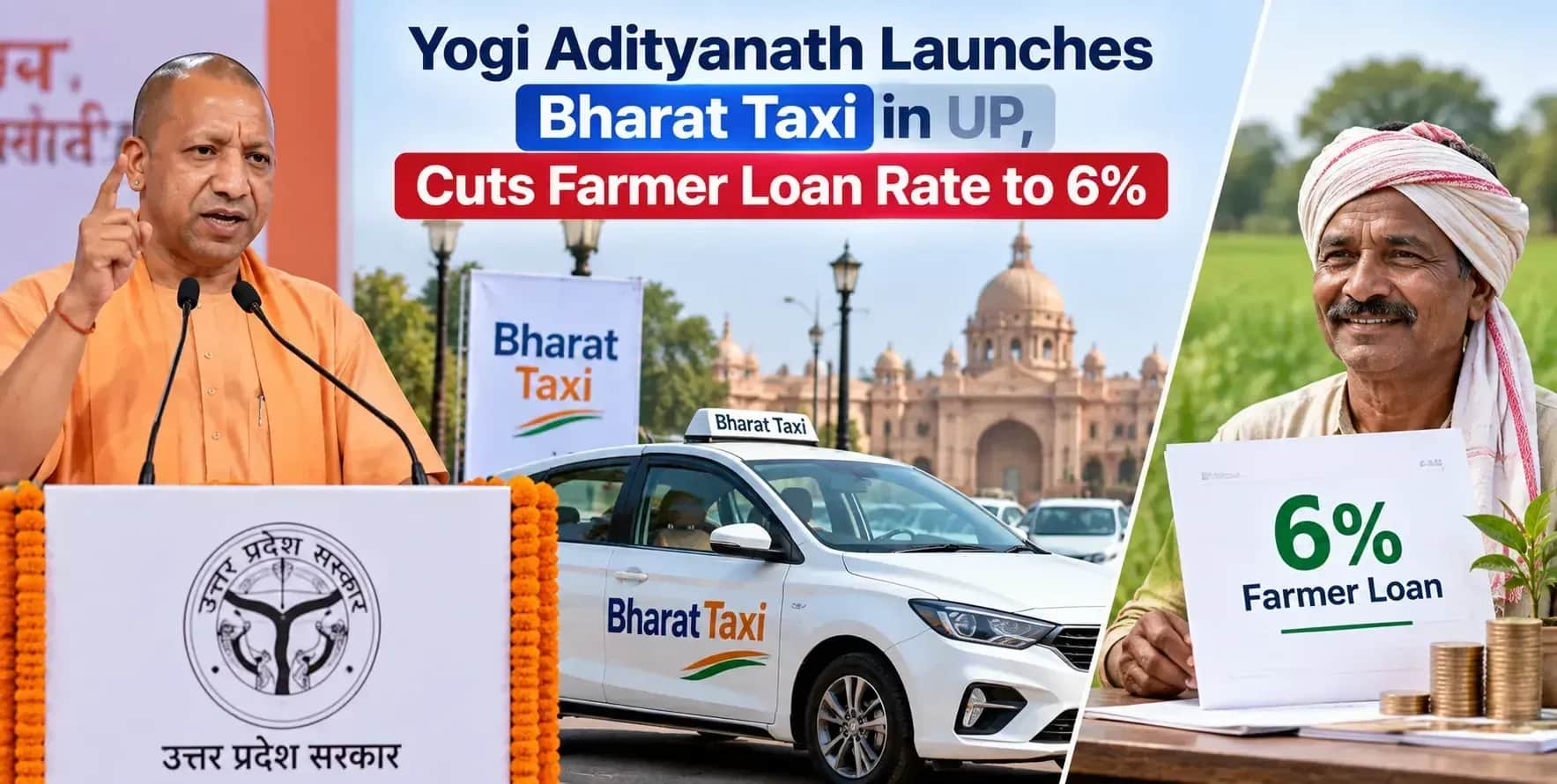
At an event in Lucknow on 23 September 2026, Uttar Pradesh Chief Minister Yogi Adityanath launched 2 cooperative programmes. One brings cheaper long-term credit for small and marginal farmers through the Uttar Pradesh Cooperative Rural Development Bank. Eligible borrowers will pay 6% interest, down from the earlier 11%. The same event marked a wider push for Bharat Taxi across the state.
The immediate gains are direct. Farmers face a lower stated borrowing rate, and drivers do not lose part of every app fare as commission. There are conditions, though. Farmers must repay on schedule, while the taxi platform needs enough active vehicles, trained drivers and responsive local support outside busy city pockets.
The 5-point rate reduction applies to long-term credit for small and marginal farmers. Adityanath said the state intends to bring 5 lakh farmers under the scheme. It remains repayable, not debt relief, and approval will depend on bank checks, applicant documents and the permitted use of funds.
The rate tells only part of the cost. A borrower-focused reading from LoansJagat is that applicants should also read the tenure, instalment dates, security clause, processing charges and overdue terms. The concessional rate has been linked with timely repayment. A missed date may alter the benefit.
The scheme differs from Kisan Credit Card finance. KCC generally supports seasonal cultivation, allied activities and working-capital needs. The UP facility concerns long-term borrowing through the state cooperative rural development bank. Eligibility under one route does not bring approval under another. The sanction letter will govern the amount, purpose and repayment.
Bharat Taxi is operated by Sahakar Taxi Cooperative Limited. Drivers join as cooperative members and keep app-ride fares without a commission deduction. The platform follows a subscription model. Adityanath said Bharat Taxi drivers would get social-security cover of up to ₹5 lakh.
Bookings have already begun in Lucknow, Gorakhpur, Varanasi and Prayagraj. For the Lucknow rollout, the taxi cooperative is working with the city’s airport, Metro network and police. The links cover pickups, last-mile trips and emergencies. Daily usefulness still depends on whether a vehicle arrives, the fare shown is charged, and help answers when a trip goes wrong.
Adityanath connected the lower rate with rural income and repayment capacity. “If the farmer is prosperous, India will be prosperous,” he said. He gave sanction letters to 5 borrowers and share certificates to 5 Sarathis. The certificates mark their cooperative membership, beyond ordinary app work.
Union Cooperation Minister Amit Shah had described ownership, security cover, dignity and distribution of dividends as the 4 principles behind Bharat Taxi during its national launch on 5 February 2026. That promise now has to survive ordinary operating pressure. Verification, training, police coordination and grievance handling cannot weaken as registrations rise. The farmer scheme faces a similar test at branch level, where every applicant should receive the same repayment terms and subsidy conditions in writing.
The initiatives serve different groups and use separate systems. The table records their main terms.
None means automatic loan approval or guaranteed rides. The bank will assess applications. Bharat Taxi must complete onboarding, vehicle checks and local permissions during expansion. Announcement and actual use remain different stages.
The launch also included the Urvarak Setu app and the Uttar Pradesh Cooperative Database Centre app. Both tools form part of the state’s effort to move cooperative records and services onto digital channels for farmers and institutions.
Sahakar Taxi Cooperative Limited was established on 6 June 2025 by 8 national cooperative institutions. Amit Shah gave Bharat Taxi its national launch on 5 February 2026. By then, the service was already running in Delhi-NCR and selected parts of Gujarat. Expansion followed from there.
In Uttar Pradesh, official records counted 21,621 enabled Sarathis on 28 July 2026. That figure covered drivers registered with cabs, autorickshaws and bikes.
The national count was far larger. An update dated 12 August 2026 reported 8.48 lakh registered drivers and 44.27 lakh customers as of 4 August 2026. The figures need careful reading, though. They show registrations, not the number of drivers or passengers using Bharat Taxi on an average day.
On 17 September 2026, the Ministry announced plans to take Bharat Taxi across all 75 UP districts and towards villages through the cooperative network. The proposed service includes bikes, autorickshaws and cabs. Another official reply dated 4 August 2026 described the platform as an alternative to private ride-booking companies, not a replacement. It also reported no direct Union government equity support for establishing or expanding it.
The farmer scheme can lower the stated cost of long-term credit for eligible borrowers, provided they meet the bank’s conditions and keep repayments on time. Before accepting a loan, an applicant needs the instalment schedule, overdue charges and subsidy rules on paper. Verbal assurances are not enough when a multi-year repayment commitment is involved.
Bharat Taxi gives drivers a different proposition: cooperative membership, zero in-app commission and a promised security net. Passengers will be less interested in the ownership structure than in availability, price and safety. The launch has supplied the framework. Completed loans, regular repayments and dependable rides will show whether it works.
It offers long-term loans at 6% to eligible small and marginal farmers through the Uttar Pradesh Cooperative Rural Development Bank.
No. Borrowers must repay the principal and interest under the bank’s schedule. Delayed instalments may affect the concessional rate.
The service is operating in Lucknow, Gorakhpur, Varanasi and Prayagraj. A statewide rollout covering all 75 districts has been announced.
No. Sahakar Taxi Cooperative Limited, a multi-state cooperative society, operates it. The Union government has reported no direct equity support.
No in-app commission is deducted from their ride earnings. Drivers join as cooperative members, while the platform follows a subscription-based model.









.png&w=3840&q=75)


