By continuing, you agree to LoansJagat's Credit Report Terms of Use, Terms and Conditions, Privacy Policy, and authorize contact via Call, SMS, Email, or WhatsApp
Disclaimer: The information published on LoansJagat is intended for general informational and educational purposes only and should not be considered financial, legal, or investment advice. Interest rates, loan terms, statistics, and other data may change over time and may vary by lender or source. Please verify the latest information and consult a qualified financial advisor or the respective Bank/NBFC before making any financial decisions.
Subscribe Now
About the author

Vaishnavi kale
Vaishnavi is a Financial Content Writer at LoansJagat. She holds a B.Sc. and an M.Sc. She has experience in writing SEO-focused content across finance, digital marketing, education, and Ayurveda. Before joining LoansJagat, she worked with digital marketing agencies serving fintech clients and quick-commerce brands like Zepto and blinkit. At LoansJagat, Vaishnavi writes on banking, loans, personal finance, and insurance. Her work involves researching financial topics, understanding user search intent, and creating content that is clear and accurate. She has experience in SEO content writing, keyword research, content optimisation, and AEO. She enjoys simplifying complex topics into practical information that readers can easily understand and use. She believes that well-researched and reliable content plays an important role in helping people make informed financial decisions.
Related Blog Post
Simplify All Your Loans Into One Affordable EMI

Customers Served

Debt Consolidated

1200+ Reviews

Locations in India
Club all Loans & Credit Card Bills into Single EMI

Quick Apply Loan
Consolidate your debts into one easy EMI.

Takes less than 2 minutes. No paperwork.

10 Lakhs+
Trusted Customers

2000 Cr+
Loans Disbursed

4.7/5
Google Reviews

50+
Banks & NBFCs Offers
Other services mentioned in this article
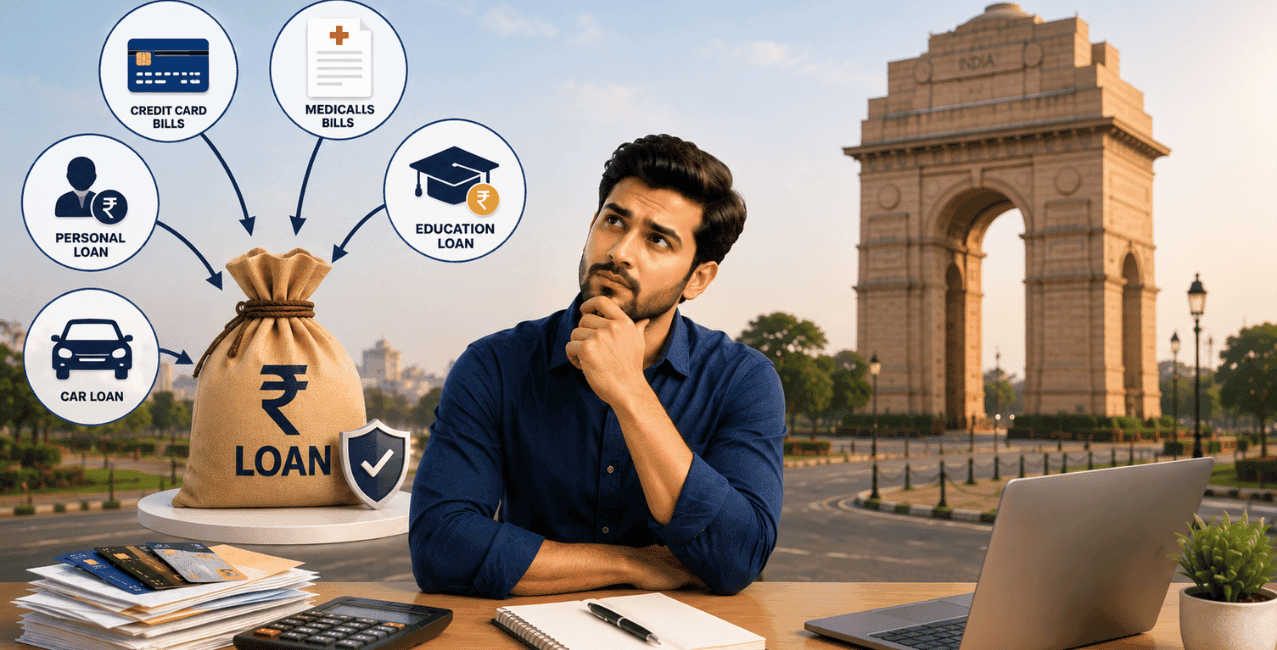
Debt consolidation is a financial tool that is used to ease loan payment. You can combine your multiple loans which have high-interest and turn them into a single personal loan. You can plan a monthly budget, lower interest rate, and reduce financial stress with the debt consolidation loan. You need to execute this strategy effectively otherwise it can trap you in a deeper debt cycle. When you understand debt consolidation loans in India, you can protect your savings and become debt-free faster. That's why avoiding debt consolidation mistakes is important.
Key takeaways
Debt consolidation is a loan payment method in which borrowers combine their multiple loans and turn into a single debt; as a result, they have to pay only one EMI.
This is a common method for those who are fed up with multiple EMI payments and want to simplify their financial planning.
For example:
Kavita is a Pune-based IT professional. She pays four loan EMIs monthly:
Now we know that Kavita's total loan amount is ₹12,00,000 and she pays ₹36,000 as EMI monthly. It was difficult for her to pay this much money. Then she decided to consolidate her loan. After consolidation her monthly payment can be reduced from ₹24,000 to ₹12,000 but the overall savings depends on the interest rate, tenure, and charges. But there are mistakes people make during debt consolidation that cost them lakhs. It is important to focus on common debt consolidation mistakes to avoid.
In the above example, you see that Kavita successfully dropped her monthly EMI from ₹36,000 to ₹24,000. In India, borrowers typically achieve consolidation through three primary routes:
What are the risks that occur due to debt consolidation?
Debt consolidation isn't only about benefits. If you don't pay attention, it can also have risks. If you don't understand the hidden costs before consolidating your debt, a ₹5 lakh loan could end up costing you much more over time.
No doubt, debt consolidation is an effective way to pay your loan. But many people consider it a cure rather than a tool and end up facing all of the above problems.
To avoid these risks, primarily you need to identify those mistakes. Let's see about those mistakes.
Summary of Common Debt Consolidation Mistakes:
This is a big trap. When banks or lenders offer borrowers lower EMI, they easily fall for it. If someone says you don't need to pay ₹40,000 EMI each month and you can pay ₹22,000 instead. It seems nice from the surface but has hidden risks. The risk is the timeline.
If you extend a loan that has only 2 years left into a new 6-year loan. You will definitely reduce your monthly EMI, but you'll pay interest for a much longer time. This can significantly increase the total cost of the loan.
For example:
Let's say you consolidate your ₹10 Lakhs at 14% interest.
Earlier, your timeline was 3 years, and you were going to pay a total of ₹2,29,000 in interest. But after consolidation, the time period becomes 7 years, and of course, your monthly EMI payment is much lower. But longer tenure can also increase the total interest rate. For example, if interest rates fall to 13%, the total interest could be around ₹5,44,000 over 7 years which depends on the loan amount and other applicable charges.
That means you are going to pay more than ₹3,00,000 as interest in return for a low monthly EMI.
So, always see this hidden risk while applying for debt consolidation.
The second mistake that borrowers make is ignoring foreclosure and processing charges. They compare interest rates but forget about the extra charges involved in debt consolidation.
Do you know? In India, many banking and loan-related fees, such as loan processing fees, documentation charges, and applicable prepayment charges, attract 18% GST. However, GST is charged on the fee or charge, not on the loan principal or interest.
If your new bank or NBFC charges a 2% processing fee on a ₹10 lakh loan (₹20,000), the GST at 18% would be ₹3,600, taking the total processing cost to ₹23,600. You should calculate your net savings after accounting for GST on applicable fees and charges.
When you go for debt consolidation, you should compare different lenders. But applying to several banks at the same time can hurt your credit score.
When you apply to a bank or lender, they simply go for a hard inquiry on your credit report. It can consider overall credit assessment and can affect your credit profile. That's why it's advisable to compare suitable loan options and avoid making unnecessary applications.
So, you can compare loan offers using eligibility checkers or loan comparison websites first. Apply to only one lender after choosing the best offer.
Also Read - 4 Common Loan Mistakes First-Time Borrowers
What people do: they combine all their loans for debt consolidation. But it doesn't work like this. Not every loan should be included in a debt consolidation loan. When you choose the wrong loan. It can increase your overall borrowing cost.
So, which loans should you add into debt consolidation?
If you are going for debt consolidation, it works best for high-interest unsecured debts like:
These loans usually have high interest rates. So by consolidating them into a lower-interest loan, you can save money.
Loans You Should Avoid Consolidating
When you replace these loans with a personal loan. It may result in a higher interest rate or the loss of valuable loan benefits.
So, you should always consolidate only high-interest debts. And keep low-interest loans separate unless a financial expert advises otherwise.
So, this is Last but not least. Debt consolidation is useful for making payments easier, but it doesn't solve your problem. If you don't change your spending habits, you may end up borrowing again.
So, take some time to review your finances. Check your credit card statements and loan records so that you will understand where your money is going. Plus, identify unnecessary expenses and create a budget to avoid overspending.
So if you want to avoid the above mistake and save your lakhs of rupees, then never look at EMI alone. You need to focus entirely on the total finance charge, like principal, total interest, and all fees.
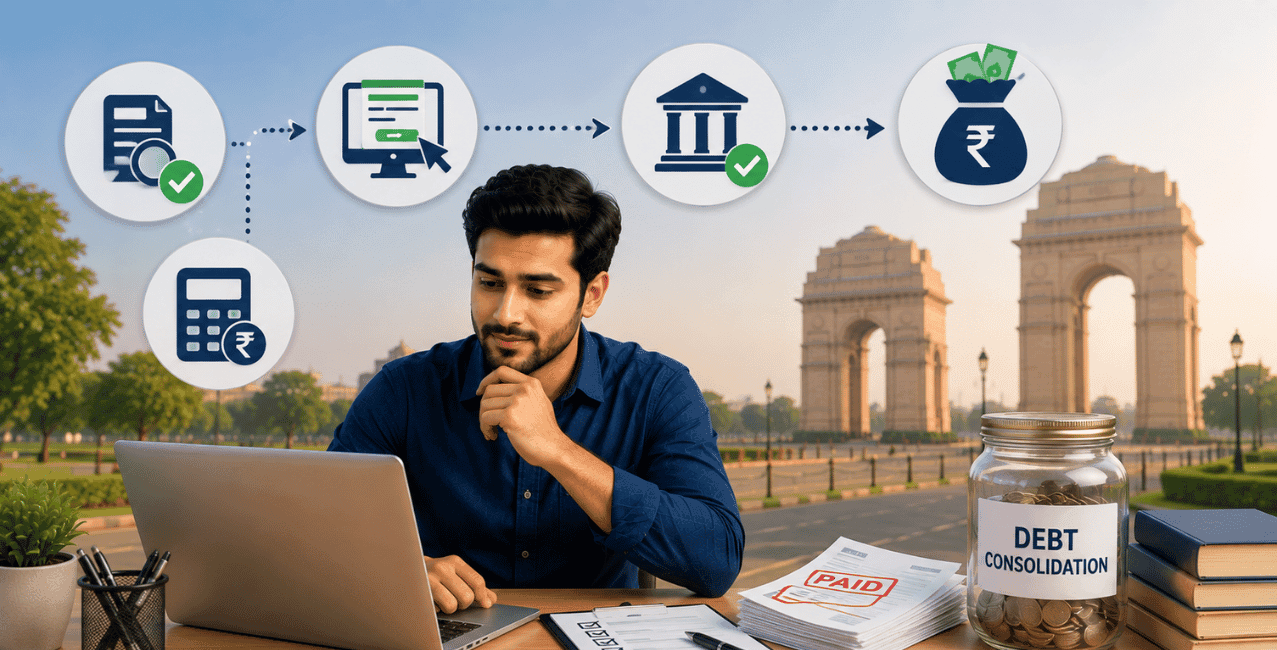
Write your outstanding loan amount, its interest rate, timeline, and EMI amount.
Then confirm the loan amount, foreclosure or prepayment charges, and any other loan closure fees.
Then ask them about the interest rate, monthly EMI, loan tenure, processing fee, and total repayment amount.
Compare all the above criteria, and if the new loan costs more overall. You are paying extra for a lower EMI, not actually saving money.
These are the tips to prevent debt consolidation mistakes.
This is why understanding common debt consolidation mistakes is important. You know debt consolidation can simplify debt repayment and improve your monthly cash flow, but making the wrong decisions can lead to higher interest costs, longer repayment periods, and unnecessary financial losses.
If you are someone who is planning to apply for a debt consolidation loan India. Always compare different lenders, calculate the total repayment cost instead of focusing only on the EMI, check all applicable fees, and consolidate only the right types of debt.
Most importantly, improve your spending habits and avoid taking on new debt after consolidation. This can help you maximise the benefits of debt consolidation.
1. Can a lower EMI actually make a debt consolidation loan more expensive?
Yes. Your lower EMI potentially increases the total amount of loan. But it depends on the repayment timeline. Always compare the total interest and total repayment amount, not just the monthly EMI.
2. Is it a mistake to choose a debt consolidation loan only because it has a lower interest rate?
It can be. The advertised interest rate may not represent the complete cost of the loan. Check the processing fee, applicable taxes, insurance or other charges, prepayment conditions and total amount payable before comparing offers.
3. Can consolidating credit card debt save money if I continue using the cards?
The benefit can quickly disappear if you accumulate new balances after paying off the cards through consolidation. You could end up repaying the consolidation loan while simultaneously building new credit-card debt.
4. Should I consolidate every outstanding loan into one loan?
Not necessarily. Some existing loans may already have a lower interest rate or favourable remaining terms. Consolidate only eligible debts where doing so provides a meaningful financial or repayment-management benefit.
5. Can foreclosure charges make debt consolidation less beneficial?
Debt consolidation is used to lower the borrowing cost but the financial benefit depends on the total cost of switching. You need to compare the total interest saved and calculate the break-even point before closing your existing loans.
6. Is extending the loan tenure a mistake when consolidating debt?
Not automatically. A longer tenure can make the EMI more manageable, which may be useful when cash flow is tight. However, it can increase total interest substantially, so the decision should be based on both affordability and total cost.
7. Can applying to many lenders for debt consolidation hurt my credit profile?
Yes, it can hurt your credit profile. When you apply to many lenders for debt consolidation loans it results in hard inquiry. This can lower your credit score.
8. Is it risky to use a debt consolidation loan for expenses other than existing debts?
When you use the debt consolidation loan for new expenses instead of repaying your existing debts can reduce benefits of consolidation. It may leave high-interest debt unpaid.
9. Can closing old loan accounts incorrectly cause problems after debt consolidation?
Yes it can cause problems. If your loan status is “settled” instead of “closed” it will affect your future loans. It shows that you have not paid the full loan and settled it.
10. What is the biggest mistake to avoid after taking a debt consolidation loan?
You should not treat your new loan or EMI as extra money. It will increase your debt burden.