By continuing, you agree to LoansJagat's Credit Report Terms of Use, Terms and Conditions, Privacy Policy, and authorize contact via Call, SMS, Email, or WhatsApp
Disclaimer: The information published on LoansJagat is intended for general informational and educational purposes only and should not be considered financial, legal, or investment advice. Interest rates, loan terms, statistics, and other data may change over time and may vary by lender or source. Please verify the latest information and consult a qualified financial advisor or the respective Bank/NBFC before making any financial decisions.
Subscribe Now
About the author

Vaishnavi kale
Vaishnavi is a Financial Content Writer at LoansJagat. She holds a B.Sc. and an M.Sc. She has experience in writing SEO-focused content across finance, digital marketing, education, and Ayurveda. Before joining LoansJagat, she worked with digital marketing agencies serving fintech clients and quick-commerce brands like Zepto and blinkit. At LoansJagat, Vaishnavi writes on banking, loans, personal finance, and insurance. Her work involves researching financial topics, understanding user search intent, and creating content that is clear and accurate. She has experience in SEO content writing, keyword research, content optimisation, and AEO. She enjoys simplifying complex topics into practical information that readers can easily understand and use. She believes that well-researched and reliable content plays an important role in helping people make informed financial decisions.
Related Blog Post
Simplify All Your Loans Into One Affordable EMI

Customers Served

Debt Consolidated

1200+ Reviews

Locations in India
Club all Loans & Credit Card Bills into Single EMI

Quick Apply Loan
Consolidate your debts into one easy EMI.

Takes less than 2 minutes. No paperwork.

10 Lakhs+
Trusted Customers

2000 Cr+
Loans Disbursed

4.7/5
Google Reviews

50+
Banks & NBFCs Offers
Other services mentioned in this article
Monthly EMI payments become difficult to manage when you have multiple loans. With debt consolidation, you can turn your multiple EMIs into a single EMI. If you have multiple loans like a personal loan, vehicle loan, and home loan, managing them is a difficult task. You can combine your debts and take a new loan, which is called a debt consolidation loan. Debt consolidation options vary by lender and loan product. It is not necessary that every type of debt may qualify for consolidation. So, the eligibility depends on the lenders criteria and terms of loan. Now you can use this new loan to pay all previous loans. If your current EMI amount is large and you want to reduce it by ₹12,000, debt consolidation can help you with this.
Key takeaways
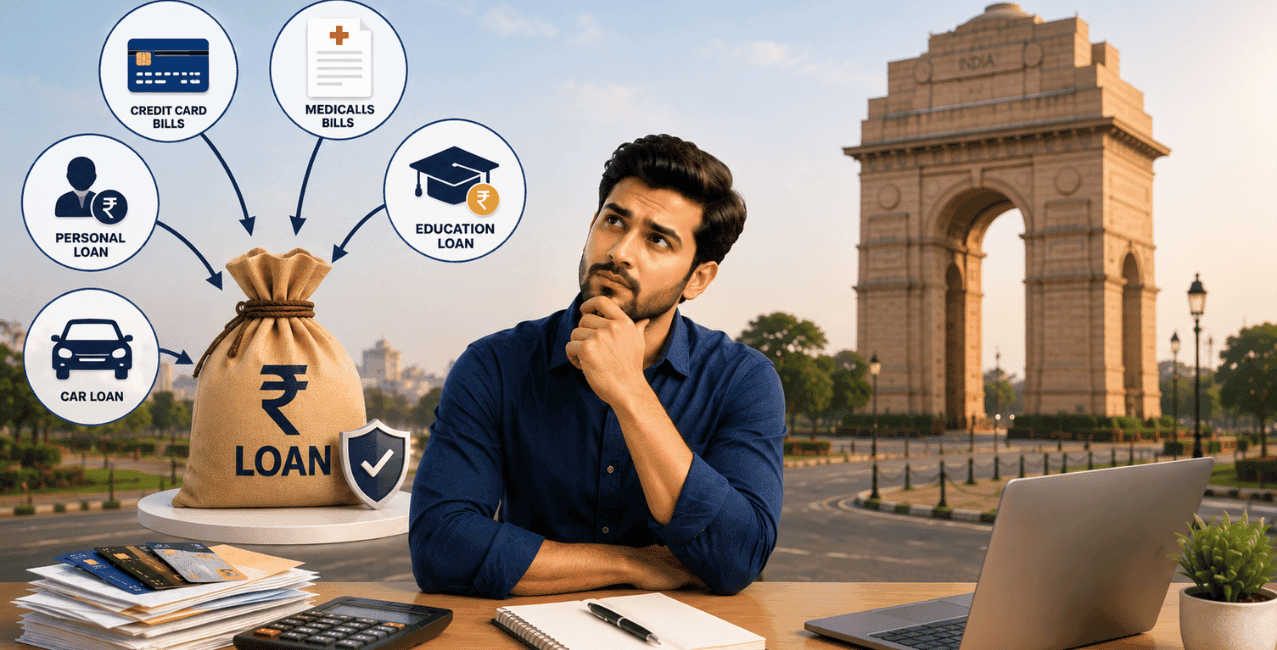
Six months ago, I had an educational loan. Later, I took out a personal loan for my father's medical expenses. Then I used my credit card for home repairs. A few months later, I bought a scooty on EMI.
These loans were manageable individually. But after some time, it became difficult.
My monthly loan payment before debt consolidation was:
My salary was not enough to bear ₹36,000 as EMI and other daily life expenses; then I realised that I needed to change something.
After debt consolidation, I didn't have to pay multiple EMIs; I would only have one EMI.
So, I went to the lender, and the lender approved the application after reviewing the background and documents. The process was really easy.
When the lender approved debt consolidation, my payment became like this.
After debt consolidation, you can save ₹12,000 but the actual financial savings depends on the interest rate and other charges. It gave me breathing space, and this is how I used a personal loan for debt consolidation.
I had read about debt consolidation in an online blog. The idea was simple. After debt consolidation, I didn't have to pay multiple EMIs; I would only have one EMI.
So, I went to the lender, and the lender approved the application after reviewing my background and documents. The process was really easy.
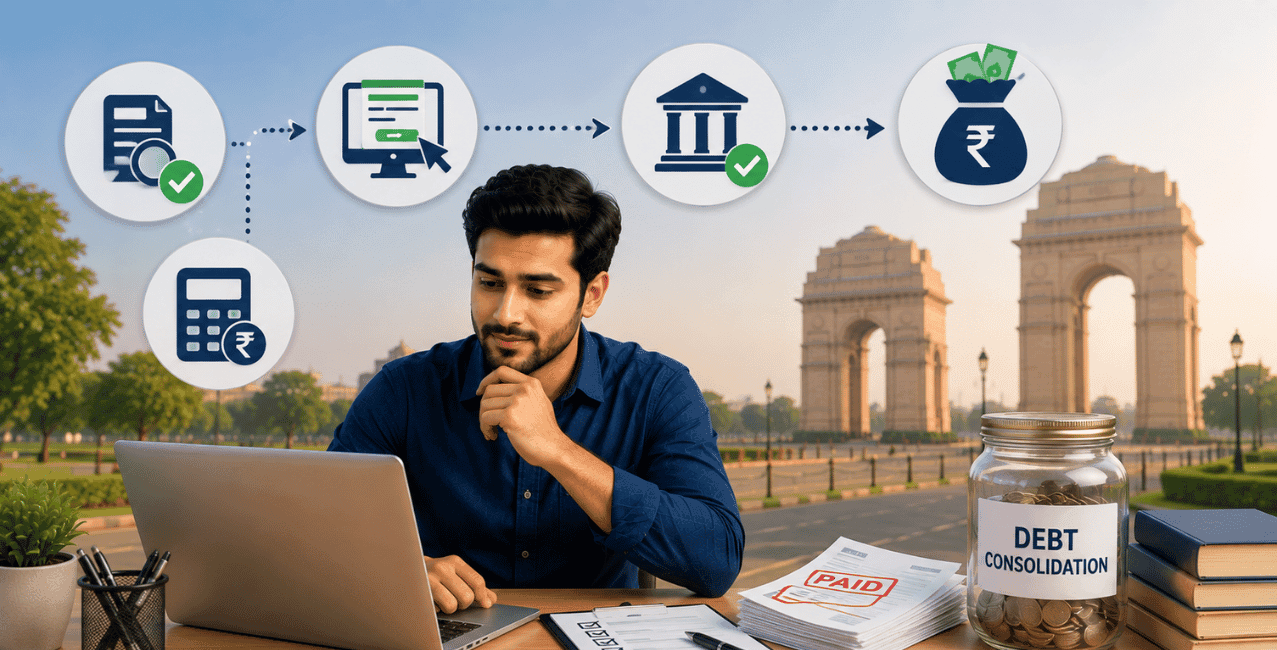
Here are the steps with which I applied for debt consolidation.
Then my lender reviewed all the documents and approved the debt consolidation loan.
The biggest change for me was the reduction in EMI payment by ₹12,000. It was really a massive relief in my monthly cash flow. Other than this, there were some shifts in the financial situation.
Let me tell you about the benefits of debt consolidation.
So, debt consolidation isn't just a method; it is a stress reliever for you if you are struggling with multiple EMI payments.
Debt consolidation isn't just about benefits. It has some negative sides too.
Debt consolidation only helps if spending habits change. So, these are the drawbacks of debt consolidation. You can compare and apply for debt consolidation.
Debt consolidation is not for everyone. It is for only those who have multiple loans in their name. Let me tell you who can go for debt consolidation.
Debt consolidation is effective when you avoid taking on new debt. If you continue using your credit cards after consolidating your loans, you may end up with even more debt than before.
The debt consolidation loan worked for me. It combines multiple loans into one EMI. It improves your monthly cash flow. It can also help reduce your interest burden and lower the risk of missed EMI payments.
If you are someone who is struggling, like I am, with multiple loans and finding it difficult to manage your monthly EMIs, debt consolidation could be a proactive solution.
You should compare different banks and their interest rates before applying for a debt consolidation loan. Also, after getting a debt consolidation loan, you should not go for a new loan. It will increase the burden on you.
A ₹12,000 reduction in EMI doesn't mean it's a monthly saving. It means your monthly payment has decreased by ₹12,000. Overall savings depend on the interest rate, loan tenure, and processing fees. That's why, before getting a debt consolidation loan, you should check different lenders' interest rates, tenure, and fees.
The loan can combine multiple outstanding debts into a single loan with a different interest rate and repayment tenure. Extending the repayment period can lower the monthly EMI even though the principal amount being repaid may remain broadly similar initially.
When you go for a new debt consolidation loan with a lower EMI, you should always calculate the outstanding amount, current EMIs, and interest rate. Also calculate the remaining tenure and prepayment charges. Now compare all these with the new debt consolidation loan.
People with high income can spend larger amounts on EMI because their remaining income is sufficient for their living expenses, and people with low income can not spend a high amount on EMI. Also, people with a good credit profile and better credit history are granted higher EMI-to-income ceilings. All these factors are important in EMI, and these vary from person to person. Also, every bank sets its own internal risk policies. That's why EMI varies by lender.
This is not necessary. A longer tenure can reduce the monthly EMI, but it can increase the total interest paid over the loan period. If you want the right tenure, you should balance affordable monthly payments with the overall cost of borrowing.
If the consolidation loan permits credit card debt to be included, you can factor eligible card balances into the calculation. Compare the interest cost of those balances with the cost of the new consolidation loan before deciding.
The old loans or eligible debts need to be repaid and closed according to the consolidation arrangement. Once they are settled, you should verify that the previous lenders have updated the accounts correctly and that you are left with the new consolidation-loan EMI.
Yes, particularly if you take on new loans or accumulate fresh credit-card balances after consolidation. The EMI reduction works best when the consolidated debts are not replaced with additional borrowing.
Compare the total amount before and after consolidation, then compare the total amount payable over the remaining rearrangement periods. Also account for processing fees, foreclosure charges and other costs to determine whether the reduction improves your overall financial position.
TransUnion CIBIL issues a CIBIL report, and the CIBIL score is mentioned there. The CIBIL score shows the creditworthiness of the borrower. That's why it is an important factor. This CIBIL score ranges from 300 to 900. That means 300 is the lowest CIBIL score.