

By continuing, you agree to LoansJagat's Credit Report Terms of Use, Terms and Conditions, Privacy Policy, and authorize contact via Call, SMS, Email, or WhatsApp
Disclaimer: The information published on LoansJagat is intended for general informational and educational purposes only and should not be considered financial, legal, or investment advice. Interest rates, loan terms, statistics, and other data may change over time and may vary by lender or source. Please verify the latest information and consult a qualified financial advisor or the respective Bank/NBFC before making any financial decisions.
Subscribe Now
About the author

Arshathul Afia
Arshathul Afia is a journalism graduate and fintech content writer with 4+ years of experience in digital publishing and research-led writing. She has written 200+ articles covering personal finance, lending, banking, digital payments, credit, insurance, and major financial developments in India. At LoansJagat, she focuses on simplifying complex fintech news, RBI updates, loan-related changes, policy developments, and industry trends for everyday readers. Her journalism background helps her approach stories with research, context, and clarity, while her SEO experience ensures content remains discoverable and relevant. She aims to make financial news easier to understand, practical, and useful for readers across India.
Related News
Simplify All Your Loans Into One Affordable EMI

Customers Served

Debt Consolidated

1200+ Reviews

Locations in India
Club all Loans & Credit Card Bills into Single EMI

Quick Apply Loan
Consolidate your debts into one easy EMI.

Takes less than 2 minutes. No paperwork.

10 Lakhs+
Trusted Customers

2000 Cr+
Loans Disbursed

4.7/5
Google Reviews

50+
Banks & NBFCs Offers
The Mudra loans are now ₹20 lakh, but under the new rules for PMMY, Tarun Plus is only available for entrepreneurs who have repaid their earlier loan from the Tarun scheme under the current PMMY guidelines across the country.
The Pradhan Mantri MUDRA Yojana (PMMY), a scheme that offers business loans without the need for collateral up to ₹20 lakh for all states in India, is not accessible to all applicants. In a Press Information Bureau release dated 14th March 2026, Release ID 2240159, Tarun Plus is specifically available for entrepreneurs who have already availed of loans of over ₹10 lakh with Tarun and have successfully paid back the loan. The information came from Minister of State for MSME Shobha Karandlaje's written Lok Sabha reply dated 12 March 2026.
For a small shop, workshop, service unit or trading business, the higher Tarun Plus slab can support expansion after a successful borrowing cycle. The loan may help pay for machinery, inventory or working capital without property being pledged as collateral. That Tarun Plus restriction can trip up first-time PMMY applicants. A new borrower who needs ₹15 lakh cannot automatically enter Tarun Plus, and final sanction still depends on the participating lender's appraisal.
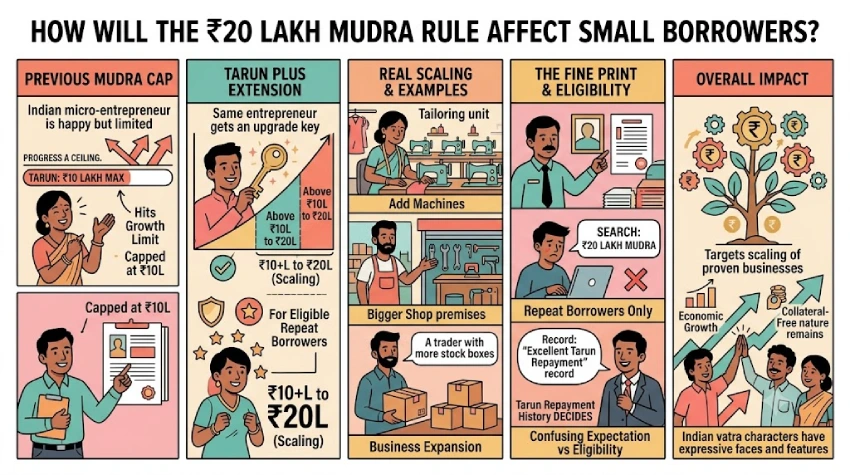
The biggest benefit goes to existing micro entrepreneurs who have already used formal credit and repaid it. Earlier, the Mudra structure stopped at ₹10 lakh under Tarun. Tarun Plus now gives an eligible repeat borrower another funding band, from above ₹10 lakh to ₹20 lakh, without changing the collateral-free nature of PMMY.
For the wider public, Tarun Plus can help businesses that have moved beyond a very small loan. A tailoring unit adding machines, a repair business taking larger premises, or a trader increasing stock may fit that profile. The downside comes from searches for a "₹20 lakh Mudra loan", which can create the wrong expectation among new applicants. Under PMMY, the previous Tarun repayment condition decides who can use the top bracket.
PMMY uses 4 categories based on loan size and the stage of the enterprise. Shishu remains the smallest slab. Kishor and Tarun cover larger requirements, while Tarun Plus is a repeat-borrower category with an extra eligibility condition.
The above PMMY figures are scheme slabs, not sanctioned amounts. A borrower who wants to borrow ₹8 lakh is in the Tarun category and will satisfy the repayment condition under Tarun, whereas a borrower who wants to borrow ₹18 lakh will have to satisfy the Tarun Plus repayment condition. The lender that will participate in the process can still request business records, bank statements, quotations, or project details before determining the sanctioned amount.
PMMY celebrated its 11 years with a good message on 8 April 2026, when Finance Minister Nirmala Sitharaman announced that the scheme has assisted in “removing the entry barriers to credit”. As per the update by the Ministry of Finance, cumulative loans disbursed as of 27 March 2026 were at 57.79 crore while the cumulative disbursement stood at ₹40.07 lakh crore. In the same government announcement, it was reported that 67% of those beneficiaries were women.
Tarun Plus continues to be a small component of that PMMY amount. According to government data from 8 April 2026, Tarun Plus only represented 0.004% of the number of loans. The figure is actually consistent with the product design, as Tarun Plus is for borrowers who have gone through a borrowing cycle through Tarun. In practice, for the applicants, it is better to select the category of PMMY that corresponds to the amount of funding required and not the maximum amount of ₹20 lakh.
Read Also : RBI Draft 2026: 3-Month Loan Reset & Spread Rules Explained
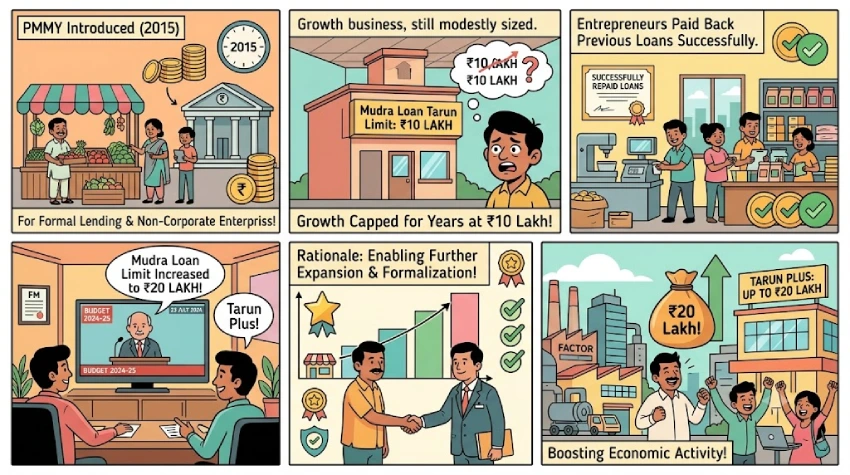
PMMY was introduced on 08th April 2015 for the formalization of non-corporate, non-farm micro enterprises through formal lending. For years, the Mudra scheme capped the loan amount at ₹10 lakh under Tarun. The next big shift was in the Union Budget 2024-25. On 23 July 2024, Finance Minister Nirmala Sitharaman announced that the limit of the Mudra loan would be increased to ₹20 lakh for entrepreneurs who had successfully paid back their previous loans under the Tarun scheme.
According to the official record of implementation of the India Budget, the Gazette notification was issued on 24 October 2024, and the Tarun Plus was created. On 25 October 2024, Member Lending Institutions were advised to adopt the revised structure. It is evident from the sequence that the doubling of ₹20 lakh per new applicant should not be interpreted in isolation. Tarun Plus was launched as a graduation scheme for successful borrowers of Tarun.
A LoansJagat report dated 16 March 2026 highlights the detail that can disappear when borrowers see only the maximum Mudra amount: the ₹20 lakh headline applies through Tarun Plus and carries a previous repayment condition. That borrower-facing reading is useful because many applicants begin by searching the maximum loan size before checking the PMMY category attached to it.
The useful borrower takeaway is about sequence. A first Mudra application and a repeat application are treated differently at the top end of PMMY. Someone who has never taken Tarun should not build a ₹15 lakh or ₹20 lakh funding plan on Tarun Plus alone. A borrower who repaid Tarun successfully has a route to request the higher slab, subject to the participating lender's normal appraisal.
The Department of Financial Services website describes PMMY as collateral-free institutional credit for micro enterprises. Eligible activities include manufacturing, trading and services, along with specified activities allied to agriculture such as poultry, dairy and beekeeping. PMMY can support term finance as well as working-capital requirements.
Applicants still need an income-generating business proposal under PMMY. A conventional crop loan should not automatically be presented as a Mudra loan merely because the applicant works in agriculture. Collateral-free also does not mean document-free. Participating banks, NBFCs, and MFIs assess the business, repayment capacity, and submit papers before sanctioning a Mudra loan.
A Mudra borrower can approach a Member Lending Institution directly. PMMY lenders include public sector banks, private banks, Regional Rural Banks, Small Finance Banks, NBFCs and MFIs. The scheme is also listed on the government's JanSamarth platform, where applicants can check eligibility for credit-linked schemes and move an application to participating lenders.
Before applying for PMMY, the borrower should keep identity and address details, business information, bank records, and the proposed use of funds ready. A ₹7 lakh machinery purchase, for example, may require a quotation or project details. An operating business may be asked for financial records or transaction history. Tarun Plus applicants should also keep the earlier Tarun loan details and repayment history available.
The ₹20 lakh maximum should come after the business requirement. If a PMMY applicant needs ₹6 lakh, seeking ₹20 lakh simply because the scheme permits that ceiling can weaken the proposal. Participating lenders examine repayment capacity and use of funds. A realistic project cost, existing turnover, and a defensible reason for borrowing are more useful than automatically choosing the biggest Mudra slab.
Borrowers should also avoid agents promising guaranteed Mudra approval for advance fees. PMMY does not remove the bank or financial institution from the sanction decision. Another point often missed is that collateral-free lending does not erase repayment responsibility. Mudra borrowers should check EMIs, tenure, lender charges, and any applicable margin contribution before accepting an offer.
The ₹20 lakh Mudra ceiling is real, but Tarun Plus comes with a specific gate. The category covers loans above ₹10 lakh and up to ₹20 lakh only for entrepreneurs who successfully repaid an earlier Tarun loan. New PMMY borrowers still have Shishu, Kishor and Tarun available according to their funding requirement and lender assessment.
For small businesses that have already borrowed responsibly under Tarun, the higher ₹20 lakh slab creates room for another expansion step. Other applicants need to start with the Mudra category they qualify for. Borrowers should check the PMMY category, prepare a business-backed request, verify the lender, and treat ₹20 lakh as a conditional maximum, not an assured payout.
No. Tarun Plus, Tarun loan must be successfully repaid. For a first-time PMMY applicant, he/she could be considered under Shishu, Kishor, or Tarun based on the requirement of funding and the lender's appraisal.
Yes, it is possible to apply for a PMMY as a new business in a job since it offers the facility of collateral-free credit. Even after the lender checks the business scheme, documents, and capacity to repay, they will still examine whether to approve the requested loan amount from Mudra or not.
Yes. Under PMMY, collateral-free refers to security requirements, not automatic approval. A lender may reject or reduce the amount if the proposal, repayment ability, credit profile, or business records do not support it.
Yes. PMMY can cover term loans and working-capital requirements for eligible manufacturing, trading, service and specified agriculture-allied activities. The Mudra borrower should state the planned use of funds accurately in the application.
An eligible Tarun Plus borrower can approach a participating bank, NBFC, MFI or another Member Lending Institution. PMMY is also available through JanSamarth, while previous Tarun repayment must be verifiable.









.png&w=3840&q=75)


