

By continuing, you agree to LoansJagat's Credit Report Terms of Use, Terms and Conditions, Privacy Policy, and authorize contact via Call, SMS, Email, or WhatsApp
Disclaimer: The information published on LoansJagat is intended for general informational and educational purposes only and should not be considered financial, legal, or investment advice. Interest rates, loan terms, statistics, and other data may change over time and may vary by lender or source. Please verify the latest information and consult a qualified financial advisor or the respective Bank/NBFC before making any financial decisions.
Subscribe Now
About the author

Arshathul Afia
Arshathul Afia is a journalism graduate and fintech content writer with 4+ years of experience in digital publishing and research-led writing. She has written 200+ articles covering personal finance, lending, banking, digital payments, credit, insurance, and major financial developments in India. At LoansJagat, she focuses on simplifying complex fintech news, RBI updates, loan-related changes, policy developments, and industry trends for everyday readers. Her journalism background helps her approach stories with research, context, and clarity, while her SEO experience ensures content remains discoverable and relevant. She aims to make financial news easier to understand, practical, and useful for readers across India.
Related News
Simplify All Your Loans Into One Affordable EMI

Customers Served

Debt Consolidated

1200+ Reviews

Locations in India
Club all Loans & Credit Card Bills into Single EMI

Quick Apply Loan
Consolidate your debts into one easy EMI.

Takes less than 2 minutes. No paperwork.

10 Lakhs+
Trusted Customers

2000 Cr+
Loans Disbursed

4.7/5
Google Reviews

50+
Banks & NBFCs Offers
Axis Bank has launched a Scapia co-branded travel card, targeting younger Indians as card ownership rises and travel becomes a bigger payments opportunity across India.
The timing is useful for Axis. India’s outstanding credit-card base reached 12.29 crore in July 2026, according to an Economic Times report published on August 25, 2026. More cards do not automatically mean better household finances. Younger users can gain from competition among issuers, yet expensive revolving balances remain a risk. Axis lists finance charges of 3.75% a month on the new card, which can wipe out travel rewards if unpaid dues carry forward.
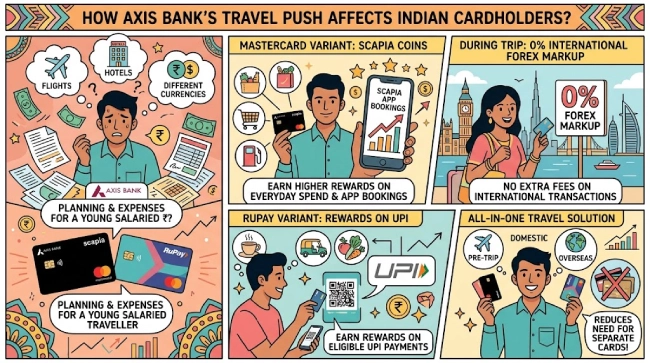
The new product is built around spending before, during and after a trip. The Mastercard variant earns Scapia Coins on eligible everyday purchases, while bookings through the Scapia app can earn a higher reward rate. International transactions carry 0% forex markup. There is also a RuPay version with rewards on eligible UPI spending. For a young salaried traveller who already pays for flights, hotels and regular purchases by card, that can reduce the need for a separate overseas-spending card.
Airport benefits need more attention. The card requires ₹20,000 of eligible spending in the preceding month to unlock listed domestic lounge, dining, shopping or spa benefits. A recent LoansJagat review of airport lounge credit cards found that spending thresholds for complimentary airport lounge access across Indian cards ranged from ₹20,000 to ₹1 lakh, depending on the card. The borrower-side test is simple: compare the benefit with routine spending before applying, rather than spending extra only to unlock it.
Travel demand gives banks a reason to keep building around this category. The Ministry of Tourism’s India Tourism Data Dashboard shows 32.83 million Indian national departures in 2025, up 6.3% from 2024. A Press Information Bureau release from the Ministry of Civil Aviation, published on March 18, 2026, said Indian airports were handling more than 5 lakh passengers a day. These figures do not guarantee card growth, but they explain why banks see travel as a recurring payments opportunity.
The table below keeps the card’s main consumer terms in one place. The useful question is whether those terms match the cardholder’s actual spending.
A zero-fee card can still become expensive when repayment slips. Travel rewards are strongest for customers who would make the purchase anyway, pay the total amount due on time and redeem coins for trips they actually plan to take. That is where card value is won or lost.
Arnika Dixit, Group Head for Cards and Payments at Axis Bank, said at the September 3 launch that travel gives the bank access to younger consumers and to a category where average card spending can be higher than everyday purchases. She described travel as a “high-spend category” and said the opportunity goes beyond flights to hotels, airport spending, buses, visas, cross-border payments and travel shopping. Dixit added that Axis Bank has been issuing at least 1 million cards every quarter and that industry issuance had started picking up after a slowdown.
Scapia founder and CEO Anil Goteti argued that India still has room for long-term card growth as disposable incomes rise and more consumers seek formal credit. He estimated card penetration in India at around 7% to 8%, while saying the longer-term opportunity could grow over 5, 10 or 20 years. That figure is Goteti’s assessment, rather than an official government estimate.
The practical borrower view is narrower. A co-branded card works best when the customer earns benefits on spending that was already planned. A person expecting regular overseas transactions could gain directly from 0% forex markup. Someone travelling once in 2 years may get far less value. And if rewards start driving extra purchases, the economics move against the cardholder. Monthly repayment, excluded transactions and redemption rules deserve more attention than the reward percentage printed at the top of an advertisement.
Axis Bank had already moved deeper into travel cards earlier in 2026. On February 18, the bank and IndiGo announced 2 co-branded products, the IndiGo Axis Bank Credit Card and IndiGo Axis Bank Premium Credit Card. Both were linked to IndiGo’s BluChip loyalty programme, with higher earnings on eligible IndiGo spending and additional travel and lifestyle features. That partnership focused more heavily on airline loyalty.
Scapia broadens the route. Its proposition covers flights, hotels, experiences, everyday purchases and overseas spending through a travel app. It is also Scapia’s 3rd banking collaboration after Federal Bank and Bank of Baroda. Axis gets access to an established travel platform, while Scapia gets another large banking partner. The September launch therefore extends an existing travel strategy rather than starting one from scratch.
Axis already had products such as Magnus for premium users and the IndiGo partnership for airline-linked rewards. Scapia gives the bank another route to younger customers who may care more about 0% forex markup, app-based redemption, and no annual fee than airline status or premium-card positioning.
There is a customer-acquisition argument here too. Someone who takes a travel card in their 20s or early 30s may later use the same bank for larger credit products, investments or wealth services. That outcome is not guaranteed, but it helps explain why acquiring a younger cardholder can have value beyond one year's card spending.
Read Also : RBI’s Proposed Revolving Credit Ban Could Reshape ₹30 Lakh Crore NBFC Sector
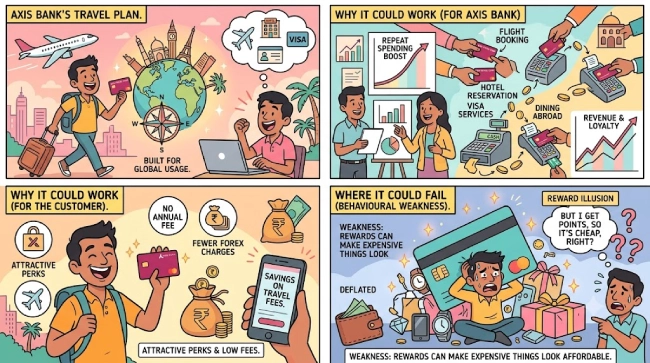
For Axis Bank, travel can create repeat spending across several merchants and countries. A customer may book a flight in India, reserve a hotel, pay for a visa service, and then use the same card abroad. For the customer, fewer forex charges and no annual fee can be attractive. The weakness is behavioural. Credit rewards can make expensive purchases look cheaper than they are.
There is also growing scrutiny around lounge rules and card devaluations. Credit-card discussions on Reddit in 2026 show users comparing 0% forex cards against lounge thresholds, annual fees and international lounge access rather than judging one feature alone. One June discussion involved a 24-year-old salaried traveller planning a Japan trip and looking specifically for low forex costs, lounge access and a low annual fee. Another user called Scapia’s ₹20,000 lounge threshold too high for their spending pattern. These are individual views, but they reflect the exact trade-off issuers now have to address.
For prospective cardholders, 3 checks are more useful than chasing a launch offer. Expected foreign-currency spending comes first. Next is whether the airport-benefit threshold would be crossed through ordinary purchases. Finally, the customer needs enough monthly cash flow to pay the total bill, rather than only the minimum amount due.
Axis Bank’s September 3 partnership with Scapia shows how the credit-card race is moving towards younger, travel-focused customers. The 12.29 crore outstanding-card base gives issuers scale, while rising outbound travel creates several payment points during 1 trip.
For Indian consumers, ₹0 annual fees and 0% forex markup can be useful. The catch is familiar. Rewards do not cancel interest, and airport perks can carry spending conditions. Axis Bank may find its next card-growth pocket in travel, but customer value will depend on what happens after the booking, especially repayment and everyday card use.
It is a co-branded travel credit card launched by Axis Bank and Scapia on September 3, 2026. It combines travel rewards, everyday spending, 0% forex markup, and domestic airport benefits tied to qualifying expenditure.
Younger customers use app-based bookings and digital payments extensively, while travel creates spending across flights, hotels, airport purchases, and overseas transactions. Axis sees that combination as a route to acquire customers earlier and increase card usage over time.
It can help someone who regularly pays in foreign currency because the issuer’s forex markup is removed on eligible international transactions. The traveller should still check merchant currency conversion, ATM withdrawal charges, and repayment costs before using the card abroad.
Not if extra spending is being created only to qualify. The threshold works better for someone who already crosses ₹20,000 through normal eligible purchases. Frequent travellers should compare likely lounge usage with their usual monthly spending.
The IndiGo cards are closely tied to IndiGo BluChips and airline spending. The Scapia card uses a broader travel platform covering flights, hotels, experiences, overseas payments, and eligible everyday spending, with ₹0 joining and annual fees.









.png&w=3840&q=75)


