By continuing, you agree to LoansJagat's Credit Report Terms of Use, Terms and Conditions, Privacy Policy, and authorize contact via Call, SMS, Email, or WhatsApp
Disclaimer: The information published on LoansJagat is intended for general informational and educational purposes only and should not be considered financial, legal, or investment advice. Interest rates, loan terms, statistics, and other data may change over time and may vary by lender or source. Please verify the latest information and consult a qualified financial advisor or the respective Bank/NBFC before making any financial decisions.
Subscribe Now
About the author

LoansJagat Team
‘Simplify Finance for Everyone.’ This is the common goal of our team, as we try to explain any topic with relatable examples. From personal to business finance, managing EMIs to becoming debt-free, we do extensive research on each and every parameter, so you don’t have to. Scroll up and have a look at what 15+ years of experience in the BFSI sector looks like.
Related Blog Post
Simplify All Your Loans Into One Affordable EMI

Customers Served

Debt Consolidated

1200+ Reviews

Locations in India
Club all Loans & Credit Card Bills into Single EMI

Quick Apply Loan
Consolidate your debts into one easy EMI.

Takes less than 2 minutes. No paperwork.

10 Lakhs+
Trusted Customers

2000 Cr+
Loans Disbursed

4.7/5
Google Reviews

50+
Banks & NBFCs Offers
Other services mentioned in this article
India’s BFSI sector faces no systemic scare, but fresh lending may slow as banks deal with geopolitical worries, deposits and cautious borrowers.
Key Takeaways
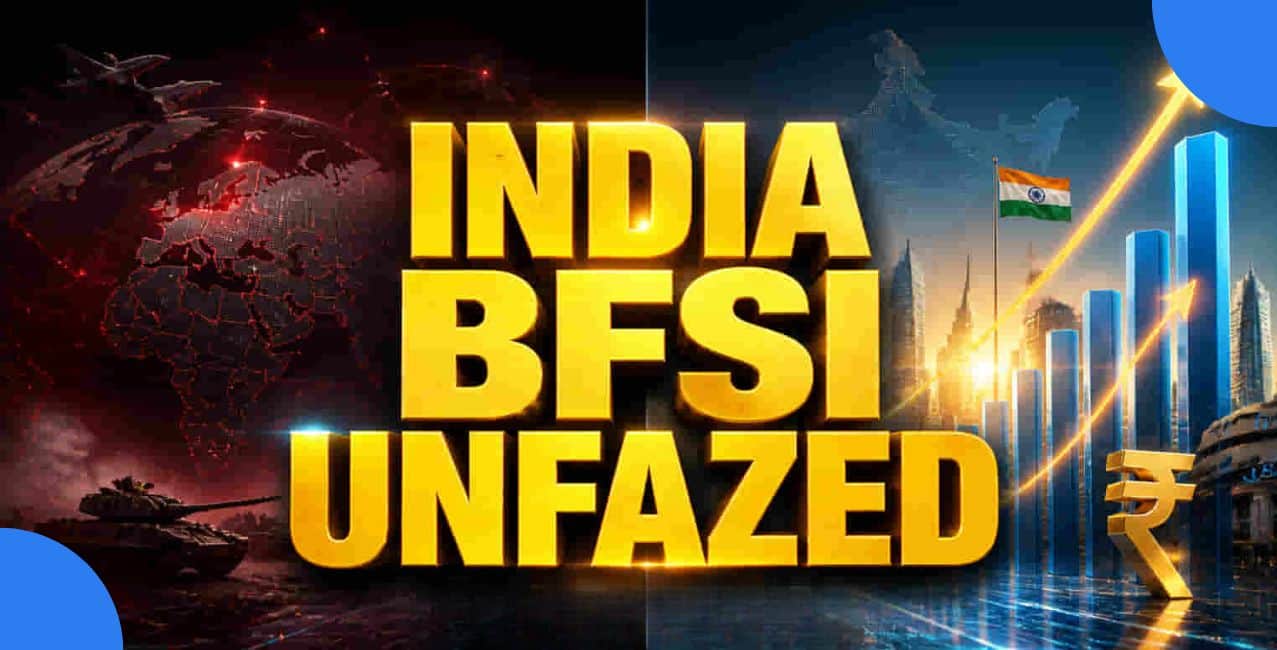
India’s banking and financial services sector is not staring at a crisis, but lenders may become selective. Former HDFC Chairman Deepak Parekh said on 5 May 2026 that BFSI may see a slowdown in business and new loan applications due to geopolitical uncertainty.
In the short term, borrowers could face tighter checks, mainly in unsecured loans and small business credit. In the long term, stronger bank balance sheets, retail demand and MSME lending can support growth, but deposit pressure may keep loan pricing sticky.
The banking system still has solid credit demand, though the pace has started moving unevenly across segments.
The data shows a simple issue. Loan demand is present, but deposits are not rising at the same pace. That can push banks towards higher-cost funding and slow fresh approvals.
For common borrowers, the first impact may come through stricter loan screening. Salaried customers with good repayment records may still get loans, but risky borrowers may face more rejections, lower limits or higher rates.
Small businesses may feel the pressure faster because working capital needs are regular. LoansJagat reported on 6 February 2026 that liquidity tightness hit banks as loan demand rose, with bank loan growth at an 18-month high of 14.5% as of 31 December 2025.
Retail, services and MSME credit are still driving activity, while agriculture and industry are softer.
These numbers suggest that banks are not shutting the tap. They are likely to lend more carefully, especially where borrower income is volatile.
Parekh also said SIP flows helped offset foreign investor selling, with FPIs pulling out $12 billion in January-April 2026. He added that slow deposit mobilisation is linked to household savings moving towards SIPs.
The FICCI-IBA Bankers’ Survey, reported by Business Standard on 19 April 2026, said banks expect 11-13% non-food credit growth in January-June 2026. Financial Express also reported the same survey, adding that bankers flagged cyber risks along with credit growth expectations.
*T&C Apply
India’s BFSI sector is stable, but banks may not chase every loan.
The next phase will be slower, more selective and deposit-linked.
Why Are Banks Worried About Slow Deposit Growth When Loan Demand Is Still Strong?
Banks are worried because deposits are their main fuel for lending. When people move money from FDs to mutual funds, equities or daily expenses, banks get less stable money to give loans. At the same time, loan demand is still rising, so the gap between credit growth and deposit growth becomes a problem.
This can push banks to offer better FD rates, launch new deposit products or borrow at higher cost. For customers, it may mean stricter loan approvals and slightly costlier loans. It is not a banking crisis, but it shows banks need stronger retail deposits.
What happens to a customer’s money if a bank shuts down in India?
If an Indian bank fails, depositors are protected by the Deposit Insurance and Credit Guarantee Corporation, or DICGC. It covers up to ₹5 lakh per depositor, per bank, including both principal and interest. This applies to savings accounts, fixed deposits, current accounts and recurring deposits. If a person has ₹8 lakh in one bank, only ₹5 lakh is insured.
But if the money is kept in different banks, each bank gets separate coverage. The payment is made after the bank goes into liquidation, merger or reconstruction, as per DICGC rules.
Related Finance News | |||









.png&w=3840&q=75)



