By continuing, you agree to LoansJagat's Credit Report Terms of Use, Terms and Conditions, Privacy Policy, and authorize contact via Call, SMS, Email, or WhatsApp
Disclaimer: The information published on LoansJagat is intended for general informational and educational purposes only and should not be considered financial, legal, or investment advice. Interest rates, loan terms, statistics, and other data may change over time and may vary by lender or source. Please verify the latest information and consult a qualified financial advisor or the respective Bank/NBFC before making any financial decisions.
Subscribe Now
About the author

LoansJagat Team
‘Simplify Finance for Everyone.’ This is the common goal of our team, as we try to explain any topic with relatable examples. From personal to business finance, managing EMIs to becoming debt-free, we do extensive research on each and every parameter, so you don’t have to. Scroll up and have a look at what 15+ years of experience in the BFSI sector looks like.
Related News
Simplify All Your Loans Into One Affordable EMI

Customers Served

Debt Consolidated

1200+ Reviews

Locations in India
Club all Loans & Credit Card Bills into Single EMI

Quick Apply Loan
Consolidate your debts into one easy EMI.

Takes less than 2 minutes. No paperwork.

10 Lakhs+
Trusted Customers

2000 Cr+
Loans Disbursed

4.7/5
Google Reviews

50+
Banks & NBFCs Offers
Other services mentioned in this article
Budget 2026-27 sells “Viksit Bharat” through higher capex and jobs schemes, but a tight deficit path and heavy interest costs limit quick wins.
Union Budget 2026-27, presented on February 1, 2026, pitches a development-first playbook for “Viksit Bharat”, with a visible tilt towards public investment, urban growth engines and employability. The big pitch is simple: keep building, keep hiring, and keep the fiscal numbers credible. The challenge is also clear.
The government is raising capital spending while trimming the fiscal deficit only slightly, with debt expected to fall gradually. Rating agencies are already calling the consolidation pace “gradual”.
The core issue is whether the Budget’s “viksit” framing converts into measurable outcomes on the ground, especially jobs and productivity. The government has set capex at ₹12.2 lakh crore for 2026-27 and targeted a fiscal deficit of 4.3% of GDP, down from 4.4% in 2025-26 (RE).
Read More - Groundwork for Affordable, Smarter Credit
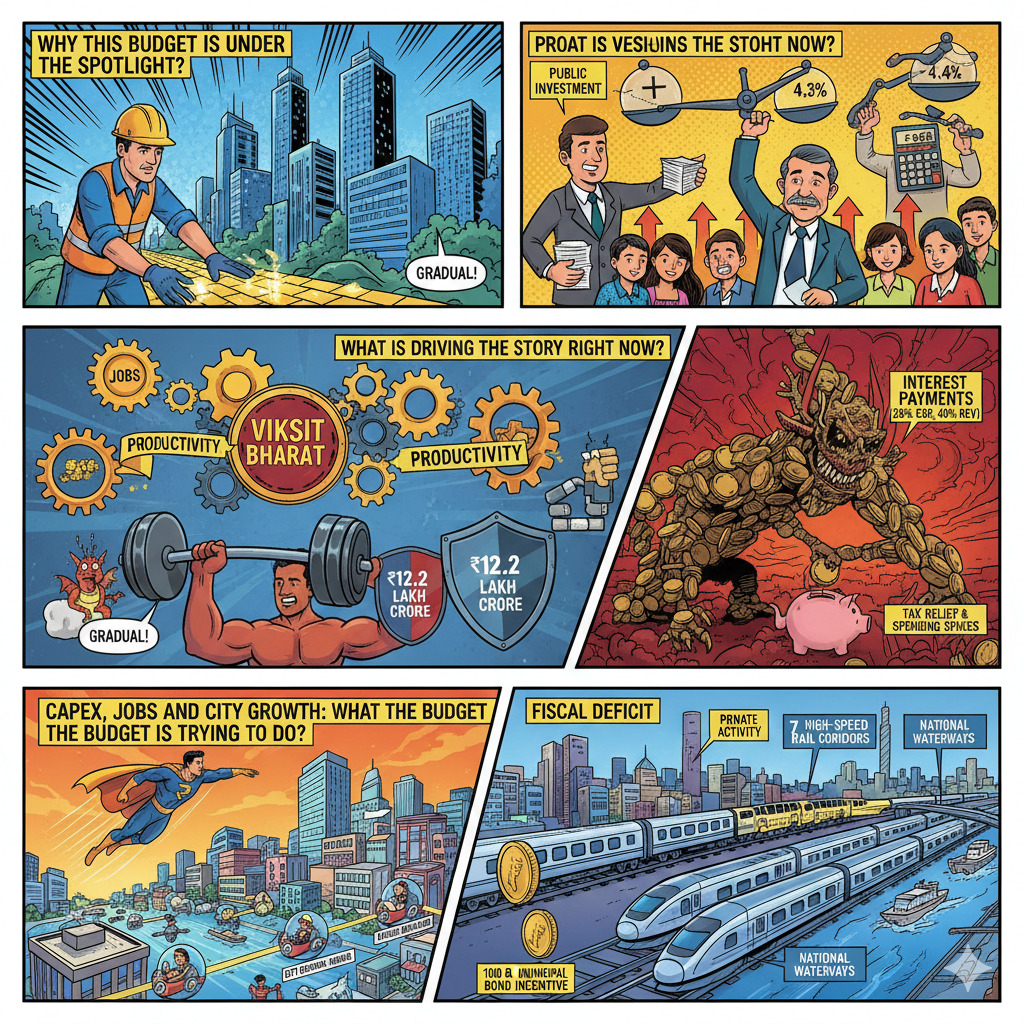
Debt is estimated at 55.6% of GDP in 2026-27 (BE) versus 56.1% in 2025-26 (RE). At the same time, PRS underlines the pressure point: interest payments are 26% of total expenditure and 40% of revenue receipts. That interest load reduces room for large tax relief or sudden spending spikes.
The main play is to keep public investment high and use it to crowd-in private activity, while funding targeted job incentives. Several mainstream outlets flagged the same headline move: capex at ₹12.2 lakh crore and deficit at 4.3%.
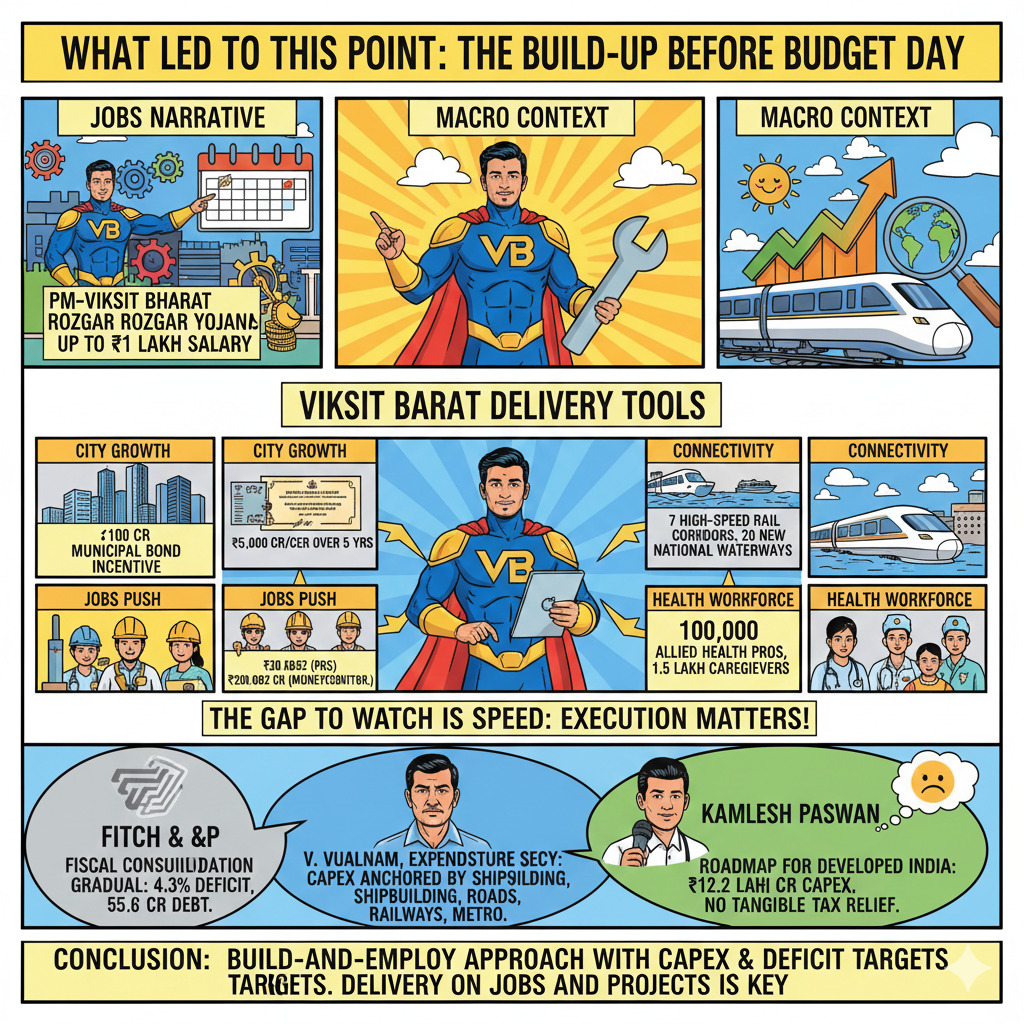
A second layer is where the money and policy attention is going: urbanisation and connectivity. The Budget speech talks about City Economic Regions (CERs) with ₹5,000 crore per CER over 5 years and a ₹100 crore incentive to encourage a single large municipal bond issue by big cities. On transport, it proposes 7 high-speed rail corridors and 20 new National Waterways over 5 years.
The credibility test shifts to execution. A Finance Ministry note through PIB repeats the deficit and debt numbers, reinforcing that the government wants the fiscal story to be read as steady, not risky.
The jobs narrative was already warming up through the PM-Viksit Bharat Rozgar Yojana. A PIB release on January 30, 2026 states the scheme covers employment created between August 1, 2025 and July 31, 2027, and applies to employees with monthly salary up to ₹1 lakh.
On Budget-side funding signals, PRS tables show ₹20,083 crore against Viksit Bharat Rozgar Yojana.
Also Read - Budget 2026 Impact On Real Estate
Moneycontrol, in its Budget coverage, reported an allocation of ₹20,082 crore for the employment-linked incentive scheme, showing how close the headline figure is across public reporting.
The macro context also matters because it shapes how investors and households read Budget promises. LoansJagat, in its Economic Survey coverage dated January 30, 2026, flags the Survey’s growth projection of 6.8% to 7.2% for FY2026-27.
Before the final stakeholder quotes, a quick view of the “Viksit Bharat” delivery tools that show up repeatedly across the speech and coverage.
*T&C Apply
7 high-speed rail corridors; 20 new National Waterways over 5 years
The gap to watch is speed. A capex-heavy Budget looks strong on paper, but citizens usually judge it through local jobs, faster services, and visible project completion.
Reuters reported on February 2, 2026 that Fitch and S&P see fiscal consolidation continuing but at a gradual pace, with the 4.3% deficit and 55.6% debt targets in view.
Expenditure Secretary V. Vualnam was quoted by Economic Times saying capex will be anchored by shipbuilding, roads, railways and metro projects.
On the political pitch, MoS Kamlesh Paswan called it a roadmap for developed India and highlighted ₹12.2 lakh crore capex and about ₹53 lakh crore outlay. On taxpayer sentiment, TOI reported tax expert Mukesh Patel saying there was no tangible relief aligned with inflation.
Budget 2026-27 pushes a clear build-and-employ approach, backed by capex at ₹12.2 lakh crore and a deficit target of 4.3%. The year’s real headline will be delivery, especially jobs and project completion, under a heavy interest bill.









.png&w=3840&q=75)



