
By continuing, you agree to LoansJagat's Credit Report Terms of Use, Terms and Conditions, Privacy Policy, and authorize contact via Call, SMS, Email, or WhatsApp
Disclaimer: The information published on LoansJagat is intended for general informational and educational purposes only and should not be considered financial, legal, or investment advice. Interest rates, loan terms, statistics, and other data may change over time and may vary by lender or source. Please verify the latest information and consult a qualified financial advisor or the respective Bank/NBFC before making any financial decisions.
Subscribe Now
About the author

Arshathul Afia
Arshathul Afia is a journalism graduate and fintech content writer with 4+ years of experience in digital publishing and research-led writing. She has written 200+ articles covering personal finance, lending, banking, digital payments, credit, insurance, and major financial developments in India. At LoansJagat, she focuses on simplifying complex fintech news, RBI updates, loan-related changes, policy developments, and industry trends for everyday readers. Her journalism background helps her approach stories with research, context, and clarity, while her SEO experience ensures content remains discoverable and relevant. She aims to make financial news easier to understand, practical, and useful for readers across India.
Related News
Simplify All Your Loans Into One Affordable EMI

Customers Served

Debt Consolidated

1200+ Reviews

Locations in India
Club all Loans & Credit Card Bills into Single EMI

Quick Apply Loan
Consolidate your debts into one easy EMI.

Takes less than 2 minutes. No paperwork.

10 Lakhs+
Trusted Customers

2000 Cr+
Loans Disbursed

4.7/5
Google Reviews

50+
Banks & NBFCs Offers
EPFO’s 2026 rules let eligible members withdraw 75% of their provident fund balance, offering quicker relief while keeping 25% protected for retirement savings in India.
The change offers quick help during a hospital emergency, a break in salary or another approved expense. It also carries a future cost. An EPF advance is non-refundable, so the withdrawn money does not return to the account unless the employee rebuilds savings through later contributions. The 25% protected portion limits full depletion, but a household without income for several months may still find that restriction difficult.
Also Read: EPFO Portal Update 2026
The biggest gain is earlier access. Under the older framework, the waiting period changed with the purpose and could run up to 7 years. A person who had only recently joined formal employment often could not use PF savings for education, marriage or several housing needs. The common 12-month threshold brings younger workers into the withdrawal system much sooner.
Hospital bills are the most immediate example. A family may need to pay before treatment begins, while insurance reimbursement could arrive later. The Essential Needs category provides access to existing savings. Before comparing the limits, one distinction is necessary: 75% is the maximum available from the eligible balance, not an assured share of the passbook total.
The ₹5 lakh figure needs careful reading. It is a processing ceiling. If a member is eligible for ₹2 lakh, auto-settlement will not increase that entitlement. Mismatched KYC, bank or employment details can also send a claim for manual review.
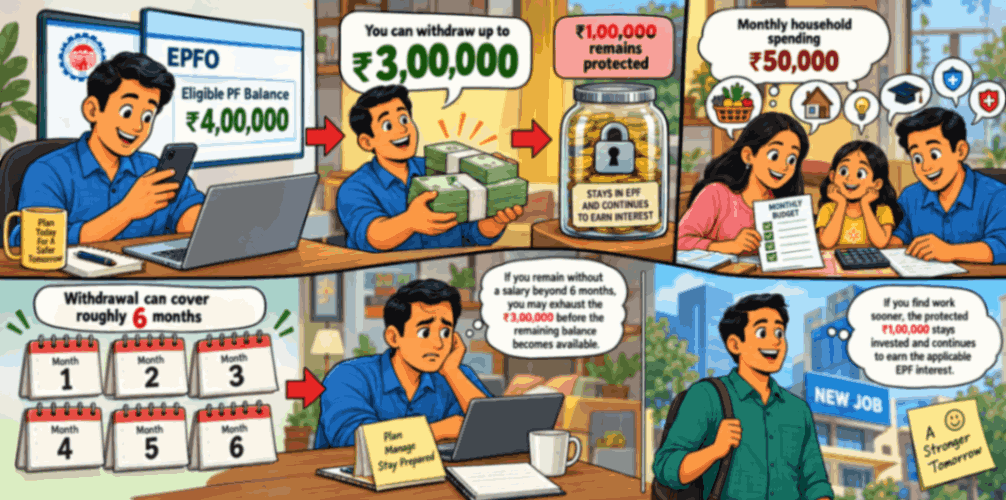
A rupee example gives the rule a practical shape. A member with an eligible PF balance of ₹4,00,000 could access up to ₹3,00,000, leaving ₹1,00,000 protected. If the household spends ₹50,000 a month, the available withdrawal could cover roughly 6 months. The calculation assumes that EPFO accepts the full eligible claim. It does not include other income, insurance payments or earlier advances.
This LoansJagat analysis of EPF withdrawal rules for 2026 shows both sides of the change. The ₹3,00,000 can provide a useful buffer after job loss, yet a worker who remains without salary beyond 6 months may exhaust it before the remaining balance becomes available. For someone who finds work sooner, the protected ₹1,00,000 stays invested and continues to earn the applicable EPF interest.
The present framework began with the 238th meeting of EPFO’s Central Board of Trustees on October 13, 2025. The board approved the merger of 13 partial-withdrawal provisions into Essential Needs, Housing Needs and Special Circumstances. It also standardised the minimum service requirement at 12 months and required members to retain 25% of their contributions.
Earlier rules produced different outcomes. A medical advance was generally limited to the lower of 6 months’ basic wages plus dearness allowance or the employee’s share with interest. Education and marriage advances were commonly restricted to 50% of the employee’s share, with a combined limit of 3 claims. Housing followed another formula.
The Ministry of Labour and Employment said the protected balance was introduced because repeated withdrawals left many workers with very small sums at final settlement. The government’s October 15, 2025, clarification reported that 50% of members had less than ₹20,000 at final settlement and 75% had less than ₹50,000. Keeping 25% invested was presented as a way to prevent the account from being emptied during working years.
The legal transition followed when the Employees’ Provident Funds Scheme, 2026, was notified through G.S.R. 525(E) on June 29, 2026, under the Code on Social Security, 2020.
Financial specialists support access during genuine hardship, but not automatic withdrawal after a job change. Swati Jain, CEO, Wealth at Arihant Capital Markets, told The Economic Times in August 2026 that transferring the balance to the new employer’s PF account is generally preferable, unless immediate cash is needed or the employee is leaving permanently.
Nikunj Saraf, CEO of Choice Wealth, has warned that EPF and EPS follow separate rules. A member with less than 10 years of eligible EPS service may qualify for a withdrawal benefit. After 10 years, the member generally moves towards pension eligibility instead of a lump sum.
For unemployed members, Sriram V, CHRO at BankBazaar, explained that EPFO identifies unemployment through the absence of monthly contributions. An outdated exit date or a late contribution can therefore affect how the system reads a claim.
PF should be used after checking insurance, emergency savings and employer benefits. If withdrawal remains necessary, the employee can claim only the cash shortage. Later contributions can begin rebuilding the amount removed.
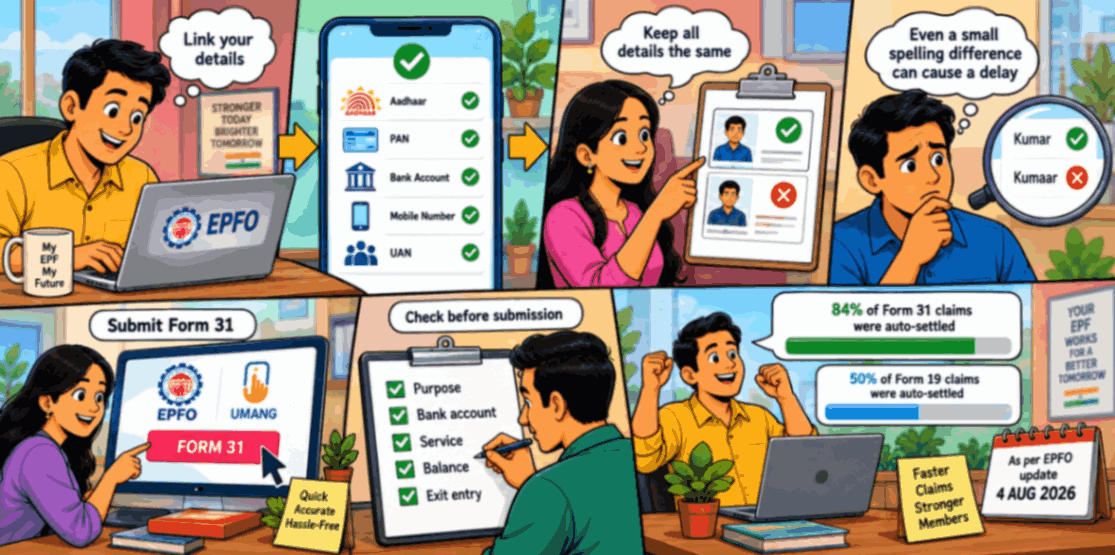
Uttam Prakash advised members to link an active Universal Account Number with Aadhaar, PAN, an operating bank account and a current mobile number. Personal details should match across EPFO and Aadhaar records. A spelling difference may push a case out of automated processing.
Members can submit Form 31 through the EPFO portal or UMANG application. Before Aadhaar authentication, the claimant should check the selected purpose, bank account, service, balance and exit entry. EPFO reported on August 4, 2026, that 84% of Form 31 claims nationally were auto-settled, against 50% of Form 19 claims.
The 2026 rules give salaried workers earlier access during illness, unemployment, housing needs and other eligible situations. A single 12-month threshold is easier to follow, while automated processing can shorten the wait.
An advance still takes money away from retirement. The 25% retention rule protects part of the account, while 75% offers immediate support. A routine job switch is better handled through transfer. Checking KYC, service history and the cash shortage can prevent rejection and an unnecessarily large withdrawal.
An eligible member with 12 months of contributory service may withdraw up to 75% of the eligible PF balance. The sanctioned amount can be lower because EPFO checks the claim type, available balance and earlier withdrawals.
No. ₹5 lakh is the ceiling for automated processing of eligible advances. It does not increase a member’s entitlement. EPFO will approve only the amount allowed by the member’s record and scheme conditions.
Yes. An employed member can submit a partial advance for an eligible medical need. Under the revised framework, illness falls under Essential Needs, subject to the service requirement and eligible balance displayed by EPFO.
The 2026 framework protects 25% of the eligible balance for retirement. The portal may show less than 75% when previous claims, unavailable contributions or incomplete service reduce the amount eligible for withdrawal.
No. EPF holds provident fund savings, while EPS provides pension benefits. EPS eligibility depends heavily on service history, especially the 10-year threshold. Members should check both records before filing a final claim.









.png&w=3840&q=75)


