
By continuing, you agree to LoansJagat's Credit Report Terms of Use, Terms and Conditions, Privacy Policy, and authorize contact via Call, SMS, Email, or WhatsApp
Disclaimer: The information published on LoansJagat is intended for general informational and educational purposes only and should not be considered financial, legal, or investment advice. Interest rates, loan terms, statistics, and other data may change over time and may vary by lender or source. Please verify the latest information and consult a qualified financial advisor or the respective Bank/NBFC before making any financial decisions.
Subscribe Now
About the author

Arshathul Afia
Arshathul Afia is a journalism graduate and fintech content writer with 4+ years of experience in digital publishing and research-led writing. She has written 200+ articles covering personal finance, lending, banking, digital payments, credit, insurance, and major financial developments in India. At LoansJagat, she focuses on simplifying complex fintech news, RBI updates, loan-related changes, policy developments, and industry trends for everyday readers. Her journalism background helps her approach stories with research, context, and clarity, while her SEO experience ensures content remains discoverable and relevant. She aims to make financial news easier to understand, practical, and useful for readers across India.
Related Blog Post
Simplify All Your Loans Into One Affordable EMI

Customers Served

Debt Consolidated

1200+ Reviews

Locations in India
Club all Loans & Credit Card Bills into Single EMI

Quick Apply Loan
Consolidate your debts into one easy EMI.

Takes less than 2 minutes. No paperwork.

10 Lakhs+
Trusted Customers

2000 Cr+
Loans Disbursed

4.7/5
Google Reviews

50+
Banks & NBFCs Offers
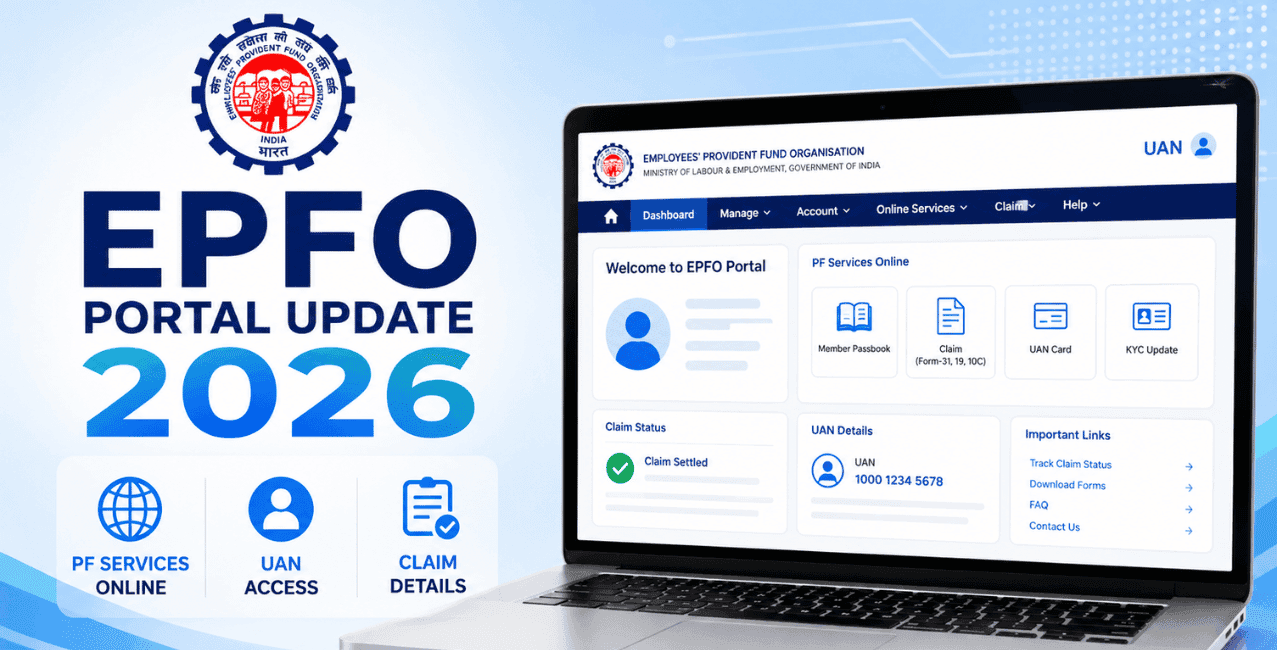
According to EPFO’s official Member Portal, claims, KYC, transfers and passbooks are online, while members must first verify Aadhaar, bank and employment records before applying.
The short-term snag is the new route for UAN work. Direct UAN allotment and activation are no longer completed through the web portal. Members must use Aadhaar-based Face Authentication on UMANG. Over time, this can reduce incorrect identity data and employer dependence. For now, an old Aadhaar-linked mobile number, facial-authentication failure or weak internet connection may stop some users before they reach the wider services.
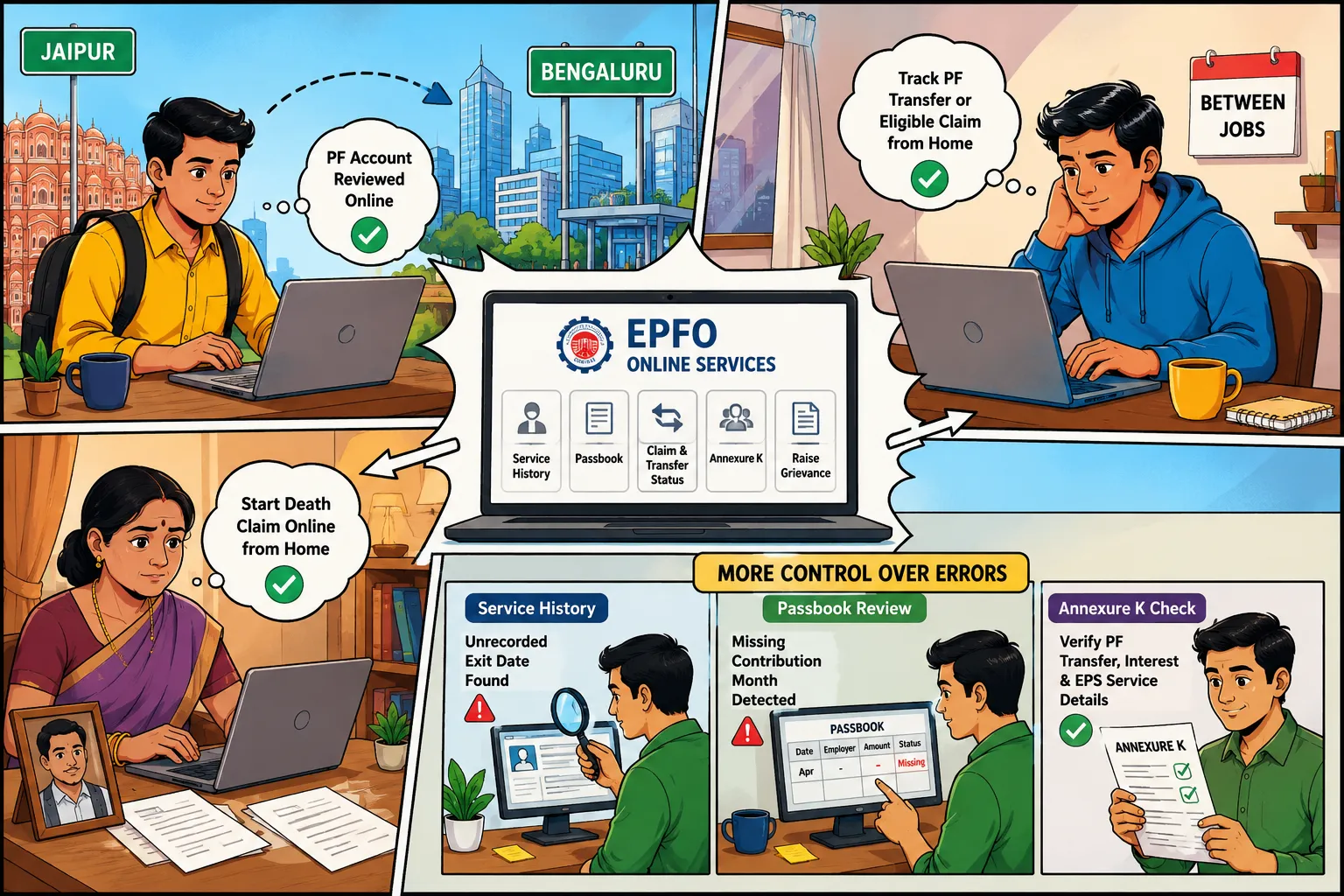
An employee who has moved from Jaipur to Bengaluru can review an old PF account without returning to the previous workplace. Someone between jobs can track a transfer or eligible claim from home. A family member handling a death claim can start online, although supporting records still depend on the benefit claimed.
Workers also gain more control over errors that often remain hidden until money is needed. The service-history page can expose an unrecorded exit date. A passbook review can show a missing contribution month. Online Annexure K can help a member check whether transferred PF money, interest and EPS service details reached the present account. These checks do not settle a claim, but they can reveal the problem earlier.
PF specialists place record accuracy ahead of portal speed. A claim can fail when the name on Aadhaar differs from the UAN profile, the bank account has closed, an IFSC has changed after a merger or 2 employment periods overlap. Selecting the wrong form can cause another rejection. The portal only changes where the request is filed. It does not remove the eligibility test attached to Form 19, Form 10C or Form 31.
The workable solution is a pre-claim audit. Members should compare Aadhaar, PAN, bank and UAN entries character by character, then inspect the service history. LoansJagat’s borrower-facing analysis adds a useful step: verify the bank account before choosing the claim form. Its 9 July 2026 guide explains the online PF withdrawal process for Forms 31, 19 and 10C. Correcting a record before submission is usually easier than chasing a rejection later.
Members should begin with identity and employment records, not the displayed balance. The following table separates each service from the check most likely to affect it.
Online availability must not be mistaken for automatic approval. EPFO still checks KYC, service history, bank validation and the withdrawal rule. Members employed by exempted establishments may also need a statement from the employer’s recognised PF trust because the regular EPFO passbook may not display the full balance.
A second check should cover account security. EPFO says it does not seek Aadhaar, PAN, bank details, passwords or money through telephone calls. Members should avoid search-result advertisements that imitate a helpdesk. If a request remains unresolved, they can use EPFiGMS and retain the grievance number for follow-up.
The current interface follows several reforms introduced during 2025. EPFO moved towards Aadhaar Face Authentication for direct UAN allotment, activation of existing UANs and authentication of active accounts. This route draws identity details from Aadhaar and connects the mobile number used for OTP verification.
At its 239th Central Board meeting, reported by the Press Information Bureau on 2 March 2026, EPFO said earlier digital measures had simplified claims, online transfers and corrections. They also enabled the delinking of erroneous UAN records and wider use of online joint declarations. Those changes dealt with the records behind claims, rather than only redesigning the screen.
Late June 2026 brought the next visible stage. EPFO carried out scheduled system migration, and member and employer services resumed on 3 July 2026 with a refreshed interface. UAN activation stayed with UMANG. Other facilities, including UAN retrieval and death-claim filing, remained accessible through the web system.
EPFO’s stated position is that Face Authentication can reduce wrong entries at the point of UAN creation. It also allows a worker to generate and activate a UAN without waiting for the employer to complete the first step. For a new employee with matching Aadhaar data and a working mobile number, that can shorten onboarding.
Employers have raised a different concern. On 11 August 2025, Southern India Mills’ Association Secretary General K Selvaraju reported app crashes, server errors and problems mapping UANs for employees with previous jobs. The association said the difficulties had delayed UAN generation for member mills. That earlier complaint remains relevant because a phone-based process can still exclude a worker when the app, camera or identity match fails.
Employers can help first-time workers complete activation without taking control of their credentials. EPFO offices can handle corrections needing verification. Members should keep screenshots, acknowledgement numbers and copies of submitted records. A digital trail helps when a request needs escalation.
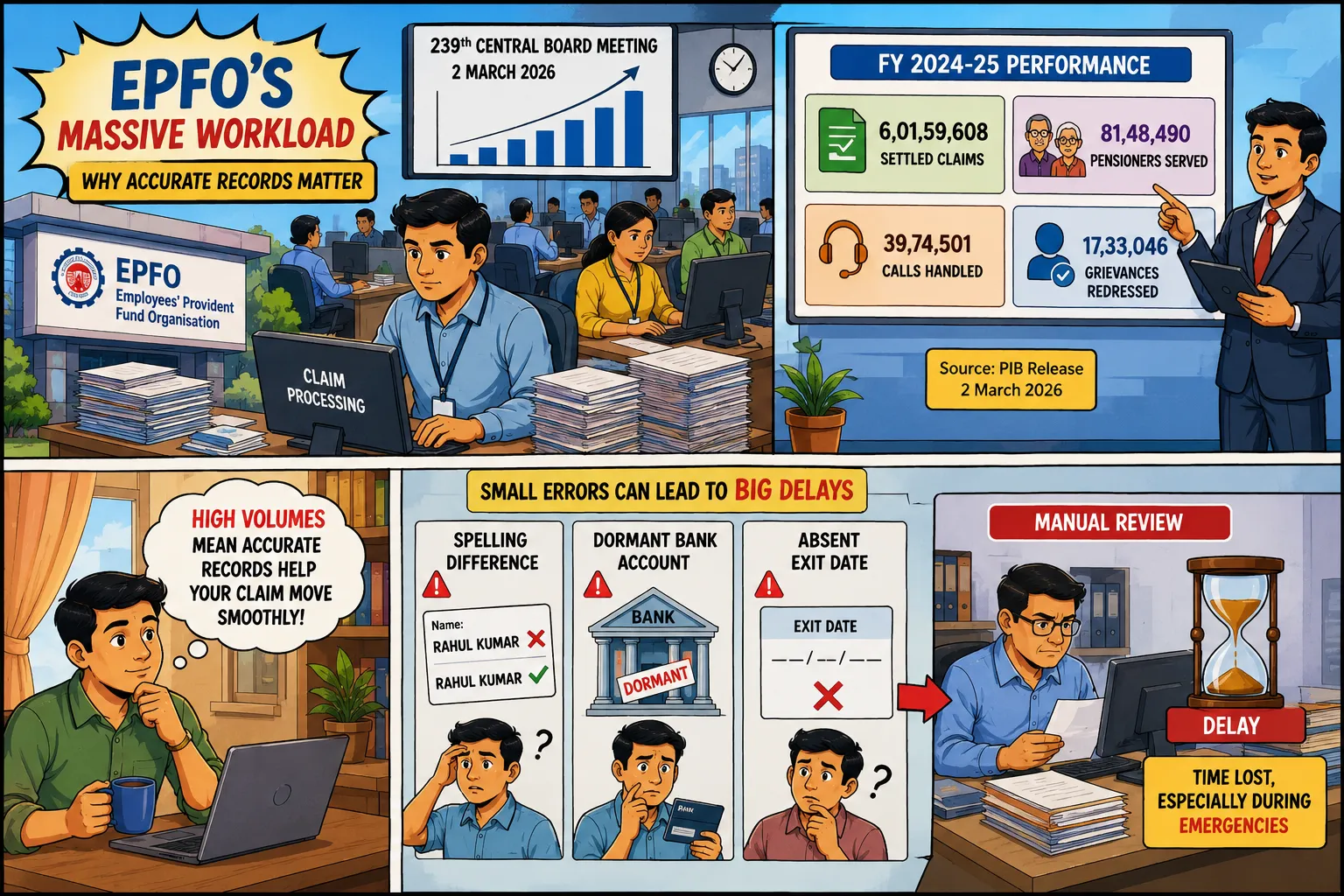
EPFO processes requests at a scale where automated checks are unavoidable. At the 239th Central Board meeting on 2 March 2026, the organisation reported 6,01,59,608 settled claims, 81,48,490 pensioners served, 17,33,046 grievances redressed and 39,74,501 calls handled during FY 2024-25. The figures were published in the linked PIB release on the same date.
For members, the useful reading of these numbers is not that every case will move quickly. High volumes increase the value of correct input. A spelling difference, dormant bank account or absent exit date can move a request out of routine processing and into manual review. That costs time, particularly during an emergency withdrawal.
The EPFO portal update gives members wider online access, but the safest first action is still a full record check. Aadhaar, PAN, bank information, Member IDs, joining dates, exit dates, passbook entries and nomination details should agree before a claim or transfer request is submitted.
For a member with accurate records, the change can cut travel and employer follow-ups. Someone carrying an older error may need correction before the new interface becomes useful. The portal opens the door. The account data decides how far the request goes.
Members can use online claims, passbooks, KYC changes, transfers, UAN retrieval, e-nomination, claim tracking and death-claim facilities.
No. New UAN allotment and activation now use Aadhaar Face Authentication through the UMANG app.
EPFO may reject it for KYC mismatches, wrong bank details, missing service dates, ineligibility or selection of the wrong form.
The member must connect the old PF account to a UAN, correct any record mismatch and submit Form 13 for transfer.
No. The member should update or correct the date of exit in EPFO records before submitting a final-settlement claim.








.png&w=3840&q=75)


