

By continuing, you agree to LoansJagat's Credit Report Terms of Use, Terms and Conditions, Privacy Policy, and authorize contact via Call, SMS, Email, or WhatsApp
Disclaimer: The information published on LoansJagat is intended for general informational and educational purposes only and should not be considered financial, legal, or investment advice. Interest rates, loan terms, statistics, and other data may change over time and may vary by lender or source. Please verify the latest information and consult a qualified financial advisor or the respective Bank/NBFC before making any financial decisions.
Subscribe Now
About the author

Arshathul Afia
Arshathul Afia is a journalism graduate and fintech content writer with 4+ years of experience in digital publishing and research-led writing. She has written 200+ articles covering personal finance, lending, banking, digital payments, credit, insurance, and major financial developments in India. At LoansJagat, she focuses on simplifying complex fintech news, RBI updates, loan-related changes, policy developments, and industry trends for everyday readers. Her journalism background helps her approach stories with research, context, and clarity, while her SEO experience ensures content remains discoverable and relevant. She aims to make financial news easier to understand, practical, and useful for readers across India.
Related Blog Post
Simplify All Your Loans Into One Affordable EMI

Customers Served

Debt Consolidated

1200+ Reviews

Locations in India
Club all Loans & Credit Card Bills into Single EMI

Quick Apply Loan
Consolidate your debts into one easy EMI.

Takes less than 2 minutes. No paperwork.

10 Lakhs+
Trusted Customers

2000 Cr+
Loans Disbursed

4.7/5
Google Reviews

50+
Banks & NBFCs Offers
Indian homebuyers currently face the highest indicative rate among 4 major markets, while personal-loan pricing remains closest to the latest US commercial-bank average.
As of August 25, 2026, large Indian lenders advertise home loans from about 7.20%. That is above the US 30-year fixed mortgage average of 6.65%, the UK’s 4.35% effective rate on new mortgages and China’s new housing-loan rate of roughly 3.05%. Indian borrowers, major banks and housing buyers are directly involved in this widening international rate gap.
The short-term result is a larger EMI for Indian households. Over 20 or 30 years, the difference adds heavily to total interest and may force buyers to reduce their property budget. Personal loans show a narrower divide. Indian pricing is near the US average but remains above the latest UK figure and China’s unusually low consumer-loan rates.
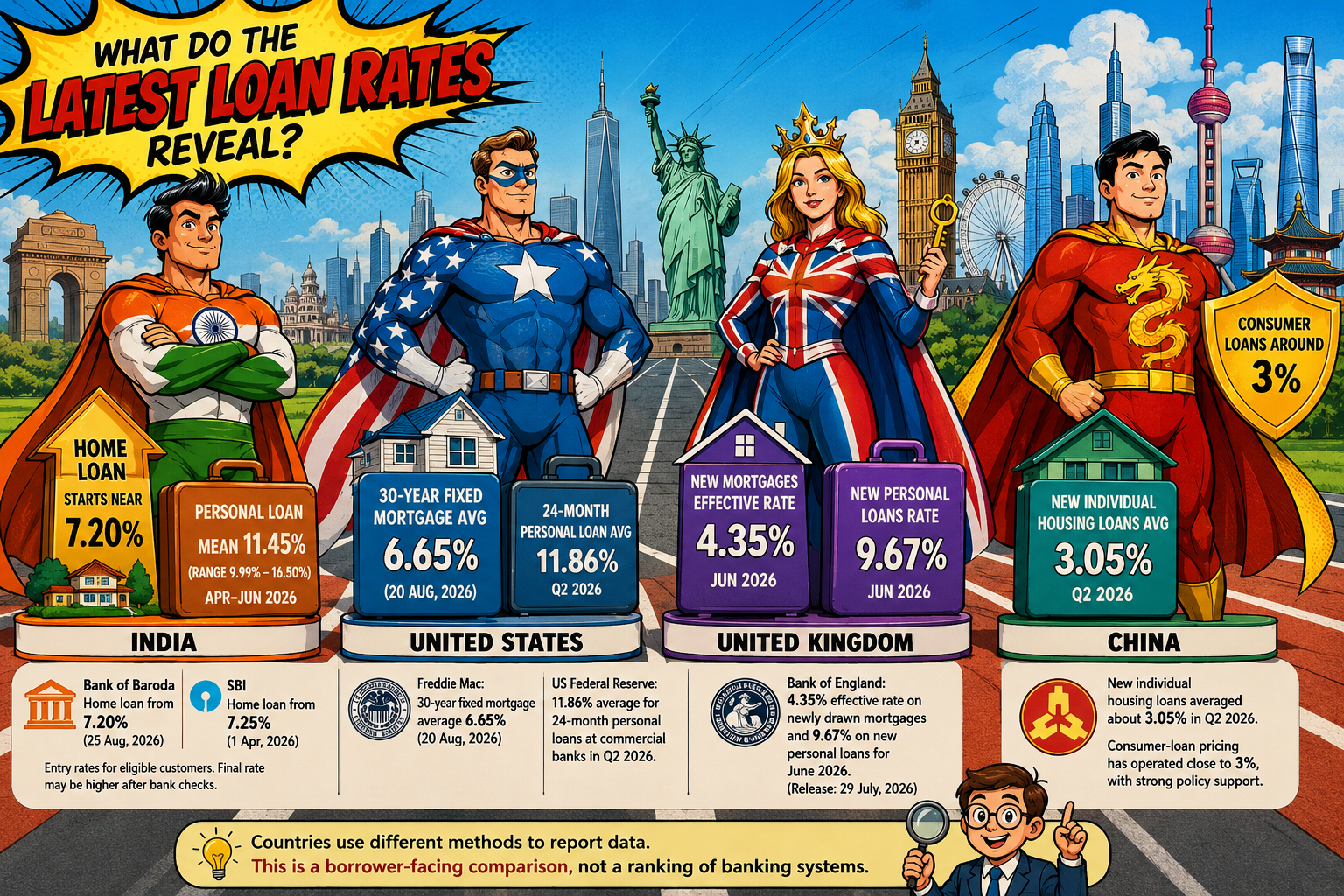
India ranks as the costliest home-loan market in this 4-country snapshot. Bank of Baroda displayed home-loan pricing from 7.20% on August 25, 2026, while SBI’s published offer started at 7.25%, effective April 1, 2026. These are entry rates for eligible customers. Many applicants receive a higher rate after the bank checks income, credit history, loan size and property documents.
The countries do not publish household credit data through one common method. The table therefore separates advertised rates from effective and national average rates. It gives a borrower-facing comparison, not a ranking of the wider banking systems.
The housing result is fairly direct. India’s starting rate exceeds the other 3 readings. Personal loans need more care. The 11.45% Indian figure is a mean disclosed by 1 major bank, while the US number covers commercial banks nationally. The UK figure records new loans actually issued. China’s roughly 3% consumer-loan pricing comes from a heavily supported credit system.
For an Indian buyer, a difference of half a percentage point can alter the property search. A household may choose a smaller flat, bring a larger down payment or extend the loan tenure. Each route carries a cost. A smaller flat may not suit a growing family, while a longer tenure keeps the borrower in debt for more years.
A rate-only calculation shows the impact. A ₹50 lakh loan over 20 years produces an EMI of roughly ₹39,367 at 7.20%. At 6.65%, the EMI would be close to ₹37,721. The difference is about ₹1,646 each month and nearly ₹3.95 lakh across 240 installments. The illustration excludes processing fees and insurance, but it shows how a modest rate gap builds over time.
There is still a positive route for applicants with strong profiles. Banks compete aggressively for salaried borrowers with dependable income, lower existing debt and good repayment records. A higher down payment can also reduce the lender’s risk. That may help the applicant qualify for the lower end of the advertised rate band.
Freddie Mac Chief Economist Sam Khater said on August 20, 2026, that the dip in US mortgage rates provided modest relief. He added that “borrowers can potentially save thousands by shopping around for the best mortgage rate.” Indian borrowers face the same choice, though loan pricing and reset rules differ.
The practical solution begins with the complete repayment cost. Applicants should compare the sanctioned rate, processing charge, legal fee, insurance requirement and prepayment condition. A floating home loan may change at the next reset, while a fixed personal loan generally keeps the instalment unchanged. Borrowers should also request the applicable spread in writing. The lowest website advertisement may not be the rate offered after verification.
Existing customers have another option. A balance transfer can reduce interest when the new rate is sufficiently lower and several years remain on the loan. Yet switching creates fresh costs. Valuation charges, documentation expenses and processing fees can absorb the early savings, especially when the outstanding balance is already small.
Indian bank advertisements usually show the lowest available rate. That figure may apply to a limited group with a high credit score, stable employment and a lower loan-to-value ratio. ICICI Bank’s April to June 2026 disclosure illustrates the gap. Its personal-loan range began at 9.99%, while the reported mean stood at 11.45%. Processing charges could reach 2% plus taxes.
Freddie Mac follows another route for its US mortgage figure. Its weekly survey uses rates collected from thousands of loan applications submitted by lenders. The 6.65% reading focuses on conventional conforming home-purchase loans and reflects a national average for a defined borrower group.
Britain’s 4.35% mortgage figure is an effective rate recorded on newly drawn borrowing in June 2026. China publishes benchmark and weighted loan readings, with lenders pricing many mortgages around longer-term loan prime rates. A direct comparison remains useful, but only when each number keeps its original label.
Read Also : EPF Withdrawal for Indians Moving Abroad in 2026: 36-Month EPS Rule Explained
The gap was already visible early in the year. LoansJagat reported on February 25, 2026, that aggregated Indian lender listings showed home loans from 7.10% as of February 4. The US 30-year fixed mortgage average had fallen to 6.01% on February 19.
By August, Indian starting offers remained broadly in the low-7% band. The US average moved back to 6.65%, reducing the gap without overtaking India. UK borrowing costs increased during spring, though the June mortgage reading stayed well below Indian offers.
China kept its loan prime rates unchanged on August 20, 2026. The State Council of China’s official website reported the 1-year LPR at 3% and the over-5-year LPR at 3.50%. Wang Qing, Chief Macro Analyst at Golden Credit Rating, said policy remained in an observation period as investment and consumption momentum weakened after Q2 began.

Chinese policymakers continue to favour low financing costs as they try to support household spending and housing demand. People’s Bank of China Deputy Governor Zou Lan said interest-rate levels would be guided by economic conditions, price movements and policy needs. Low rates there reflect policy support as well as weak credit demand.
Indian lenders place greater weight on the applicant. Their published terms show that income stability, repayment history, employer category and existing EMIs can shift the final offer. This gives borrowers some control before applying. Closing a costly personal loan, correcting credit-report errors and lowering the requested home-loan amount can improve the bank’s assessment.
LoansJagat’s February borrower analysis also pointed to reset timing. A lower lending rate does not always reach every floating-rate customer at once. The benefit may appear only when the loan reaches its scheduled reset date, or after the lender formally changes the applicable spread.
Read Also : ITAT Upholds ₹23.92 Crore Relief in Black Money Act Case
Indian homebuyers currently pay the highest indicative rate among the 4 markets examined. The gap with the US is smaller than it was earlier in 2026, but UK and Chinese borrowing costs remain far lower.
Personal-loan pricing places India closer to the US. For borrowers, the final decision should rest on the sanctioned rate, charges, tenure and reset date. A headline rate starts the comparison. The loan agreement finishes it.
By late August 2026, the lowest advertised offers from large Indian banks were bunched around 7.20% to 7.25%. That is the front-window price, though. Someone with patchy income, a modest credit record or a smaller down payment may get a costlier offer.
China, by a fair distance. New housing loans were running near 3.05%, against 4.35% in the UK and 6.65% in the US. India’s entry point was roughly 7.20%. Since the products differ, the ranking shows the broad rate gap rather than an identical loan comparison.
The bank has less to fall back on. A home loan is backed by the property being purchased, whereas a personal loan usually has no asset attached. Recovery becomes harder when repayments stop. Lenders price that added risk into the rate offered to the customer.
The answer changes from one applicant to another. A bank may quote its lowest rate to a salaried borrower with a strong credit score, then price a self-employed customer differently. Comparing sanction letters works better than comparing website banners. Processing charges need checking too.
A transfer may help when the new rate is sufficiently lower and several repayment years remain. Processing, valuation, legal and documentation expenses must be deducted from the expected saving.








.png&w=3840&q=75)


