

By continuing, you agree to LoansJagat's Credit Report Terms of Use, Terms and Conditions, Privacy Policy, and authorize contact via Call, SMS, Email, or WhatsApp
Disclaimer: The information published on LoansJagat is intended for general informational and educational purposes only and should not be considered financial, legal, or investment advice. Interest rates, loan terms, statistics, and other data may change over time and may vary by lender or source. Please verify the latest information and consult a qualified financial advisor or the respective Bank/NBFC before making any financial decisions.
Subscribe Now
About the author

Arshathul Afia
Arshathul Afia is a journalism graduate and fintech content writer with 4+ years of experience in digital publishing and research-led writing. She has written 200+ articles covering personal finance, lending, banking, digital payments, credit, insurance, and major financial developments in India. At LoansJagat, she focuses on simplifying complex fintech news, RBI updates, loan-related changes, policy developments, and industry trends for everyday readers. Her journalism background helps her approach stories with research, context, and clarity, while her SEO experience ensures content remains discoverable and relevant. She aims to make financial news easier to understand, practical, and useful for readers across India.
Related Blog Post
Simplify All Your Loans Into One Affordable EMI

Customers Served

Debt Consolidated

1200+ Reviews

Locations in India
Club all Loans & Credit Card Bills into Single EMI

Quick Apply Loan
Consolidate your debts into one easy EMI.

Takes less than 2 minutes. No paperwork.

10 Lakhs+
Trusted Customers

2000 Cr+
Loans Disbursed

4.7/5
Google Reviews

50+
Banks & NBFCs Offers
The Supreme Court has asked the Union government to examine alleged private access to EPFO and tax records, raising fresh concerns over consent and employee privacy.
In the short term, the allegation affects job applicants whose records may be checked by employers or screening agencies. Wrong dates, an old member ID, or a brief job omitted from a résumé could trigger questions during hiring. A wider risk appears if Form 26AS, AIS or ITR information reaches a commercial service without proper approval. That could expose income patterns, tax deductions and financial transactions to organisations that have no stated reason to see them.
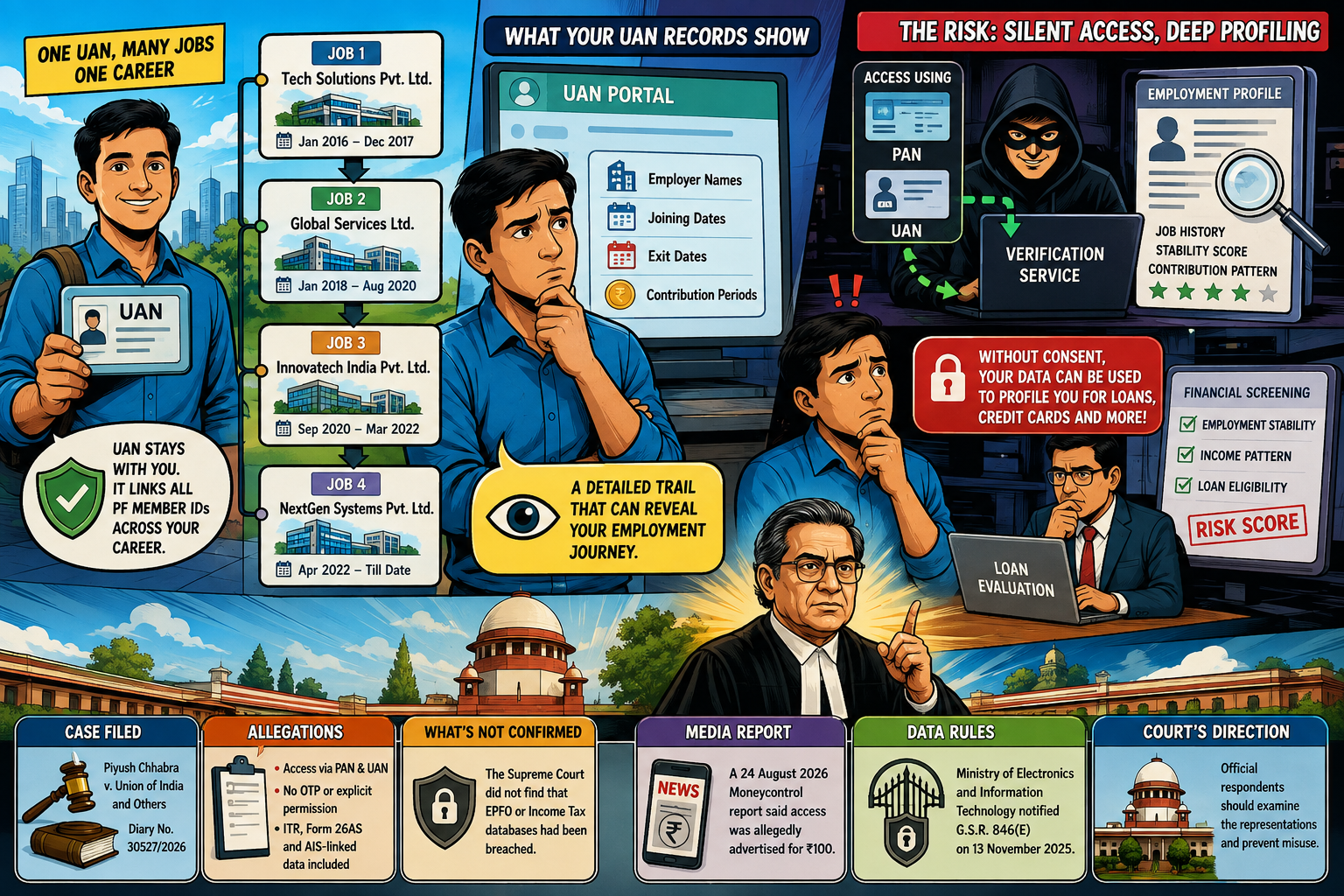
A UAN stays with an employee across different jobs and connects employer-specific PF Member IDs. That makes transfers and pension service easier. It also creates a detailed trail. A person who has changed jobs several times may have records showing employer names, joining dates, exit dates and contribution periods under the same UAN.
LoansJagat’s explanation of PF Member IDs and UAN records notes that each employer generally creates a separate Member ID while the UAN links those records through a worker’s career. LoansJagat’s editorial view is that the biggest risk for borrowers appears when employment verification and financial screening begin using the same identifiers. A PF record can support a genuine loan application, but silent access could allow a third party to profile employment stability without telling the applicant.
Before drawing a conclusion, the claims and the Court’s action need to be kept separate. The table records that difference and also shows what remains open for investigation.
The table does not show that every UAN verification product is illegal. An authorised check based on informed permission is different from a search carried out without the employee’s knowledge. The government now has to identify which route the named services used and whether that route had legal approval.
Read Also : NRIs With Inoperative PAN May Avoid ₹1,000 Aadhaar Linking Fee
The Bench reportedly favoured a policy response supported by domain specialists. Investigators may need to review access logs, repeated searches, automated requests and credential use across EPFO and Income Tax systems. They may also test whether entering a PAN and UAN combination returns information without an additional identity check. A review should list every authorised interface and compare it with services sold by background-verification firms. If a service relies on credentials supplied by a recruiter, investigators must check whether the employee approved that use and knew which records would be collected.
Consent records need equal attention. A job application may contain a general background-check clause, yet that does not automatically explain access to PF contributions or tax statements. A better process would name the data requested, identify the receiving company, state why the record is required and tell the applicant how long it will be retained. OTP authentication can support that process. It cannot replace informed permission. The EPFO Unified Member Portal already warns members not to share UAN passwords. It also states that EPFO does not seek Aadhaar, PAN or bank details through telephone calls. Employees who receive such requests should use EPFO’s official grievance facility and keep screenshots, emails and transaction references.
Before filing the PIL, Piyush Chhabra reportedly sent representations to the Ministry of Labour and Employment, EPFO, MeitY and CERT-In. The complaints asked how records collected under statutory requirements appeared to be available within private employment-verification systems. They also asked whether the access came from an authorised facility, a weak consent process or a technical vulnerability.
Other representations went to the Ministry of Finance, Income Tax Department and Central Board of Direct Taxes. The petitioner wanted the departments to establish whether commercial screening companies could lawfully obtain ITR, Form 26AS and AIS-linked records.
Years before Chhabra filed his plea, the Supreme Court had already placed privacy among India’s fundamental rights. The ruling came in 2017, when a 9-judge Bench delivered its decision in Justice K.S. Puttaswamy v. Union of India. Chhabra later relied on Articles 14, 19(1)(g) and 21, arguing that personal records should not be disclosed, transferred or sold without lawful permission.
India’s digital-data rules arrived much later. On 13 November 2025, MeitY issued G.S.R. 846(E), with different provisions starting at different stages. The rules covering security checks, access logs and breach reporting received an 18-month rollout period. Officials examining Chhabra’s complaint will therefore have to check which legal protections applied when the alleged access took place.
Read Also : Tax Regime Switch Alert: Business Taxpayers Must File Form 10-IEA By August 31
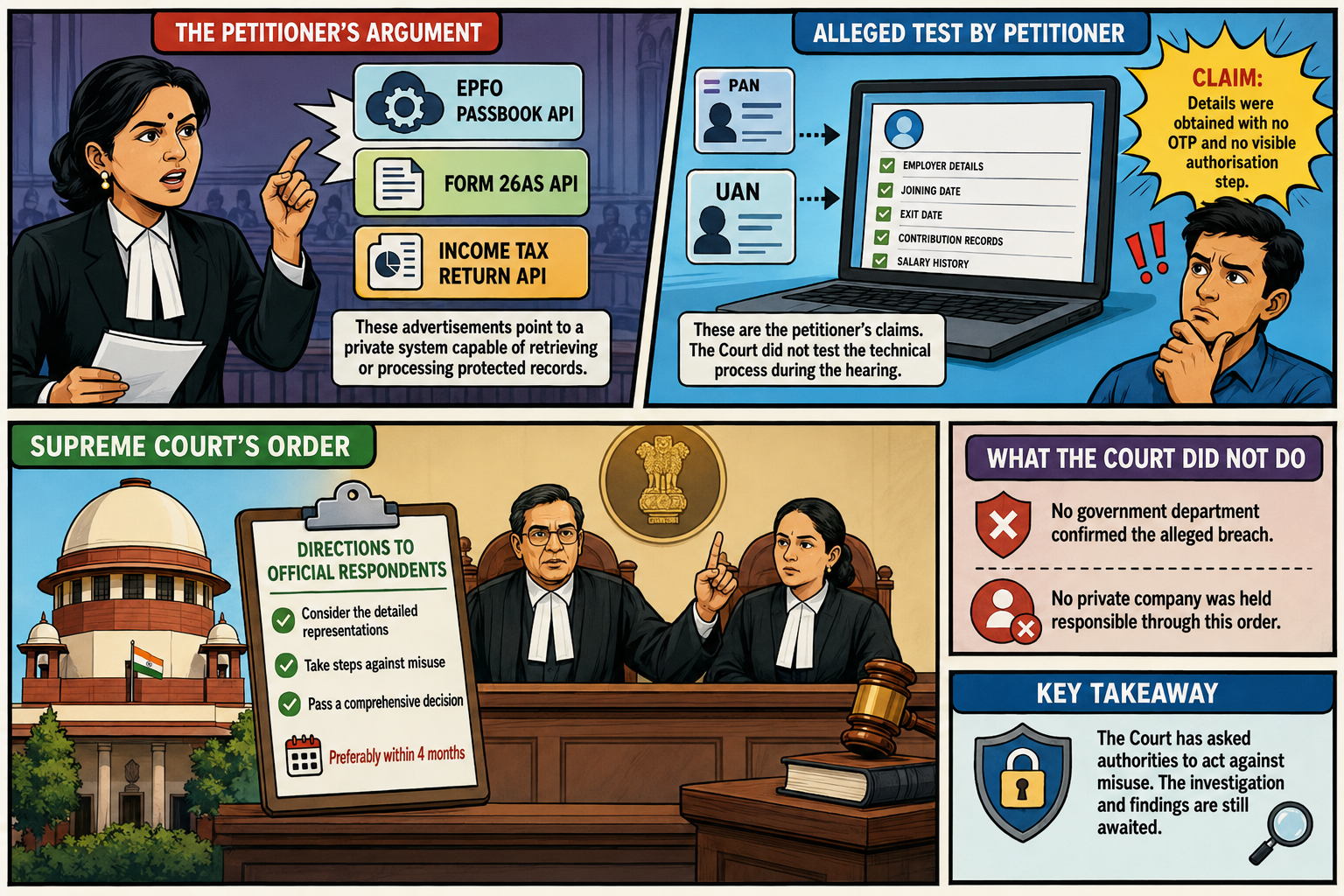
Senior Advocate Ruchi Kohli, appearing for Chhabra, referred to commercial descriptions such as “EPFO Passbook API," “Form 26AS API” and “Income Tax Return API." The petitioner argued that these advertisements pointed to a private system capable of retrieving or processing protected employment and financial records.
Counsel also described a test in which details connected with known individuals were allegedly obtained after PAN and UAN information was supplied. The submission said no OTP was generated and no visible authorisation step appeared. These remain the petitioner’s claims. The Court did not test the technical process during the hearing.
The Bench disposed of the PIL after directing the official respondents to consider the detailed representations and take steps against misuse. It sought a comprehensive decision preferably within 4 months. No government department had publicly confirmed the alleged breach when the petition was disposed of, and no private company was held responsible through this order.
Read Also : Gold Outlook This Week: MCX Holds Bullish Bias Above ₹1.58 Lakh Support
The Supreme Court’s direction puts alleged private access to EPFO, UAN and PAN-linked records before the Union government for a technical and legal review. Employees submit these identifiers for provident fund, employment and tax work. Their submission does not grant unlimited permission for commercial retrieval.
The next significant update may arrive around December 2026 if the authorities follow the preferred 4-month period. Until an investigation identifies the source, news reports must avoid calling it a confirmed EPFO or Income Tax breach. The key question remains narrow: did private firms use an approved consent-based route, or did they reach protected records through access the employee never authorised?
It asked government authorities to examine the representations and take steps to prevent private misuse of statutory employment and tax records.
No. The Court ordered an examination of allegations but did not find that either government database had suffered a breach.
Access depends on legal authority, informed employee permission and the verification route used by the company conducting the employment check.
A UAN links employer-specific PF records, but access depends on the employer’s authorisation and the verification method used.
Some employers review UAN-linked service records, although the scope varies by company, screening agency and candidate permission.








.png&w=3840&q=75)


