
By continuing, you agree to LoansJagat's Credit Report Terms of Use, Terms and Conditions, Privacy Policy, and authorize contact via Call, SMS, Email, or WhatsApp
Disclaimer: The information published on LoansJagat is intended for general informational and educational purposes only and should not be considered financial, legal, or investment advice. Interest rates, loan terms, statistics, and other data may change over time and may vary by lender or source. Please verify the latest information and consult a qualified financial advisor or the respective Bank/NBFC before making any financial decisions.
Subscribe Now
About the author

Arshathul Afia
Arshathul Afia is a journalism graduate and fintech content writer with 4+ years of experience in digital publishing and research-led writing. She has written 200+ articles covering personal finance, lending, banking, digital payments, credit, insurance, and major financial developments in India. At LoansJagat, she focuses on simplifying complex fintech news, RBI updates, loan-related changes, policy developments, and industry trends for everyday readers. Her journalism background helps her approach stories with research, context, and clarity, while her SEO experience ensures content remains discoverable and relevant. She aims to make financial news easier to understand, practical, and useful for readers across India.
Related Blog Post
Simplify All Your Loans Into One Affordable EMI

Customers Served

Debt Consolidated

1200+ Reviews

Locations in India
Club all Loans & Credit Card Bills into Single EMI

Quick Apply Loan
Consolidate your debts into one easy EMI.

Takes less than 2 minutes. No paperwork.

10 Lakhs+
Trusted Customers

2000 Cr+
Loans Disbursed

4.7/5
Google Reviews

50+
Banks & NBFCs Offers
Business taxpayers choosing the old regime for AY 2026-27 must file Form 10-IEA by deadline, or risk costly processing under the default new tax regime.
The short-term risk is straightforward. Selecting the old regime in ITR-3 or ITR-4 does not complete the legal process when the return contains business or professional income. If the form is missing, late or invalid, the department can process the return under the new regime and remove deductions claimed under the old system. Over the longer term, an ill-planned switch can restrict the taxpayer’s options in later years.

The requirement reaches beyond established traders and clinic owners. It may apply to a salaried employee who accepted a consultancy assignment, a designer paid for freelance work, an online seller, a creator reporting commercial receipts or a professional using the presumptive scheme under Section 44ADA. Even a small amount classified under “Profits and Gains from Business or Profession” changes how the regime choice must be made.
For taxpayers who planned ahead, the form preserves access to the old regime where eligible deductions produce a lower bill. That can help people with home-loan interest, qualifying investments, medical insurance premiums or other permitted claims. Yet turnover should not be confused with taxable income. A proprietor first works out business profit under the applicable provisions, while a presumptive taxpayer reports the prescribed portion of receipts as income.
Chartered accountant Ankit Gupta, managing partner at Ankit Mahesh Gupta & Associates, wrote in Mint on 24 August 2026 that business taxpayers should compare their position over several years. His point is practical. A deduction may make the old regime cheaper for AY 2026-27, but shifting back to the new regime later uses the taxpayer’s only re-entry opportunity while business income continues.
The safer approach starts with 3 checks: classify every income stream, inspect earlier Form 10-IEA acknowledgements and calculate tax under both regimes before submission. A LoansJagat review of common ITR filing errors also flags a missed Form 10-IEA as an error that can remove old-regime deductions. The form should preferably be filed before the ITR because its acknowledgement number and date must be entered in the return.
The new regime is the default under Section 115BAC. A taxpayer without business or professional income can usually choose the old regime directly in the return and reconsider that choice in another year. Business earners face a separate process. Form 10-IEA creates the valid opt-out, while the ITR reports the chosen regime and the corresponding tax computation.
The due date depends on audit and reporting requirements. Taxpayers should identify their own deadline instead of assuming that every individual has the same filing date.
The form must also be electronically verified. Aadhaar OTP, electronic verification code or digital signature may be used, depending on the taxpayer. Filing after the applicable deadline makes the form invalid. A belated ITR does not extend the time for exercising the old-regime option, and the department says Form 10-IEA cannot be revised or withdrawn in the same assessment year.
The ₹12 lakh headline can be misleading when read on its own. For AY 2026-27, it refers to the Section 87A rebate available under the new tax regime. A resident individual with eligible total income of up to ₹12 lakh may receive a rebate of as much as ₹60,000. That can bring the final tax to zero.
There are limits, though. The Press Information Bureau said on 1 February 2025 that the relief does not cover income taxed at special rates, including specified capital gains. Non-residents cannot claim the rebate either. Nor can an HUF, AOP or BOI.
Professional income needs separate attention. The ₹75,000 standard deduction belongs to eligible salary income under the new regime. It cannot be deducted from consulting fees, shop profits or freelance earnings. Someone earning a salary alongside consulting fees may claim the deduction against salary, but the consulting portion still counts as professional income. Form 10-IEA rules would therefore apply when that person chooses the old regime.
Mint reported one such filing dispute. The taxpayer declared ₹1,175,590 as total income, chose the old regime in the return and missed Form 10-IEA. The department then processed the return under the default new regime, according to the report, and issued a demand for ₹182,740.
That number needs caution. Mint did not publish the complete tax work, deductions removed during processing, TDS credits, interest or details of any special-rate income. The ₹182,740 demand cannot be calculated from the reported total income alone.
Read Also: NRIs With Inoperative PAN May Avoid ₹1,000 Aadhaar Linking Fee
The present rule dates back to the Finance Act 2023. From AY 2024-25, the new tax regime became the default. Taxpayers with business or professional income could still choose the old system, but the government added a formal step: Form 10-IEA.
This requirement covers eligible individuals and HUFs. It also extends to AOPs other than co-operative societies, BOIs and specified artificial juridical persons. Companies, partnership firms and LLPs follow different tax provisions, so they do not use Form 10-IEA to make a Section 115BAC choice.
The form does not have to be filed each year. Suppose a consultant submitted a valid Form 10-IEA in an earlier assessment year and continued with the old regime. That earlier option carries forward, and the consultant provides its acknowledgement details in the current ITR.
Switching back brings a lasting consequence. A business taxpayer who returns to the new regime must file Form 10-IEA again with the re-entry option. Once that step is taken, the taxpayer cannot choose the old regime again while business or professional income continues.
AY 2026-27 also brought a separate filing date for non-audit business cases. Such taxpayers have until 31 August 2026, compared with the 31 July deadline generally applicable to other non-audit individuals. The extra month offers more time to complete the return. Form 10-IEA still has to reach the portal within the correct Section 139(1) deadline.
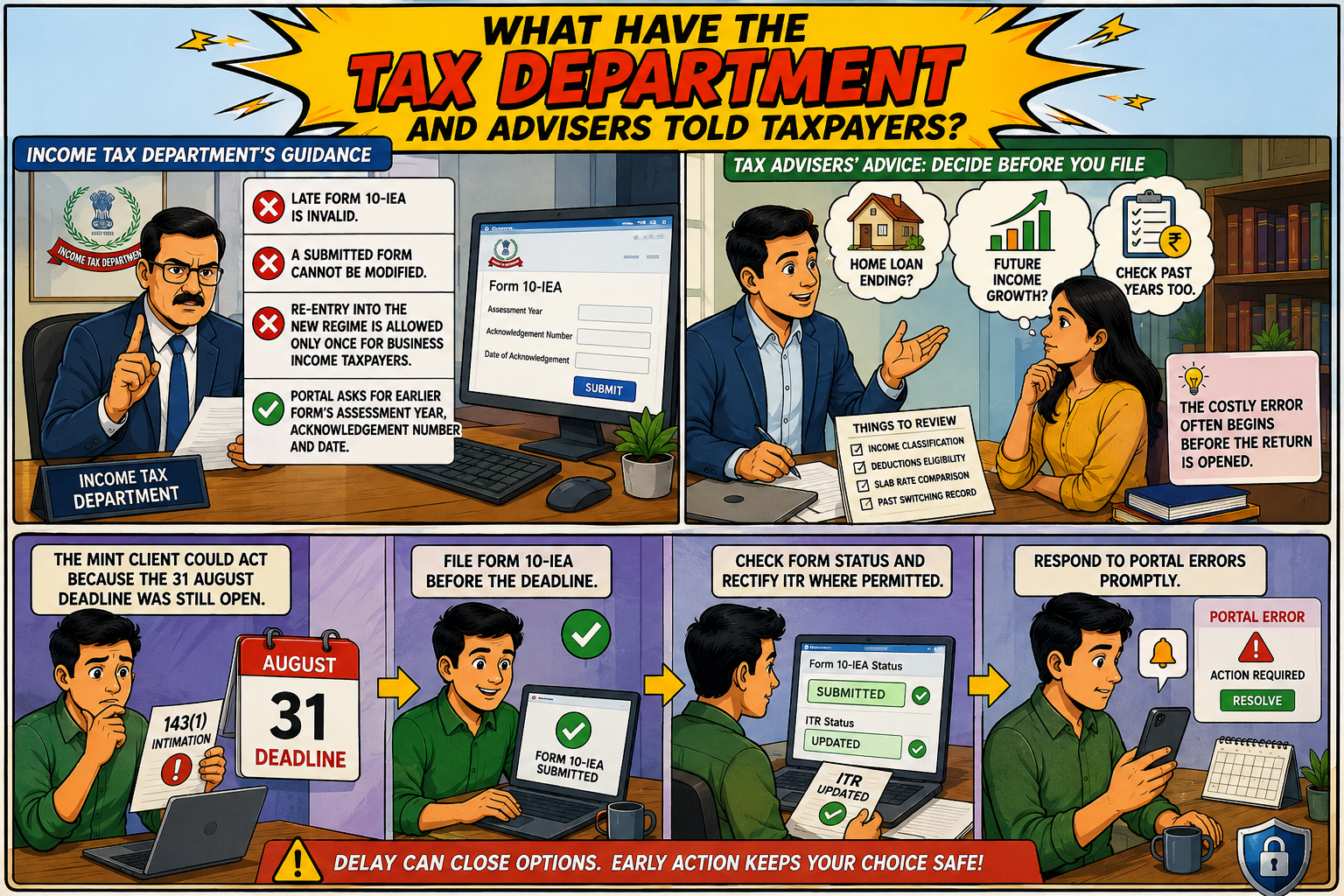
The Income Tax Department’s position leaves little room after the deadline. Its guidance says a late Form 10-IEA is invalid, a submitted form cannot be modified, and re-entry into the new regime is allowed only once for business-income taxpayers. The portal also asks for the earlier form’s assessment year, acknowledgement number and date.
Tax advisers focus on the decision before filing. Gupta’s recommendation to review several years is especially relevant for people whose deductions may fall after a home loan ends or whose freelance income may grow. The editorial reading is similar: the expensive error often begins before the return is opened. Taxpayers compare slab rates but fail to check income classification and their past switching record.
The Mint client could act because the 31 August deadline was still open when the Section 143(1) intimation arrived. A taxpayer discovering the same lapse after the statutory date may not have an equivalent route. Early filing leaves time to inspect the form status, correct the ITR where permitted and respond to portal errors.
Form 10-IEA is the legal step behind an old-regime selection for eligible business and professional taxpayers. For most non-audit cases, 31 August 2026 is the final date. The ITR tick box cannot replace it.
Taxpayers should check side income, presumptive receipts, earlier acknowledgements and the long-term effect of switching before they submit anything. The ₹12 lakh rebate does not rescue an invalid choice, cover special-rate tax or restore old-regime deductions. A short form, filed correctly, can prevent a much longer dispute.
Eligible individuals, HUFs, AOPs, BOIs and specified juridical persons with business or professional income must file it when choosing the old regime.
It is advisable to file the form first. If the ITR was filed earlier, the form must still be validly submitted by the Section 139(1) deadline.
No. The rebate is restricted to eligible resident individuals under the new regime and excludes tax charged at specified special rates.
Neither regime suits every taxpayer. Business professionals should compare deductions, income type and future plans. Choosing the old regime requires Form 10-IEA within the applicable deadline.
A business taxpayer may return to the new regime once after choosing the old regime. After re-entry, another old-regime switch is barred while business income continues.








.png&w=3840&q=75)


