
By continuing, you agree to LoansJagat's Credit Report Terms of Use, Terms and Conditions, Privacy Policy, and authorize contact via Call, SMS, Email, or WhatsApp
Disclaimer: The information published on LoansJagat is intended for general informational and educational purposes only and should not be considered financial, legal, or investment advice. Interest rates, loan terms, statistics, and other data may change over time and may vary by lender or source. Please verify the latest information and consult a qualified financial advisor or the respective Bank/NBFC before making any financial decisions.
Subscribe Now
About the author

Arshathul Afia
Arshathul Afia is a journalism graduate and fintech content writer with 4+ years of experience in digital publishing and research-led writing. She has written 200+ articles covering personal finance, lending, banking, digital payments, credit, insurance, and major financial developments in India. At LoansJagat, she focuses on simplifying complex fintech news, RBI updates, loan-related changes, policy developments, and industry trends for everyday readers. Her journalism background helps her approach stories with research, context, and clarity, while her SEO experience ensures content remains discoverable and relevant. She aims to make financial news easier to understand, practical, and useful for readers across India.
Related Blog Post
Simplify All Your Loans Into One Affordable EMI

Customers Served

Debt Consolidated

1200+ Reviews

Locations in India
Club all Loans & Credit Card Bills into Single EMI

Quick Apply Loan
Consolidate your debts into one easy EMI.

Takes less than 2 minutes. No paperwork.

10 Lakhs+
Trusted Customers

2000 Cr+
Loans Disbursed

4.7/5
Google Reviews

50+
Banks & NBFCs Offers
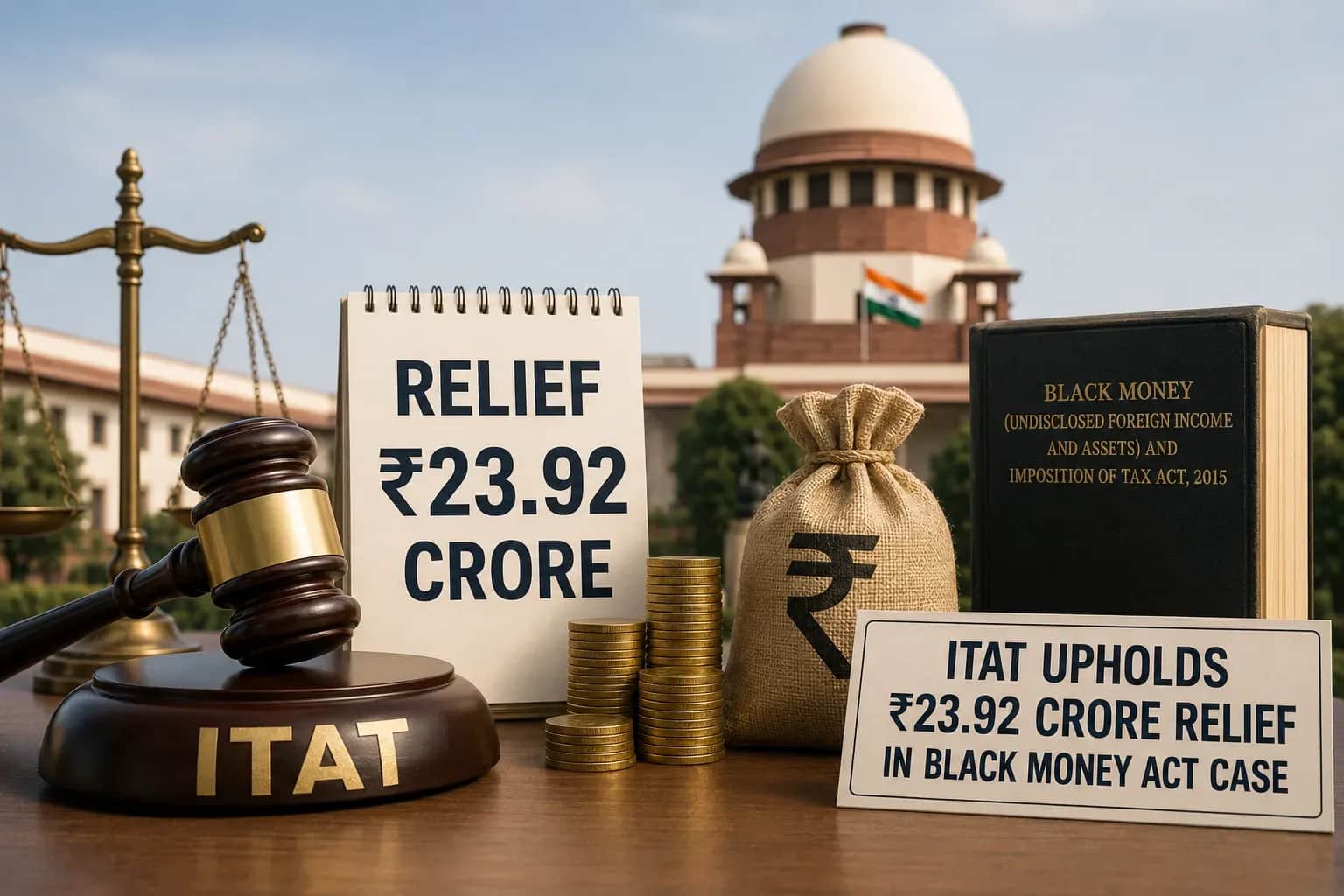
Delhi ITAT dismissed Revenue’s appeal, preserving Tarun Trikha’s ₹23.92 crore relief after finding no reason to disturb identity-theft findings tied to disputed Singapore bank accounts.
The Delhi Bench of the Income Tax Appellate Tribunal has dismissed Revenue’s appeal in Addl. CIT, Delhi vs Tarun Trikha, BMA No. 15/DEL/2025, for Assessment Year 2021-22. The order was pronounced on August 11, 2026, by Accountant Member S. Rifaur Rahman and Judicial Member Vimal Kumar. The dispute involved Singapore bank accounts that the Assessing Officer treated as undisclosed foreign assets worth ₹23,91,64,565.91. Trikha denied owning them. CIT(A) accepted evidence linked to alleged identity theft, deleted the addition, and the ITAT found no cogent material from Revenue strong enough to reverse that finding.
In the short term, the order keeps Trikha’s relief intact and closes Revenue’s appeal at the tribunal stage. For other Indian taxpayers, its reach is narrower. Genuine foreign accounts still have to be disclosed where tax rules require it. The risk remains serious because overseas account data attached to the wrong person can trigger notices, assessment and long litigation. Over time, the ruling may bring more focus on proof of ownership when credible records show that an overseas account was wrongly linked to a taxpayer.
The order helps separate a foreign account appearing in tax information from proof that a taxpayer actually owns it. That distinction can affect Indians who have worked overseas, held old bank accounts, received foreign shares through employment, or discover an incorrect overseas entry against their tax profile. Trikha did not receive relief because foreign assets were exempt from reporting. The appellate record accepted his denial of ownership, and Revenue failed to bring cogent material that displaced those findings.
The compliance side remains strict. The Income Tax Department’s Schedule FA guidance says resident taxpayers covered by the reporting requirement must disclose applicable foreign accounts, financial interests, and other overseas assets. ITR-1 and ITR-4 do not contain Schedule FA. A person who genuinely owns such an asset should choose the correct return and report it. Where an account is wrongly attributed, bank correspondence, company filings, police complaints and court documents can help show who actually opened, funded or controlled it.
In comments reported by ET Wealth Online, Chartered Accountant Suresh Surana focused on attribution and supporting evidence. The dispute turned on whether the foreign accounts and deposits could actually be attributed to Trikha after he produced identity-theft material. The ITAT also looked at his returns for the preceding 10 years and observed that they did not show the means to make investments of such magnitude outside India. That supported the wider evidentiary record considered by the bench.
LoansJagat’s reading of the order is practical: taxpayers should verify foreign-asset entries early rather than react after a demand arrives. LoansJagat’s earlier tax-filing coverage has also flagged AIS visibility and overseas information as areas taxpayers should check before filing. A genuine account should be disclosed correctly. A wrong link should be challenged with documents. That can stop an information mismatch from growing into a much larger tax dispute.
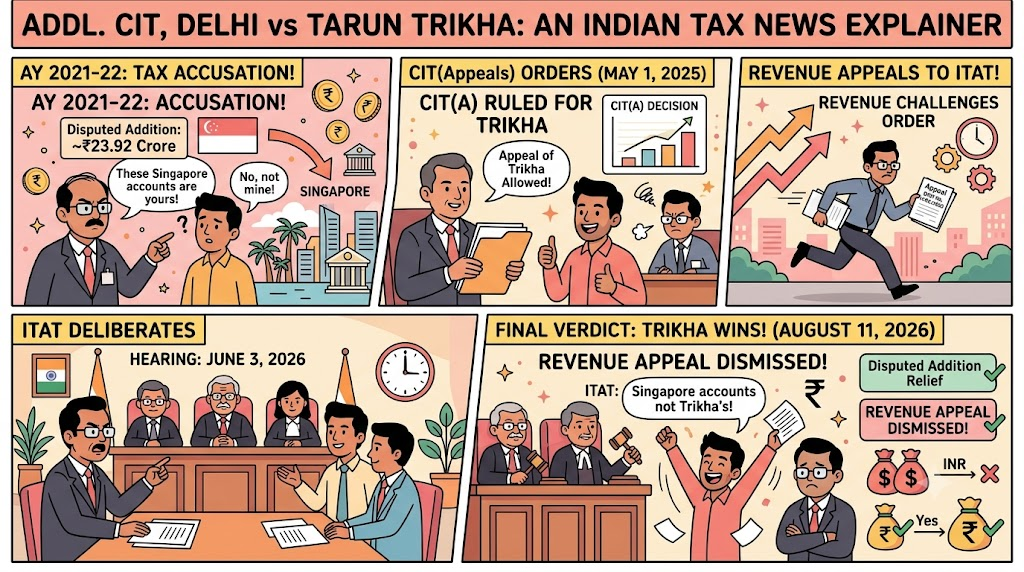
The dispute started after the Assessing Officer received information that Trikha, a resident of Karol Bagh, New Delhi, had several bank accounts in Singapore from January 2017 to February 2018. Summons under Section 131(1A) of the Income Tax Act were issued on March 22, 2019. After further notices, Trikha’s authorised representative appeared and submitted details of income earned in India with earlier returns. His stand was that he had no income source or financial interest outside India.
The AO did not accept that position. The officer treated the Singapore assets as undisclosed under the Black Money Act and valued them at ₹23,91,64,565.91. Tax at 30% was applied under Section 3(1), along with interest under Section 40. The dispute then moved to CIT(A)-31, New Delhi, where Trikha relied on material connected with alleged identity theft.
The sequence below shows how the case moved from summons to the final tribunal order.
The tribunal did not say that information received from Singapore was unusable. It looked at the later material placed before CIT(A), including the Special Court record and the EOW charge-sheet, and examined whether Revenue had enough evidence to overturn those findings. The bench concluded that it did not.
Read Also : EPF Withdrawal for Indians Moving Abroad in 2026: 36-Month EPS Rule Explained
At the first appellate stage, Trikha argued that the AO had relied on foreign-account information even though other official records pointed to alleged misuse of his identity. The CIT(A) order, reproduced by the ITAT, referred to FIR No. 36/2013 at Police Station EOW, Mandir Marg, New Delhi. It also referred to a charge-sheet dated December 31, 2021. According to the appellate findings, the investigation said Trikha had been shown as a director of TVI Express Holidays Private Limited without his consent, resolution, or permission.
CIT(A) also reviewed Special Court findings linked to the economic-offence proceedings. It accepted Trikha’s denial that he owned the foreign accounts and held that the accounts mentioned in the assessment order had been fraudulently held in his name. The addition was deleted on May 1, 2025. His separate objections over limitation and opportunity of hearing were not decided because he had already succeeded on ownership.
Revenue then filed BMA No. 15/DEL/2025. The departmental appeal came before the Delhi H Bench on June 3, 2026. After hearing both sides and reviewing the earlier findings, the tribunal pronounced its order on August 11, 2026.
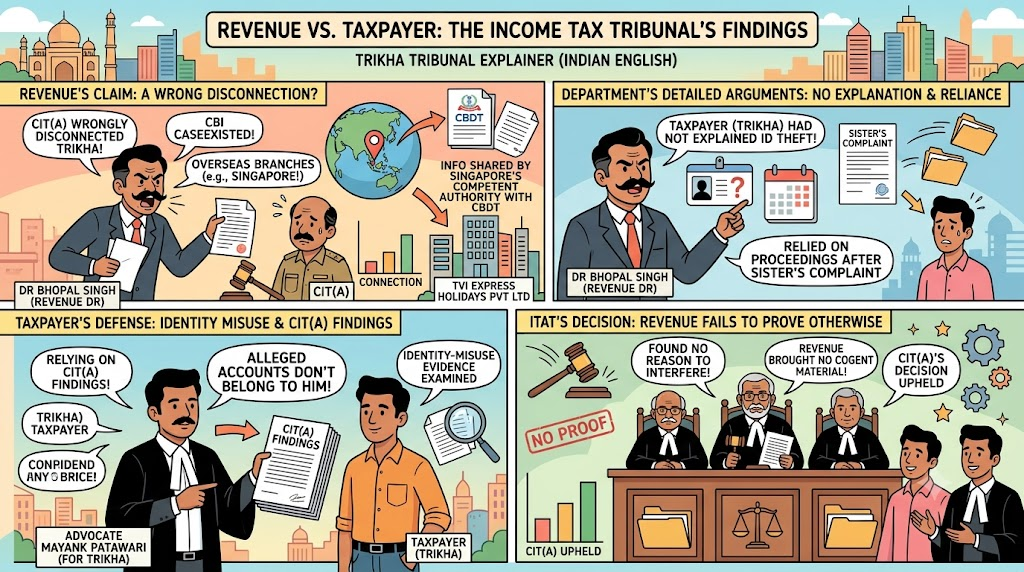
Revenue argued that CIT(A) had wrongly disconnected Trikha from TVI Express Holidays Private Limited. Its grounds referred to a CBI case, alleged overseas branches including Singapore, and information shared by Singapore’s competent authority with the CBDT. Departmental Representative Bhopal Singh also argued that Trikha had not explained how his identity was stolen and had relied on proceedings following a complaint by his sister.
Advocate Mayank Patawari, appearing for Trikha, relied on the CIT(A) findings. The taxpayer maintained that the accounts did not belong to him and that the identity-misuse material had already been examined. The ITAT found no reason to interfere, observing that Revenue had brought no cogent material to prove otherwise.
The ruling remains tied to the evidence in this dispute. It does not say that every taxpayer can defeat a Black Money Act addition with a denial. Stronger ownership records, transaction trails, or beneficial-ownership evidence could lead to a different result.
The August 11, 2026 ruling keeps Tarun Trikha’s ₹23.92 crore relief intact because Revenue could not displace the factual findings accepted by CIT(A). The Delhi ITAT examined his earlier returns, Special Court material, and the EOW-linked record before dismissing the departmental appeal. It did not create a general relaxation for foreign assets.
For taxpayers, the distinction is straightforward. Genuine foreign assets require proper disclosure. A wrongly linked account requires evidence showing why the attribution is wrong. The Trikha case shows how far that documentary trail can go when a large Black Money Act assessment rests on disputed ownership.
The tribunal dismissed Revenue’s appeal on August 11, 2026 and kept the roughly ₹23.92 crore Black Money Act addition deleted.
CIT(A) accepted identity-misuse material and found that the disputed foreign accounts could not be treated as Trikha’s. ITAT found no cogent contrary evidence.
No. Applicable resident taxpayers who genuinely hold foreign assets still have to report them in the correct return and Schedule FA.
The taxpayer should collect bank records, police complaints, company documents, and court papers, then challenge the linkage with documentary support.
An ITAT order can be challenged before the jurisdictional High Court on a substantial question of law, subject to statutory requirements.








.png&w=3840&q=75)


