By continuing, you agree to LoansJagat's Credit Report Terms of Use, Terms and Conditions, Privacy Policy, and authorize contact via Call, SMS, Email, or WhatsApp
Disclaimer: The information published on LoansJagat is intended for general informational and educational purposes only and should not be considered financial, legal, or investment advice. Interest rates, loan terms, statistics, and other data may change over time and may vary by lender or source. Please verify the latest information and consult a qualified financial advisor or the respective Bank/NBFC before making any financial decisions.
Subscribe Now
About the author

Arshathul Afia
Arshathul Afia is a journalism graduate and fintech content writer with 4+ years of experience in digital publishing and research-led writing. She has written 200+ articles covering personal finance, lending, banking, digital payments, credit, insurance, and major financial developments in India. At LoansJagat, she focuses on simplifying complex fintech news, RBI updates, loan-related changes, policy developments, and industry trends for everyday readers. Her journalism background helps her approach stories with research, context, and clarity, while her SEO experience ensures content remains discoverable and relevant. She aims to make financial news easier to understand, practical, and useful for readers across India.
Related Blog Post
Simplify All Your Loans Into One Affordable EMI

Customers Served

Debt Consolidated

1200+ Reviews

Locations in India
Club all Loans & Credit Card Bills into Single EMI

Quick Apply Loan
Consolidate your debts into one easy EMI.

Takes less than 2 minutes. No paperwork.

10 Lakhs+
Trusted Customers

2000 Cr+
Loans Disbursed

4.7/5
Google Reviews

50+
Banks & NBFCs Offers
Other services mentioned in this article
EPFO’s Aadhaar-based portal could help employees trace old provident fund accounts, link eligible balances with active UANs and reduce delays after changing jobs across India.
The Employees’ Provident Fund Organisation has developed a digital platform for workers whose old PF money remains separated after a job change. Minister of State for Labour and Employment Shobha Karandlaje shared the update in a Lok Sabha reply on 27 July 2026. The Aadhaar-based system is meant to trace old or inoperative EPF accounts, connect eligible balances with an active Universal Account Number and allow transfer or settlement. It is aimed at workers with an older member ID, duplicate UAN, missing service entry or an account created before UAN tracking became common.
The portal could cut calls to former employers, EPFO office visits and repeat paperwork. Rollout instructions were not announced with the Lok Sabha update. The government also said there was no proposal for members unable to recall earlier account details. The first official outline of E-PRAAPTI was published by Akashvani News on 29 April 2026.
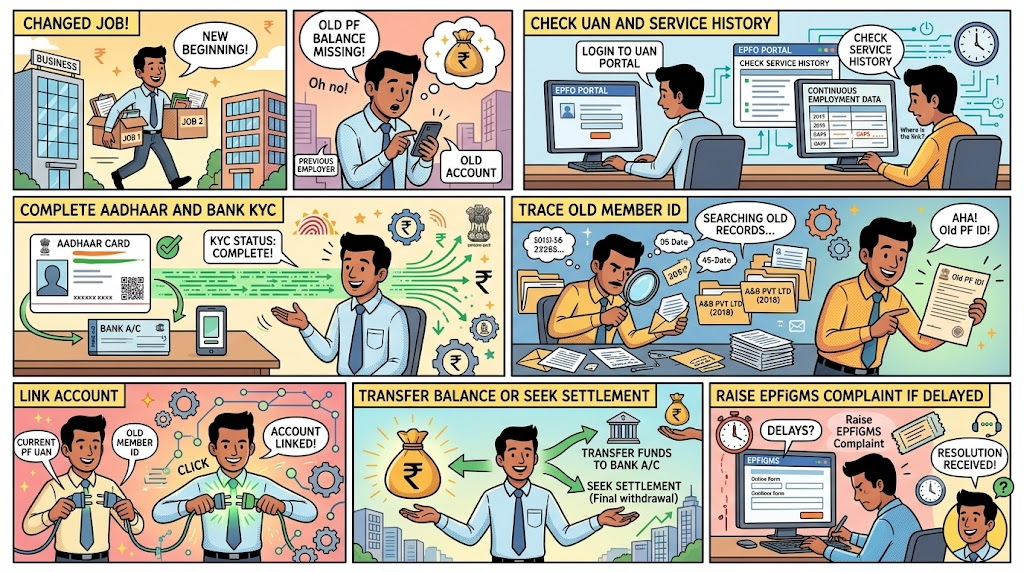
The main gain is access to an old account trail. A worker may change employers several times, with each workplace using a separate PF member ID under the same UAN. When mapping fails, the current passbook may not show the earlier balance. Aadhaar authentication could help EPFO match an eligible old record with the worker’s identity and reduce dependence on former HR teams.
A completed transfer also joins service history used in later PF and pension processing. Digital Sansad recorded in Rajya Sabha Unstarred Question No. 570, answered on 23 July 2026, that ₹9,330.56 crore was lying in inoperative EPF accounts as of 31 March 2026. The amount covers inoperative accounts under EPF rules, not only balances left after recent job changes. The Ministry said EPFO was also using Nidhi Aapke Nikat 2.0 camps and social media outreach.
PF transfers often fail because 1 record does not match another. The name on Aadhaar may differ from the UAN profile, the birth date may be wrong, the previous employer may not have entered the exit date, or the bank account may be inactive. Duplicate UANs and overlapping service dates can also hold up processing. Aadhaar can reduce tracing work, but it cannot approve a transfer where employment details are incomplete or disputed.
LoansJagat’s assessment is that the portal could save workers several rounds of follow-up, but only when the member prepares the account first. Its EPFO Aadhaar portal analysis advises employees to keep the active UAN, old member ID, Aadhaar-linked mobile number, bank KYC and exit date ready. Salary slips, Form 16, appointment letters and old PF statements can support a correction. If a claim remains pending, EPFiGMS accepts UAN-based complaints and supporting documents.
E-PRAAPTI is not another name for Form 13. Routine transfer tools work best when the old and current member IDs are already attached to the same UAN and KYC is complete. E-PRAAPTI is aimed at older or inoperative accounts that are harder to locate, activate or connect. After Aadhaar authentication, an eligible member may be able to identify the account, update profile details, link it with the active UAN and choose transfer or settlement under EPFO rules.
This difference is useful for workers who entered formal employment before UAN use became widespread. Some have only an old payslip carrying a PF number. Others cannot see the earlier member ID in service history. The route may shorten the search, yet it still needs a usable data trail. Where the employee remembers no account number, employer information or service period, EPFO may need a separate process later.
The table below separates the new portal from earlier reforms. It also shows why every PF announcement does not apply to the same worker.
The January 2025 reform removed employer routing in most eligible online transfers. The March 2026 pilot focused on tiny, verified balances. E-PRAAPTI addresses an earlier stage, tracing and linking an old account before money can move. A normal pending Form 13 claim may still need the existing route, while a missing older account is closer to the group targeted by the new platform.
Also Read: EPFO Targets August Rollout After Verifying 1.18 Lakh Dormant PF Bank Accounts
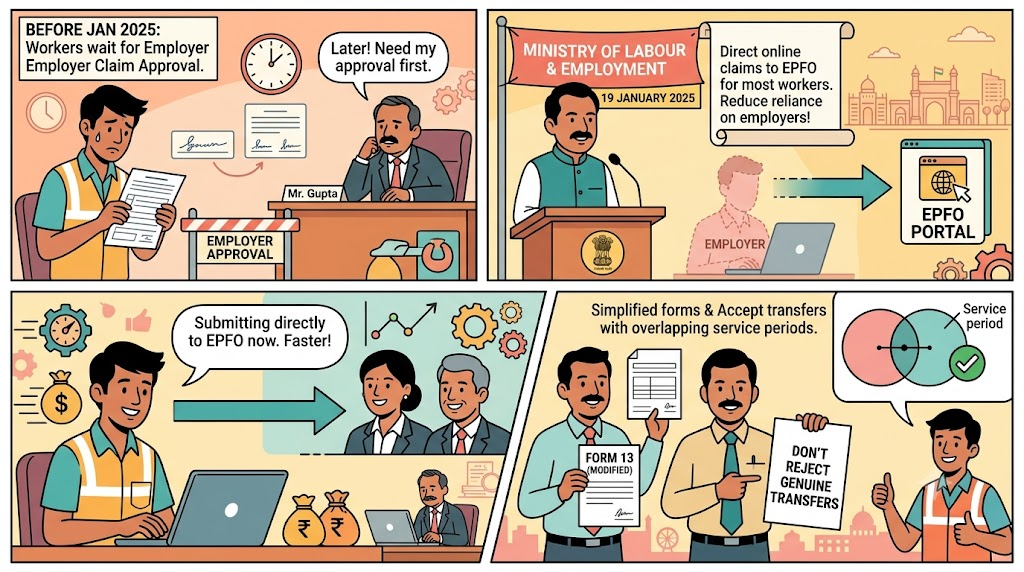
EPFO began reducing employer involvement before the 2026 portal announcement. The Ministry of Labour and Employment said on 19 January 2025 that most eligible online claims would move directly to EPFO. Earlier, a worker often waited for an employer’s approval. EPFO later changed Form 13 and told offices not to reject genuine transfers only because 2 service periods overlapped.
The Central Board of Trustees then approved the small-balance pilot on 2 March 2026. It covered Aadhaar-seeded and EPFO-linked bank accounts with inoperative balances of ₹1,000 or less. EPFO planned to begin the claim without fresh paperwork, subject to the pilot conditions. E-PRAAPTI later widened the focus from settling small verified balances to finding and linking older accounts.
Labour and Employment Minister Mansukh Mandaviya announced the E-PRAAPTI plan on 29 April 2026. The government description said Aadhaar authentication would support account identification, tracking, UAN linking and activation. The member may start with Aadhaar and available account information instead of first asking an old employer to search archives.
Shobha Karandlaje’s Lok Sabha reply on 27 July 2026 confirmed that EPFO had developed the platform. She said eligible members could authenticate through Aadhaar, transfer the balance to an active UAN or seek settlement. She also said EPFO had no proposal for workers unable to recall old account details. That leaves some people outside the promised route, including those who lost documents or worked for an establishment that later closed.
Employers still have duties. Companies should ask for an existing UAN before creating another record, check Aadhaar information, enter the exit date in the correct wage month, and guide departing staff on transfers. Employees should review the passbook soon after joining a new company. Waiting 5 or 10 years makes corrections harder because HR teams, payroll software, and establishment details may change.
LoansJagat’s editorial view is that the portal’s biggest benefit may be time saved, not a new withdrawal right. It does not change when PF money can be withdrawn. It improves the route used to find and connect eligible old savings. The first step for a stuck case is record correction, not repeated claims against incomplete data.
EPFO’s new Aadhaar-based portal could help employees whose PF savings were left under an old member ID after changing jobs. It brings tracing, profile updates, UAN linking and transfer closer to 1 digital route. It may also reduce dependence on former employers.
Its benefit will depend on execution. EPFO still needs to publish the access route, eligibility rules and a member guide. Workers with traceable records and completed KYC may gain first. Those without old account details may still need help from a former employer, an EPFO field office or EPFiGMS.
It is a platform designed to trace, link, transfer or settle eligible old PF accounts.
EPFO confirmed its development, but public access instructions were not announced with the update.
An eligible member may authenticate through Aadhaar and request transfer to the active UAN.
The government said there was no proposal for members unable to recall old account information.
They should verify UAN, Aadhaar, bank KYC, mobile number, exit date, and previous member ID.









.png&w=3840&q=75)


