
By continuing, you agree to LoansJagat's Credit Report Terms of Use, Terms and Conditions, Privacy Policy, and authorize contact via Call, SMS, Email, or WhatsApp
Disclaimer: The information published on LoansJagat is intended for general informational and educational purposes only and should not be considered financial, legal, or investment advice. Interest rates, loan terms, statistics, and other data may change over time and may vary by lender or source. Please verify the latest information and consult a qualified financial advisor or the respective Bank/NBFC before making any financial decisions.
Subscribe Now
About the author

Arshathul Afia
Arshathul Afia is a journalism graduate and fintech content writer with 4+ years of experience in digital publishing and research-led writing. She has written 200+ articles covering personal finance, lending, banking, digital payments, credit, insurance, and major financial developments in India. At LoansJagat, she focuses on simplifying complex fintech news, RBI updates, loan-related changes, policy developments, and industry trends for everyday readers. Her journalism background helps her approach stories with research, context, and clarity, while her SEO experience ensures content remains discoverable and relevant. She aims to make financial news easier to understand, practical, and useful for readers across India.
Related News
Simplify All Your Loans Into One Affordable EMI

Customers Served

Debt Consolidated

1200+ Reviews

Locations in India
Club all Loans & Credit Card Bills into Single EMI

Quick Apply Loan
Consolidate your debts into one easy EMI.

Takes less than 2 minutes. No paperwork.

10 Lakhs+
Trusted Customers

2000 Cr+
Loans Disbursed

4.7/5
Google Reviews

50+
Banks & NBFCs Offers
Paid credit services can explain falling scores, but Indian borrowers already have free reports, dispute channels and official complaint routes before paying a monthly fee.
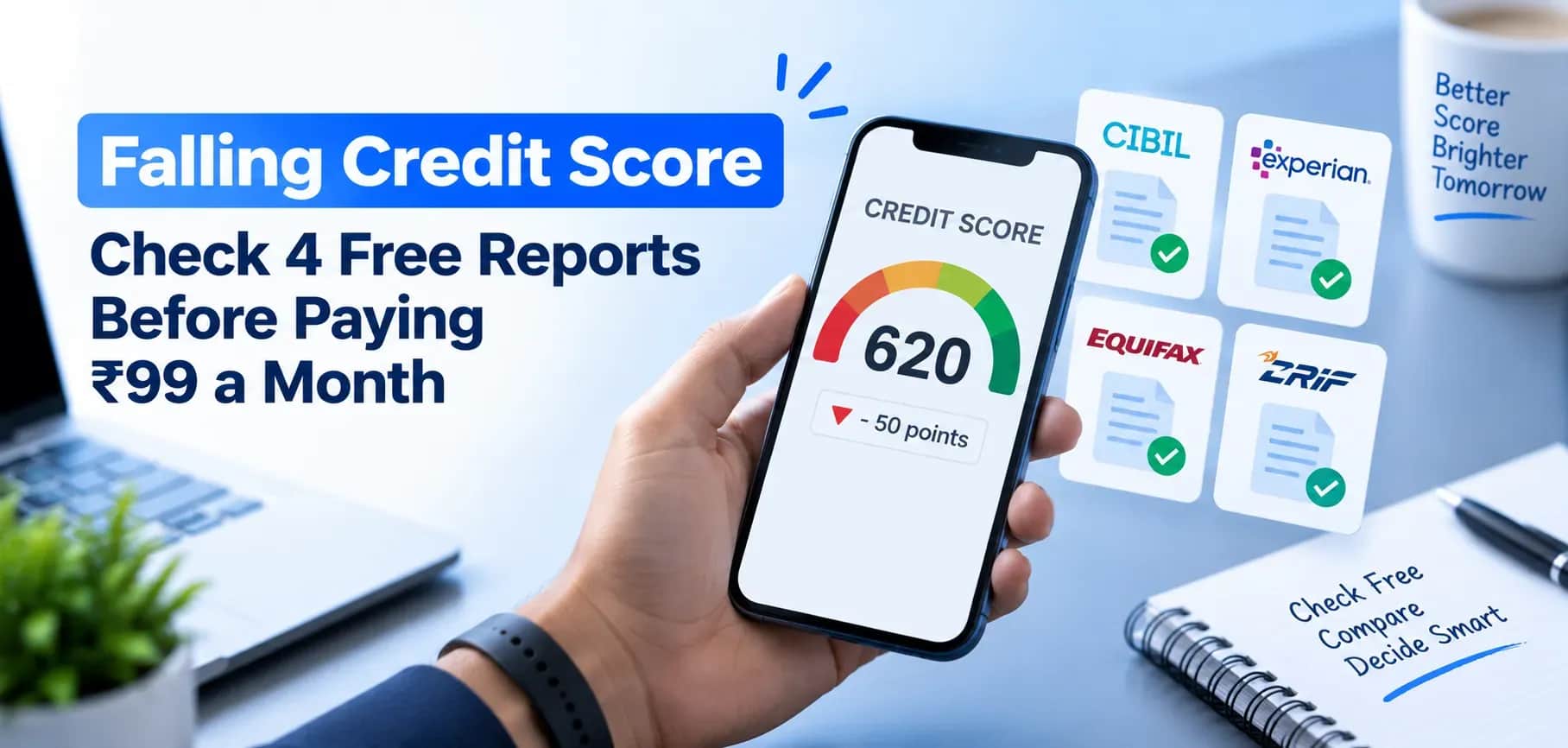
A Livemint personal finance report published on 9 September 2026 examined whether Indian borrowers should pay to repair a falling credit score. The report found that services from platforms such as GoodScore and BankBazaar charge around ₹99 monthly for monitoring, report analysis and repayment guidance. India’s 4 credit bureaus, TransUnion CIBIL, Experian, Equifax and CRIF High Mark, already provide 1 free full credit report each during a calendar year. That gives a borrower 4 opportunities to inspect credit records without buying a subscription.
The short-term risk comes from paying before identifying why the score fell. A borrower may spend ₹99 every month while an overdue EMI, incorrect balance or unknown loan remains untouched. Over time, a weaker credit profile can affect loan approval, the interest rate offered and access to unsecured credit. Paid assistance can help in a complicated case. For many consumers, however, the free route should come first.
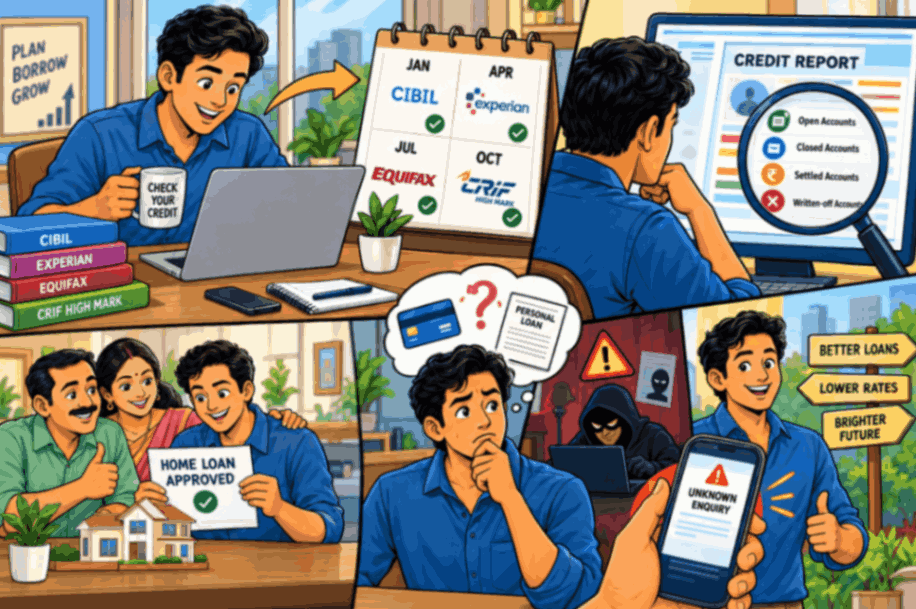
A credit score alone tells very little. The full report shows which loan or card account is affecting it, whether a lender has marked a payment late, and which financial institutions have checked the borrower’s record. It also shows open, closed, settled and written-off accounts. Those words carry different consequences. A paid app may explain them, but the original information remains available in the bureau report.
Borrowers can stagger the 4 free reports through the year instead of downloading all of them together. For example, a consumer could check CIBIL in January, Experian in April, Equifax in July and CRIF High Mark in October. The scores may not match exactly because each bureau uses its own model and may receive updates at different times. Comparing the underlying loan accounts is more useful than worrying about a small difference between 2 scores.
This free access can help families before a large borrowing decision. A home loan applicant may find that an old card still carries a small unpaid amount. Another borrower may spot a personal loan opened through a digital platform but reported under the name of the bank or NBFC that funded it. That entry may look unfamiliar until the lender’s name, loan date and disbursed amount are checked.
There is another benefit. Regular checks can catch identity misuse before the affected borrower applies for fresh credit. An unknown enquiry does not always prove fraud, but it needs attention. An unknown active loan needs faster action, especially when instalments have already become overdue.
The route depends on the entry. A genuine missed EMI cannot be handled like an incorrect balance, while an unknown loan needs a different response again. Borrowers should keep repayment receipts, bank statements, loan closure letters and complaint numbers before approaching any bureau or paid adviser.
The table also shows why the phrase “credit repair” can mislead borrowers. A bureau cannot delete accurate repayment history simply because a customer requests it. The lender that supplied the information must confirm any correction. A third-party company faces the same restriction, even after collecting a fee.
If the report contains accurate negative information, the borrower needs time and better repayment conduct. Paying pending dues, keeping future EMIs on schedule and limiting fresh credit applications can gradually improve the profile. No provider can promise an exact point increase because the bureau’s scoring formula also considers the borrower’s wider credit history.
Digital lending consultant Parijat Garg told Livemint that credit reports mainly present data, while many consumers struggle to interpret what the entries mean for their score. A borrower may have a personal loan, credit card and two-wheeler loan, with delayed payments spread across the accounts. In that situation, a service that identifies which account needs attention first may provide useful support.
Adhil Shetty, chief executive of BankBazaar, linked demand for paid credit guidance with first-time borrowers in non-metro and semi-urban areas. Buy-now-pay-later products introduced many consumers to formal credit without always showing how a delayed payment could affect later borrowing. Paid plans try to fill that information gap.
Still, the price deserves attention. A LoansJagat calculation based on the reported ₹99 monthly charge puts the yearly cost at ₹1,188. If the customer only needs basic repayment steps, the LoansJagat guide to increasing a CIBIL score covers payment dates, card usage, old accounts and report checks without creating another recurring bill.
That calculation adds a useful borrower-side view. A ₹1,188 annual expense may be reasonable when a trained person reviews several accounts, prepares a repayment order and follows up on disputed entries. The same charge offers poor value when an automated dashboard merely repeats the report already available from the bureau.
Read Also: Consumer Loans Overtake Credit Cards as Young Indians’ First Credit Product
Credit bureaus initially served lenders by collecting repayment information from banks and financial institutions. Consumer access later became easier, and each bureau began providing a free annual report. Mobile finance apps then brought score checks onto phones, making the number visible to people who had never reviewed a full credit file.
BankBazaar launched CreditStrong in 2021, according to Livemint. The service currently charges ₹1 for the starting month and ₹99 monthly after that. GoodScore was also reported at about ₹99 monthly. Some bureau subscriptions cost around ₹1,500 a year and may include frequent score refreshes, alerts, trend charts and score simulators.
These products do not all perform the same job. A bureau subscription mainly offers access and alerts. A credit-advice platform may explain the reason for a decline. Human-led repair assistance can prepare disputes and contact lenders. Borrowers should ask which service they are purchasing, who will handle the case and what happens if the provider cannot secure a correction.
The rise of instant personal loans has pushed the issue further. A customer can open several small loan accounts within a short period, sometimes through different apps. Each application may create a lender enquiry. Several active accounts can also make monthly repayment harder, and 1 failed auto-debit may turn into a reported delay before the borrower notices it.
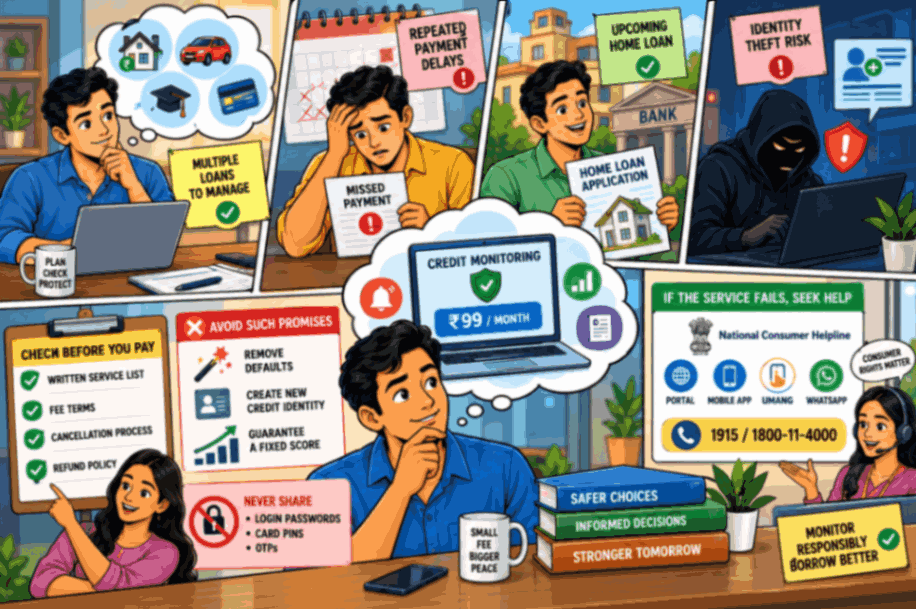
Paid monitoring may suit a borrower who has several loans, repeated payment delays or an approaching home loan application. It may also help someone dealing with identity theft who wants faster alerts about new accounts and enquiries. In such cases, the customer pays for time, interpretation and follow-up work.
A simple score decline does not justify payment by itself. The borrower should ask for a written service list, fee terms, cancellation process and refund policy. Any provider promising to remove an accurate default, create a new credit identity or guarantee a fixed score should be avoided. Login passwords, card PINs and OTPs must never be shared.
When a paid service collects money but fails to provide the promised work, the borrower can approach the National Consumer Helpline. The Department of Consumer Affairs accepts complaints through its portal, mobile app, UMANG and WhatsApp. Consumers may also call 1915 or 1800-11-4000.
Most borrowers do not need to pay ₹99 monthly as soon as their credit score falls. They can start with 4 free bureau reports, locate the affected account and contact the lender or bureau. If the entry is wrong, the dispute process is free. If it is accurate, repayment behaviour must change.
Paid support has a place when several debts, fraud or repeated follow-ups make the case difficult. The customer should pay for specific work, not a promised score. That distinction can save money and prevent a weak credit profile from becoming an expensive subscription problem.
No. The company can assist with follow-ups, but accurate repayment history cannot be deleted merely after payment of a service fee.
The borrower can download 1 annual report from each of India’s 4 bureaus and stagger the checks across the year.
It may help with several accounts or disputes. A borrower with a simple credit file can usually begin with free reports.
Payment alone cannot raise the score. Correcting errors and maintaining better repayment conduct may improve it gradually.
High card usage, several recent applications, reporting delays or an unknown account may have caused the decline.









.png&w=3840&q=75)


