

By continuing, you agree to LoansJagat's Credit Report Terms of Use, Terms and Conditions, Privacy Policy, and authorize contact via Call, SMS, Email, or WhatsApp
Disclaimer: The information published on LoansJagat is intended for general informational and educational purposes only and should not be considered financial, legal, or investment advice. Interest rates, loan terms, statistics, and other data may change over time and may vary by lender or source. Please verify the latest information and consult a qualified financial advisor or the respective Bank/NBFC before making any financial decisions.
Subscribe Now
About the author

Arshathul Afia
Arshathul Afia is a journalism graduate and fintech content writer with 4+ years of experience in digital publishing and research-led writing. She has written 200+ articles covering personal finance, lending, banking, digital payments, credit, insurance, and major financial developments in India. At LoansJagat, she focuses on simplifying complex fintech news, RBI updates, loan-related changes, policy developments, and industry trends for everyday readers. Her journalism background helps her approach stories with research, context, and clarity, while her SEO experience ensures content remains discoverable and relevant. She aims to make financial news easier to understand, practical, and useful for readers across India.
Related News
Simplify All Your Loans Into One Affordable EMI

Customers Served

Debt Consolidated

1200+ Reviews

Locations in India
Club all Loans & Credit Card Bills into Single EMI

Quick Apply Loan
Consolidate your debts into one easy EMI.

Takes less than 2 minutes. No paperwork.

10 Lakhs+
Trusted Customers

2000 Cr+
Loans Disbursed

4.7/5
Google Reviews

50+
Banks & NBFCs Offers
India’s 2026 tax rules do not cap savings deposits at ₹10 lakh, but crossing reporting thresholds can bring greater scrutiny of cash sources and records.
Cash deposits of ₹10 lakh or more in a financial year can enter the Statement of Financial Transaction, or SFT, reporting system when a PAN holder deposits the money in 1 or more accounts other than current accounts and time deposits. The reporting duty falls on banks and specified post office authorities. According to the Income Tax Department, Rule 237 of the Income-tax Rules, 2026 also sets a lower ₹5 lakh threshold where the person does not have a PAN. The rule applies across India under the direct-tax framework from 1 April 2026.
For households, salaried people, and small businesses, the short-term effect is greater visibility of large cash deposits. That can be harmless when the source is documented. Trouble can start when bank deposits do not match the return, an earlier withdrawal, a sale deed, or business books. Weak paperwork can make a later tax query harder to answer.
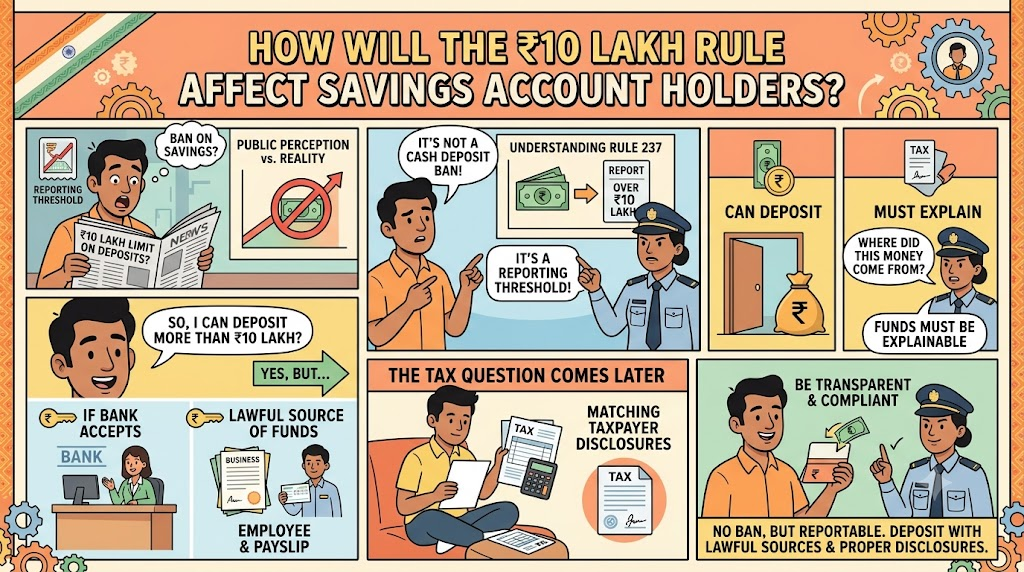
The headline figure often gets described as a “cash deposit limit”, but that wording can mislead. Rule 237 does not ban a savings account holder from depositing more than ₹10 lakh. It sets a reporting threshold. A person may deposit a higher amount if the bank accepts it and the money has a lawful, explainable source. The tax question comes later, if the department asks where the money came from and whether it matches the taxpayer’s disclosures.
That distinction can help ordinary families too. Someone who withdrew cash for a cancelled property payment can keep bank statements showing both entries. A trader can match collections with invoices and cash books. An asset seller can preserve the sale agreement and payment trail.
The Income Tax Department uses different figures for different compliance checks, so 1 number should not be applied to every bank transaction.
The ₹50 lakh figure serves a different purpose. Income Tax Department guidance released on 26 May 2026 says deposits of ₹50 lakh or more in 1 or more savings bank accounts can require return filing even where normal income-based conditions would not otherwise trigger it. The ₹2 lakh rule is different again. Section 186 restricts certain large cash receipts, but expressly excludes receipts by the government, banking companies, post-office savings banks and co-operative banks.
A taxpayer can still face a query below the SFT threshold if other information does not line up. CA Chandni Anandan, Tax Expert at ClearTax, told Financial Express on 21 July 2026 that deposits below ₹10 lakh may still be questioned where they appear disproportionate to declared income or where other information available to the department points to a mismatch. She advised taxpayers to retain bank statements, salary slips, sale documents, gift records, loan agreements and business receipts.
Shaily Gupta, Partner at Khaitan & Co, also highlighted the 2026 change in comments to ET Wealth Online on 23 May 2026. Her comparison placed the savings-account cash-deposit threshold at ₹10 lakh for a person with PAN and ₹5 lakh where PAN is absent. The practical response is simple. Records should be kept when the transaction happens, not rebuilt months later after a notice arrives.
Splitting deposits does not offer a reliable escape. Rule 237 uses annual aggregation across 1 or more relevant accounts. If a PAN holder deposits ₹2.5 lakh in June, ₹2.5 lakh in September, ₹2.5 lakh in December, and ₹2.5 lakh in February, the yearly total is still ₹10 lakh.
The safest reading is straightforward. Salary savings need bank records. Business cash should match books and the return. Loans and gifts should have supporting records where relevant. The explanation rests on where the money came from.
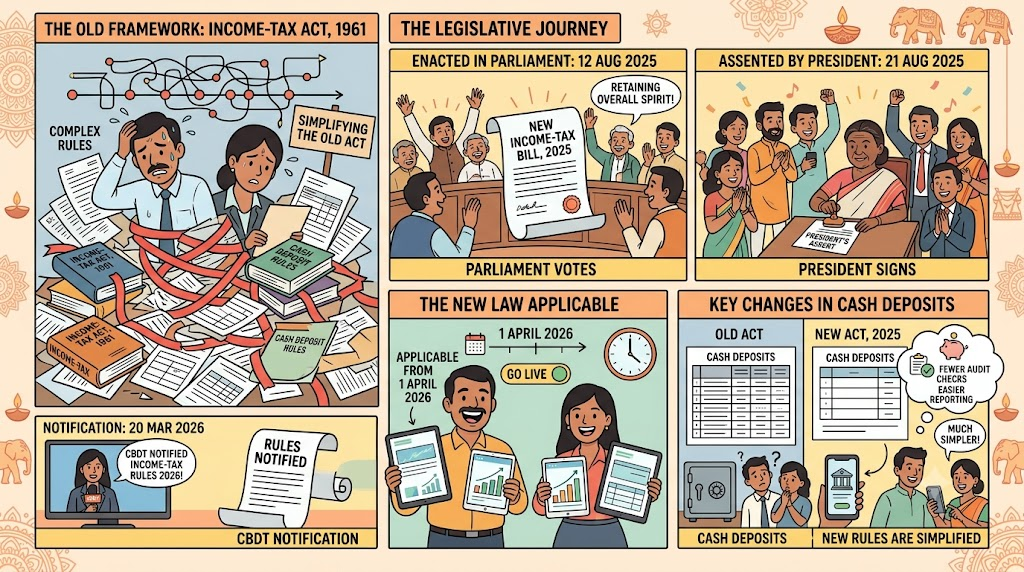
The new Income-tax Act, 2025 will be applicable from 1 April 2026 in India. The law was enacted in Parliament on 12th August 2025 and was assented to by the President on 21st August 2025, as per the Press Information Bureau (PIB) (ID 2248005). CBDT has notified the Income-tax Rules 2026 on 20 March 2026. The new law was said to be a simplified version of the Income-tax Act, 1961 and to retain the overall spirit of the tax policy.
As per the pre-revised Rule 114E, cash deposits (or credit tranches) amounting to ₹10 lakh or above in accounts (excluding current accounts and time deposits) were already being reported as SFT. For a PAN holder, Rule 237 retains ₹10 lakh for the PAN holder, while for a PAN holder who does not have a PAN, it includes the lesser amount of ₹5 lakh. The update most likely to reach people who use older explainers.
There will also be a change in 2026 for unexplained money. The Indian Budget memorandum for the Finance Bill, 2026 proposed to reduce the special tax rate under section 195 from 60% to 30% in relation to income from the assets or expenditure/investment under section 102-106 of the Income Tax Act, 1961, which includes unexplained investment, expenditure, assets and unexplained credit. The President of the Republic of Kenya approved the Finance Act 2026 on 30 March 2026, and the new tax rule will apply from 1 April 2026 in tax year 2026-27 and going forward.
The lower rate does not remove penalty risk. Section 439 provides a 200% penalty on the tax payable on under-reported income where misreporting is established. The 2026 amendments also brought income determined under Section 195(1)(b) into that framework. A depositor therefore has to separate 2 issues: bank reporting and the tax treatment of money whose source cannot be established.
Read Also: Consumer Loans Overtake Credit Cards as Young Indians’ First Credit Product
Stakeholder comments point towards documentation rather than deposit-splitting. Anandan focused on bank activity versus declared income, while Gupta highlighted the new PAN-based reporting threshold. Both put records ahead of deposit size.
A recent tribunal dispute adds a useful example. LoansJagat reported on 8 September 2026 that ITAT Mumbai deleted additions totalling ₹20.39 lakh in a Section 44AD case involving cash deposits and credit-card expenditure. The tribunal order was dated 4 September 2026. The taxpayer had reported ₹52.01 lakh of turnover from a manpower consultancy and recruitment business, and ITAT found no separate unexplained source behind the business-linked amounts in dispute.
The ruling is narrow. A person cannot label an unexplained deposit as business income after the fact and expect the issue to end. There still needs to be a credible link with disclosed activity, backed by bank entries, receipts, invoices or cash records.
For borrowers, large cash deposits can also complicate loan applications if reported income and bank activity do not agree. Lenders may compare account behaviour with income documents, so sudden unexplained cash can invite extra questions.
Read Also: Home Loan EMI Burden: 6 Ways to Reduce Your Financial Stress
The cash deposit limit in a savings account in 2026 is not a single legal ceiling. For a PAN holder, ₹10 lakh is an SFT reporting threshold under Rule 237 for the relevant account category. Without PAN, that threshold falls to ₹5 lakh. Separate provisions apply to return filing, large cash receipts and unexplained income.
A taxpayer with legitimate cash should focus on the paper trail rather than fear the number alone. Keep withdrawal records, invoices, sale documents, loan papers or gift records as applicable. Match bank entries with the income shown in the return. Reporting can be explained. Unsupported cash is where the risk grows.
There is no general ₹10 lakh legal ceiling. ₹10 lakh is the relevant annual SFT reporting threshold for a PAN holder under Rule 237.
No. Tax depends on the source and tax treatment of the money. A documented deposit does not become income merely because the bank reports it.
A deposit can be made, but reporting may apply. Whether a notice follows depends on the source, return disclosures, and other information available to the department.
They can ask for an explanation, but proper returns and source records give the taxpayer evidence to support the deposits if a query arrives.
Bank statements, withdrawal records, invoices, cash books, sale documents, loan papers, gift records and other source evidence should be retained as relevant.









.png&w=3840&q=75)


