By continuing, you agree to LoansJagat's Credit Report Terms of Use, Terms and Conditions, Privacy Policy, and authorize contact via Call, SMS, Email, or WhatsApp
The information published on LoansJagat is intended for general informational and educational purposes only and should not be considered financial, legal, or investment advice. Interest rates, loan terms, statistics, and other data may change over time and may vary by lender or source. Please verify the latest information and consult a qualified financial advisor or the respective Bank/NBFC before making any financial decisions.
Subscribe Now
About the author

LoansJagat Team
‘Simplify Finance for Everyone.’ This is the common goal of our team, as we try to explain any topic with relatable examples. From personal to business finance, managing EMIs to becoming debt-free, we do extensive research on each and every parameter, so you don’t have to. Scroll up and have a look at what 15+ years of experience in the BFSI sector looks like.
Related News
Simplify All Your Loans Into One Affordable EMI

Customers Served

Debt Consolidated

1200+ Reviews

Locations in India
Club all Loans & Credit Card Bills into Single EMI

Quick Apply Loan
Consolidate your debts into one easy EMI.

Takes less than 2 minutes. No paperwork.

10 Lakhs+
Trusted Customers

2000 Cr+
Loans Disbursed

4.7/5
Google Reviews

50+
Banks & NBFCs Offers
Other services mentioned in this article
Key Insights
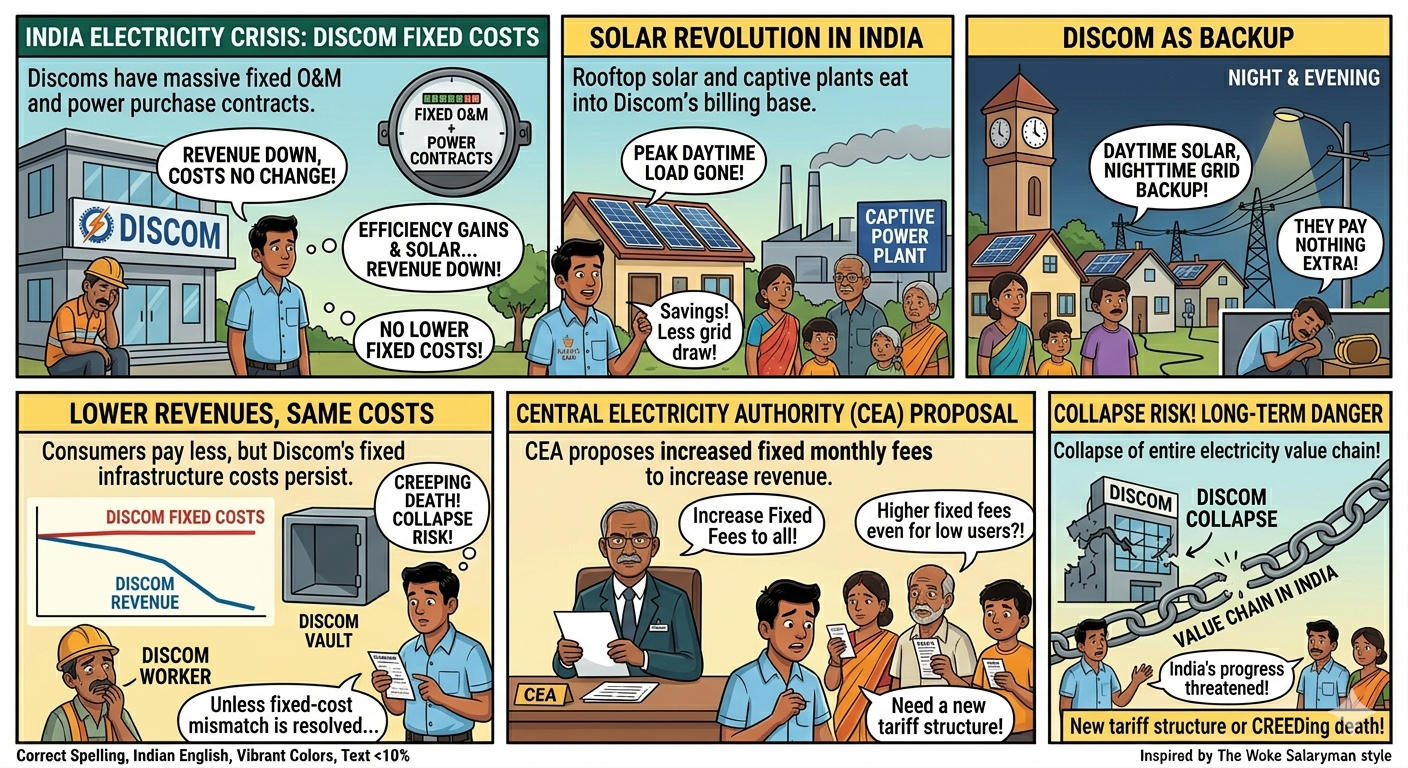
Discoms have high fixed costs of operation and maintenance of the network, and long-term contracts for power purchase.
Efficiency gains and the use of solar lead to lower electricity sales but no lower fixed costs.
The Central Electricity Authority has proposed increased fixed monthly fees, which could raise electricity rates even for those who use smaller amounts of electricity to increase revenue.
The reason is simple, and that is with increasing use of rooftop solar and captive power plants in industries, a silent revolution is eating into the billing base of discoms.
When consumers have rooftop solar installations, they cut their use of electricity from the grid during peak daytime hours.
They start drawing electricity from the grid only during nighttime or evening hours, thus using discoms as a backup facility, paying nothing extra for the service provided.
This means lower discom revenues without lower costs in the short term. Unless this fixed-cost mismatch is resolved through a new tariff structure.
There is a risk of the creeping death of discoms, which could lead to the collapse of the entire electricity value chain in India in the long term.
This table shows you the key financial health indicators of India's power distribution sector, which help you understand the depth of the structural problem and the modest improvements recorded in recent years.
In fiscal year 2024, discoms in eight states would borrow between 44% and 86% of their total borrowings for non-capital expenditures.
It means they would be borrowing only to meet their regular expenses. To put it differently, borrowing not to develop but only to stay alive financially indicates financial stress.
The financial distress facing discoms is set to show itself in their utility bill soon for the average consumer in India.
The increase in the fixed cost component of the electricity bill means consumers will see higher bills even if they consume less electricity.
Consumers opting for energy efficiency and solar to reduce costs may end up paying more due to higher fixed charges, despite lower usage.
Over 100 million meters will have been installed in India. They have a billing process to drastically reduce electricity theft by early 2026.
The AT&C losses have fallen from over 22% in 2021 to around 15.04% in 2026, which is a considerable drop.
Ministry of Power
*T&C Apply
Volume-based tariffs, whereby consumers pay based on the units of energy consumed, will not cover the costs of fixed assets in the event of reduced demand due to increased solar use and energy efficiency.
Discoms cannot make up for their infrastructure costs since there are no fixed payments involved, despite the amount of electricity transmitted.
According to experts, it is this flaw in tariff structure that defines the core problem. The Hans India
There must be a synergy between political commitment and professional management for discoms to become financially sustainable.
Most discoms can only record profits if the government intervenes through subsidies and takes over losses by the states.
This calls into question the viability of such a change when future losses arise. Republic World
The problem India faces with its discoms is not one of electricity, but one of finance. Its solution lies in transparent tariffs, less political intervention, and quicker subsidy payments. Until such problems are sorted out, the system will continue to run on borrowed money and borrowed time.
Why does India place company profits above community well-being?
The economic strategy of India favours corporate growth so as to facilitate investments, advancements, and competitiveness.
Why is the injection of money required in the power sector by the government?
Money injection in the power sector is mostly done because of the rescue of debt-laden state utilities, financing of large-scale infrastructure changes, and covering the difference in high costs of power generation from subsidised tariffs.









.png&w=3840&q=75)



