
By continuing, you agree to LoansJagat's Credit Report Terms of Use, Terms and Conditions, Privacy Policy, and authorize contact via Call, SMS, Email, or WhatsApp
Disclaimer: The information published on LoansJagat is intended for general informational and educational purposes only and should not be considered financial, legal, or investment advice. Interest rates, loan terms, statistics, and other data may change over time and may vary by lender or source. Please verify the latest information and consult a qualified financial advisor or the respective Bank/NBFC before making any financial decisions.
Subscribe Now
About the author

LoansJagat Team
‘Simplify Finance for Everyone.’ This is the common goal of our team, as we try to explain any topic with relatable examples. From personal to business finance, managing EMIs to becoming debt-free, we do extensive research on each and every parameter, so you don’t have to. Scroll up and have a look at what 15+ years of experience in the BFSI sector looks like.
Related News
Simplify All Your Loans Into One Affordable EMI

Customers Served

Debt Consolidated

1200+ Reviews

Locations in India
Club all Loans & Credit Card Bills into Single EMI

Quick Apply Loan
Consolidate your debts into one easy EMI.

Takes less than 2 minutes. No paperwork.

10 Lakhs+
Trusted Customers

2000 Cr+
Loans Disbursed

4.7/5
Google Reviews

50+
Banks & NBFCs Offers
Other services mentioned in this article
A Pune teacher lost ₹9.44 lakh after installing a fake pension APK, exposing how WhatsApp files now target savings, pensions and bank trust.
Key Takeaways
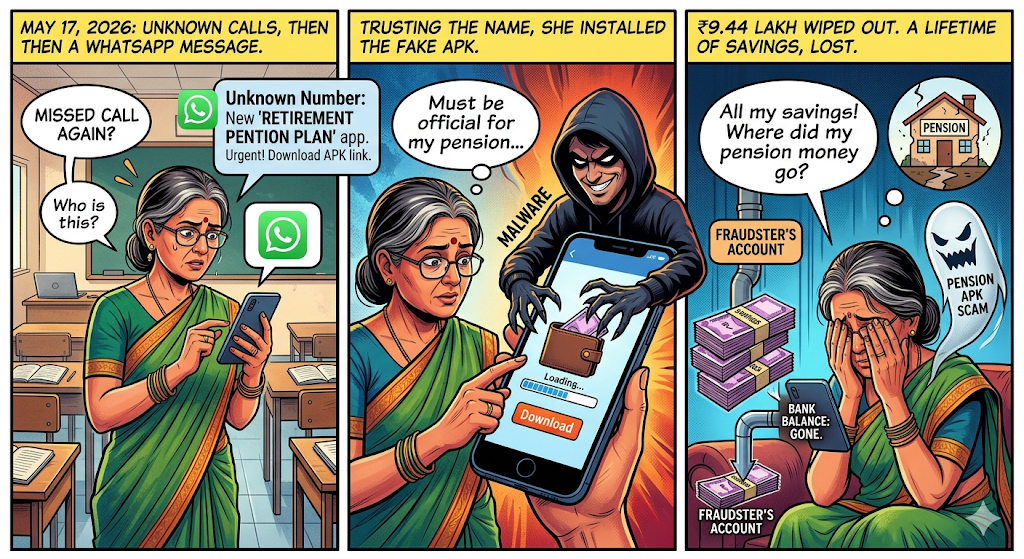
A 56-year-old private school teacher in Pune lost ₹9.44 lakh after she installed a fake Android APK file named “Retirement Pention Plan”. The file was sent through WhatsApp from an unknown number after repeated missed calls. The Indian Express reported the case on May 17, 2026, 06:15 PM IST.
In the short term, the loss has wiped out a major part of the victim’s savings. In the long term, such cases can make pensioners, teachers and salaried families more afraid of digital banking. Fraudsters are using words like pension, salary revision and bank plan to push users into installing unsafe apps.
The complaint was taken up after a preliminary inquiry by cybercrime police, and an FIR was registered at Swargate police station.
Police said the siphoned amount was a major chunk of her life savings.
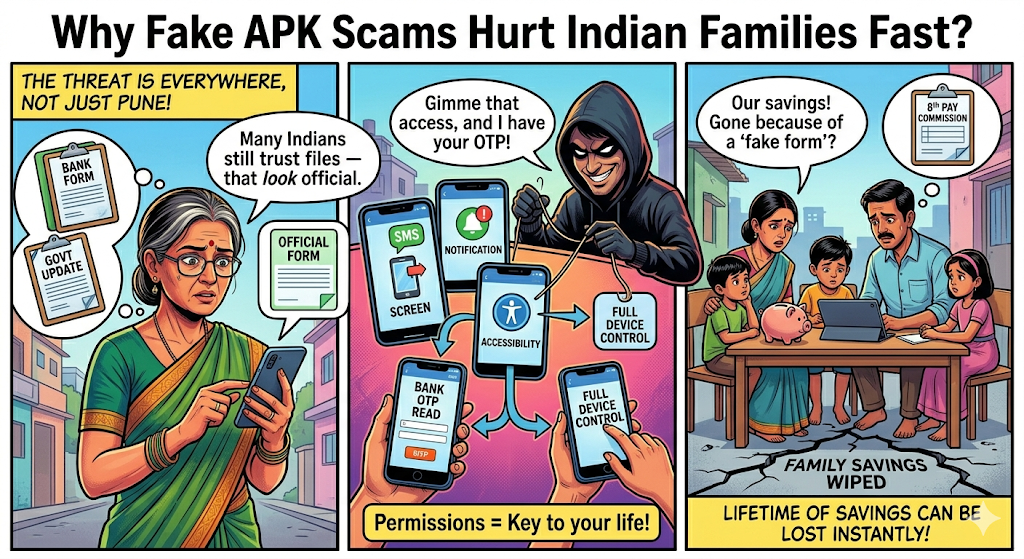
The problem is not limited to 1 Pune case. APK scams work because many Indians still trust files that look like bank forms, pension schemes or government updates. Once installed, such apps may seek SMS, notification, screen access or accessibility permissions, helping fraudsters read OTPs or control the device.
Earlier warnings show the same pattern. Moneycontrol reported on February 20, 2026, 14:05 IST that I4C, under the Ministry of Home Affairs, had warned about fake 8th Pay Commission APK files targeting government employees on WhatsApp. Mint also reported that once such APKs are installed, scammers can gain access to the mobile device.
*T&C Apply
February 13, 2026
The positive part is that these scams can be blocked at the user level. No bank or government department asks people to install APKs from WhatsApp. Apps should only come from official app stores or verified websites.
In the Pune case, police said the fraudsters gained remote access to the teacher’s phone after she installed the APK. That access helped them complete 5 transactions quickly.
I4C warned that employees were being asked on WhatsApp to download APK files to check revised salaries. Financial Express reported CyberDost’s warning on February 13, 2026, asking users not to click fake salary calculator links. The solution is simple: delete APK files from unknown numbers, disable “install unknown apps”, and report cyber financial fraud quickly on 1930.
This was not a normal banking mistake. It was a planned APK trap built around pension trust. For Indian users, the safest rule is simple: WhatsApp APK means risk, not reward.
Is it safe to open a bank KYC APK received on WhatsApp from someone I know?
No, it is not safe. In this Reddit post, the user got a “BOI ONLINE KYC.apk” from his mason, but the mason later said he never sent it. That means his phone or WhatsApp may have already been hacked. The message also tried to scare the user by saying the bank account would be blocked at night. That is a common fraud trick.
Bank KYC is never done through random APK files on WhatsApp. Such apps can steal OTPs, read SMS, access contacts and spread further. Always use the bank’s official app, website or branch.
Why do banks insist on KYC before giving full account services?
Banks ask for KYC because they need to know who is using the account. It checks a person’s name, address, ID proof and other basic details. This helps stop fake accounts, fraud, illegal transfers and money laundering. It also protects customers.
For example, if someone tries to misuse an account, the bank can verify the real account holder through KYC records. Accounts with incomplete KYC may face limits or even get frozen. So, KYC is not just paperwork. It is a basic safety check for both the customer and the bank.









.png&w=3840&q=75)



