
By continuing, you agree to LoansJagat's Credit Report Terms of Use, Terms and Conditions, Privacy Policy, and authorize contact via Call, SMS, Email, or WhatsApp
Disclaimer: The information published on LoansJagat is intended for general informational and educational purposes only and should not be considered financial, legal, or investment advice. Interest rates, loan terms, statistics, and other data may change over time and may vary by lender or source. Please verify the latest information and consult a qualified financial advisor or the respective Bank/NBFC before making any financial decisions.
Subscribe Now
About the author

Arshathul Afia
Arshathul Afia is a journalism graduate and fintech content writer with 4+ years of experience in digital publishing and research-led writing. She has written 200+ articles covering personal finance, lending, banking, digital payments, credit, insurance, and major financial developments in India. At LoansJagat, she focuses on simplifying complex fintech news, RBI updates, loan-related changes, policy developments, and industry trends for everyday readers. Her journalism background helps her approach stories with research, context, and clarity, while her SEO experience ensures content remains discoverable and relevant. She aims to make financial news easier to understand, practical, and useful for readers across India.
Related News
Simplify All Your Loans Into One Affordable EMI

Customers Served

Debt Consolidated

1200+ Reviews

Locations in India
Club all Loans & Credit Card Bills into Single EMI

Quick Apply Loan
Consolidate your debts into one easy EMI.

Takes less than 2 minutes. No paperwork.

10 Lakhs+
Trusted Customers

2000 Cr+
Loans Disbursed

4.7/5
Google Reviews

50+
Banks & NBFCs Offers
Other services mentioned in this article
The Madras High Court has changed how Section 73 notice timing is read, allowing earlier GST orders while preserving fair reply time for affected taxpayers.
The Madras High Court ruled on 17 July 2026 that a GST officer need not wait 3 months after issuing a show-cause notice before passing the final order. Justice Senthilkumar Ramamoorthy delivered the decision in Raj Machine Tools v. Assistant Commissioner (ST) (FAC) at Chennai. According to the judgment uploaded on the Madras High Court JUDIS portal
For GST-registered businesses, the short-term effect is reduced preparation time in some cases. An order may arrive before 3 calendar months have passed, even where the notice was issued much earlier. Over time, this interpretation could allow tax officers to complete older proceedings faster. There is a risk, though. Smaller firms may struggle to retrieve invoices, reconcile returns and prepare legal replies within a short schedule. The Court still requires a reasonable opportunity to respond.

The decision directly affects registered traders, manufacturers, companies and service providers facing older non-fraud GST demands. It does not immediately change the tax charged to an ordinary shopper. Still, faster demand proceedings may affect business cash flow, vendor payments and daily operations, particularly where an order leads to recovery action or a bank attachment.
There is also a positive side. A simple case need not remain pending merely to complete a fixed 3-month waiting period. Where the taxpayer has received the documents, filed a detailed response and attended the hearing, the officer can finish the proceeding earlier. The Court placed the focus on fair opportunity rather than a mechanical waiting period.
Chartered accountant Raj Jaggi, who analysed the ruling on 31 July 2026, wrote that Section 73(2) prevents officers from pushing notices too close to the limitation deadline. His reading separates 2 issues. Statutory limitation decides whether the notice was issued on time. Natural justice decides whether the taxpayer had enough time to answer the allegations properly.
Businesses should therefore act from the date on which the notice is received. They should not assume that 3 months will automatically be available. A response file should include invoices, GSTR-1 and GSTR-3B reconciliations, input tax credit records, exemption documents and proof supporting the classification of supplies. Where extra time is needed, the taxpayer should seek an adjournment in writing and record the reason.
The LoansJagat editorial reading is that the judgment changes response planning more than it changes tax liability. A registered business must treat the receipt date as the start of an active defence process, rather than the opening of a guaranteed 3-month window. The broader LoansJagat guide to the CGST Act also explains how Section 73 fits within GST demand and recovery proceedings.
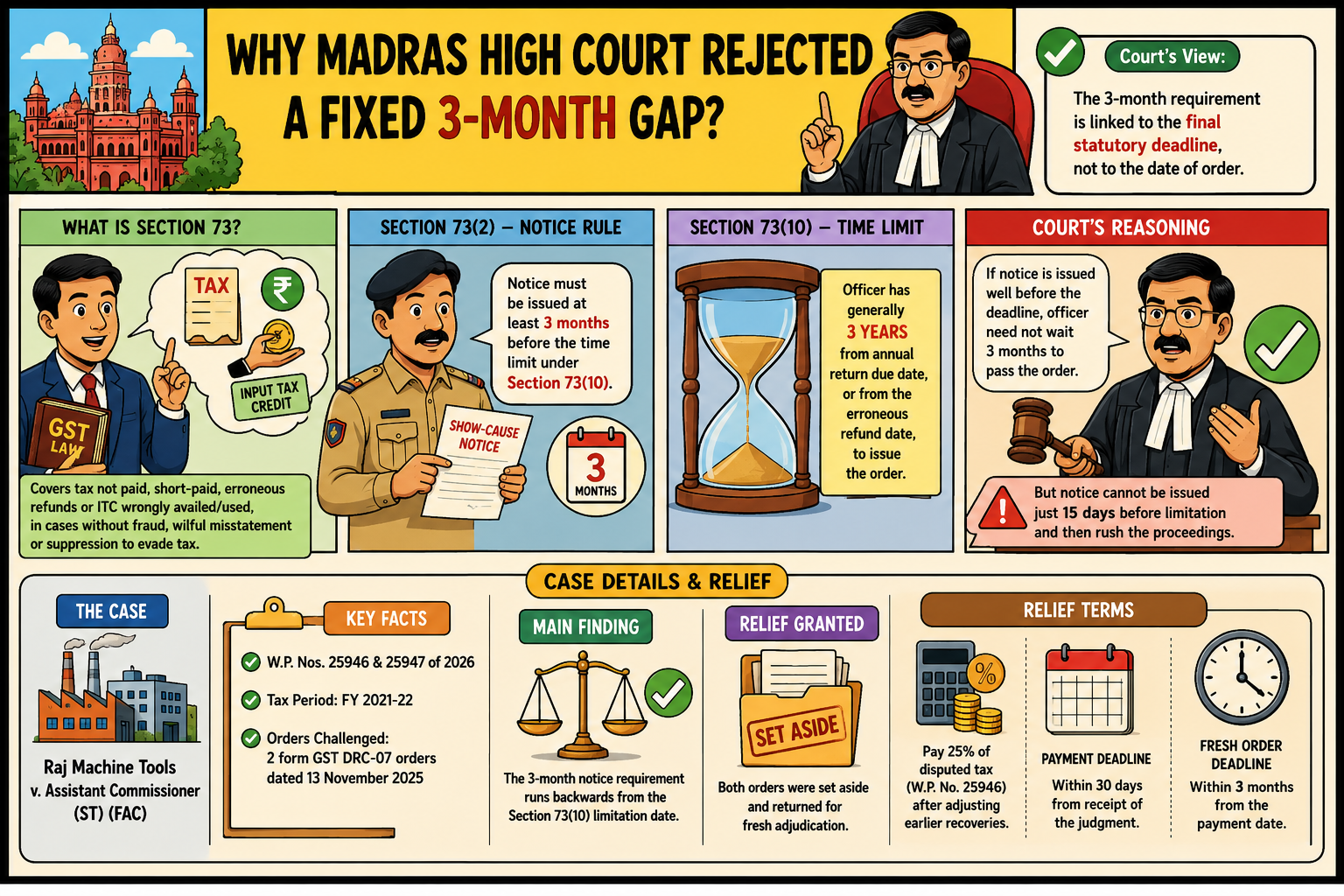
Section 73 applies to tax not paid, tax short-paid, erroneous refunds or input tax credit wrongly availed or used in cases that do not involve fraud, wilful misstatement or suppression with an intention to evade tax.
Section 73(2) requires the proper officer to issue the notice at least 3 months before the time limit specified under Section 73(10). For the periods governed by this provision, Section 73(10) generally gives the officer 3 years from the annual return due date, or from the erroneous refund date, to issue the order.
The Court read both provisions together. It found that the wording points towards the final statutory deadline, rather than the actual date selected by the officer for passing the order. An officer cannot issue a notice only 15 days before the limitation expires and then finish the proceeding in haste. But where the notice was served well before the deadline, the law does not require the officer to wait until 3 months have passed.
The case details explain both the ruling and the relief given to the taxpayer.
The remand did not settle whether the disputed supplies were exempt or taxable. The assessing officer must examine that issue again and adopt one consistent position. After the taxpayer fulfils the 25% payment condition, the bank attachment must also be lifted.
Raj Machine Tools succeeded because the department had issued 2 orders for the same assessment period using opposing tax positions. One order said the petitioner had wrongly claimed or used input tax credit connected with exempt supplies. The other proceeded on the basis that those supplies were taxable and not exempt.
That contradiction affected the foundation of both demands. If a supply is exempt, restrictions or reversals may apply to the related input tax credit. Where the same supply is taxable, output tax and credit treatment can follow a different route. The Department could not use both positions for FY 2021-22 without first deciding how the supplies should be classified.
The Court therefore set aside both orders. It allowed the proper officer to re-examine whether the supplies were exempt but directed the officer to give the taxpayer a reasonable opportunity before passing fresh orders.
The earlier major ruling came from the Nagpur Bench of the Bombay High Court on 17 January 2026. In A.M. Marketplaces Pvt. Ltd. v. Union of India, the show-cause notice was issued on 18 November 2024, and the adjudication order followed on 31 January 2025.
The gap was around 2 months and 13 days. The Bombay High Court treated the 3-month period as a mandatory taxpayer protection. It linked the interval with the time needed to file a reply, seek a hearing, consider payment options and request adjournments.
The Bombay judgment records Writ Petition No. 7943 of 2025 and neutral citation 2026:BHC-NAG:728-DB. Some later references describe it as W.P. No. 7941 of 2025. The court copy, however, displays No. 7943.
The Madras High Court expressly declined to follow the Bombay interpretation. It said procedural safeguards and adjournment rights could not be used to insert a fixed 3-month interval into Section 73 when the wording did not provide one.
This has created opposing High Court positions. The Madras view ties the 3 months to the outer limitation date. The Bombay view treats the same period as minimum preparation time before the final order. Until a higher court settles the conflict, the location of the proceeding and later rulings will remain relevant.
Counsel for Raj Machine Tools argued that Section 73(2) required a minimum 3-month gap between the notice and assessment order. The petitioner relied on the Bombay High Court ruling and also challenged the conflicting treatment of the same supplies.
The petitioner offered to remit 25% of the disputed tax connected with W.P. No. 25946 of 2026 as a condition for reconsideration. Any amount already recovered would be adjusted before payment.
Government Counsel (Tax) Amirta Poonkodi Dinakaran argued that Section 73(2) did not prescribe a fixed notice-to-order interval. She also submitted that the petitioner had approached the court late.
The Court accepted the Department’s position on the timing question. It accepted the taxpayer’s objection to the contradictory orders. That combination shaped the final result. Raj Machine Tools lost its argument for an automatic 3-month gap, yet obtained fresh adjudication because the 2 tax positions could not stand together.
A taxpayer should first record the date and method of service. The next step is to identify the applicable financial year and calculate the final limitation date. For older Section 73 proceedings, the notice date must then be checked against the 3-month backward cut-off.
The reply should address every allegation separately. A broad denial rarely helps. Businesses should attach the invoice trail, return extracts, ledger entries, exemption notification and reconciliation statement linked to each disputed figure.
A written request for a personal hearing should also be filed where an adverse order is proposed. When the notice gives too little time, the taxpayer should seek an extension immediately. Proof of the request may become important if the officer proceeds without a proper hearing.
Businesses must also identify the correct provision. Section 73 continues to govern relevant proceedings up to FY 2023-24. Section 74A applies from FY 2024-25. Under the newer framework, the notice generally has a 42-month outer limit, while the order is generally due within 12 months from the notice. An authorised officer may extend that order period by up to 6 months after recording reasons.
The Madras High Court has separated the timing of a GST notice from the waiting period before an order. Section 73(2), according to the ruling, requires the notice to arrive at least 3 months before the limitation deadline. It does not guarantee 3 months between the notice and final order.
Tax officers must still provide adequate reply time and a proper hearing. The ruling does not protect hurried proceedings, ignored submissions or conflicting findings.
For businesses, early action is now the safer approach. Each notice needs a date-by-date limitation check, a detailed written reply and properly preserved records. The conflict with the Bombay High Court also means that no single nationwide formula can yet be applied to every Section 73 case.
Not under the Madras High Court ruling, provided the notice met the statutory limitation requirement.
It is counted backwards from the final order deadline stated under Section 73(10).
Yes. A rushed order may be challenged where the taxpayer did not receive a reasonable opportunity.
The Department used contradictory positions by treating the same supplies as exempt and taxable.
It is persuasive elsewhere, but opposing High Court rulings prevent a uniform nationwide position.
Section 73 applies to relevant non-fraud proceedings up to FY 2023-24.
Section 74A governs demand proceedings for FY 2024-25 and later periods.










.png&w=3840&q=75)


