Check AI Loan Optimisation Plans to Reduce Your EMI

Disclaimer: The information published on LoansJagat is intended for general informational and educational purposes only and should not be considered financial, legal, or investment advice. Interest rates, loan terms, statistics, and other data may change over time and may vary by lender or source. Please verify the latest information and consult a qualified financial advisor or the respective Bank/NBFC before making any financial decisions.
Subscribe Now
About the author

Diwaker Sharma is a finance content specialist with expertise in banking, personal finance, credit cards, loans, fintech, and financial news. An MBA in Finance with prior experience in the banking sector, he combines industry knowledge with SEO and content strategy to produce insightful, research-backed articles. Passionate about making finance accessible, he transforms complex financial concepts into clear, engaging content that empowers readers to make smarter financial decisions with confidence.
Related Blog Post

Pay Less EMI Every Month

1Cr+
Loans analysed by our AI

50Lacs+
Customers served

10,000+
Pincodes served

₹1,000Cr+
EMI savings delivered

1,400+ Google reviews

Quick Apply Loan
Consolidate your debts into one easy EMI.

Takes less than 2 minutes. No paperwork.

10 Lakhs+
Trusted Customers

2000 Cr+
Loans Disbursed

4.7/5
Google Reviews

50+
Banks & NBFCs Offers
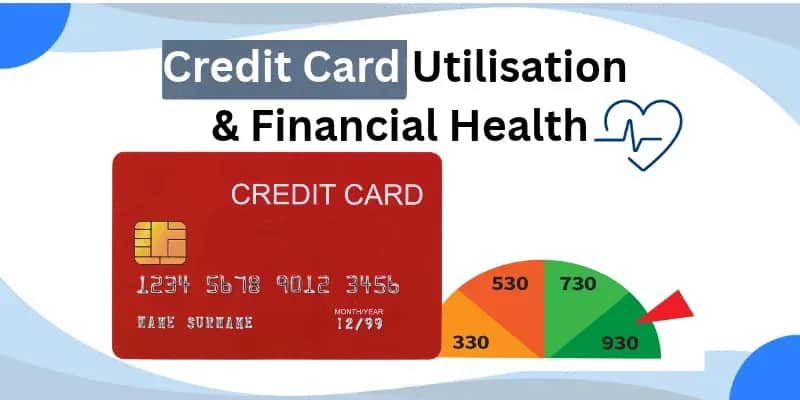
Do you use most of your credit card limit every month, even when you pay the bill on time? That habit could be lowering your credit score without you noticing. Your credit card utilisation ratio is the share of your total card limit that you are currently using. A ratio above 30% can start to pull your score down. A high ratio also signals heavier repayment pressure, higher interest risk and less room for emergencies. Keeping it low protects both your credit score and your wider financial health.
Key Takeaways

The credit card utilisation ratio is the percentage of your available card limit that you have already used.
Credit utilisation shows how much of your available credit you are using. Higher utilisation suggests you may be close to your credit limit, which can make you appear riskier to lenders.
The ratio is usually viewed in two ways:
Both figures matter. A low overall ratio can still hide one card that is almost maxed out.
You calculate the credit card utilisation ratio by dividing your total outstanding card balance by your total credit limit, then multiplying by 100.
Credit card utilisation ratio = (Total outstanding balance ÷ Total credit limit) × 100
Here is an example with two cards. The table below shows the per-card and overall ratios:
In this case, the overall ratio is just above 30%, while Card 1 alone is at 45%. Paying ₹5,000 more on Card 1 would bring the overall ratio to 30%.
A good credit card utilisation ratio is generally 30% or lower, and a lower ratio is usually better.
A ratio above 30% can start to drag down your score, so the lower it is, the better. There is no single figure that guarantees a particular score.
The table below shows how different balances on a ₹1,00,000 limit compare:
The closer your balance is to your limit, the more cautious lenders may become. Keeping a buffer below 30% gives you room for unplanned expenses.
High utilisation can lower your credit score because it signals a growing debt burden.
TransUnion CIBIL lists high credit utilisation as one of the key factors that affect your CIBIL score. The others are payment history, credit mix and multiple enquiries. High utilisation indicates a rising debt burden over time and may hurt your score.
High utilisation can affect you in the following ways:
The Reserve Bank of India (RBI) has also moved to make credit reports more current. In December 2025, the RBI issued Amendment Directions so that credit reports reflect more recent information. As a result, changes in your card balances may show up in your report sooner.

High card utilisation affects more than your credit score; it also strains your monthly cash flow and savings.
A credit card balance that is not paid in full usually attracts interest, which can add up quickly. Paying only the minimum due leaves you carrying a high balance on your card.
The table below shows how high utilisation can affect different parts of your finances:
These effects build on each other over time. A high balance today can reduce your savings and borrowing options tomorrow.
The LoansJagat Financial Peace Score reflects this wider picture. It checks card-limit use under Credit Habits and card spending under Loan Burden. Clearing card dues can also count as a positive step under its Actions and Results part.
The RBI requires card issuers to take your prior explicit consent before you can use your card beyond its sanctioned limit. Overlimit use needs prior explicit consent from the cardholder, as a fraud minimisation measure.
This rule gives you control over your spending limit. Using a card beyond its limit means your utilisation is above 100%, which can seriously weaken your credit profile.
You can lower your ratio by reducing your outstanding balances or by managing how you use your available limit.
Your credit card utilisation ratio is a simple number, but it affects your credit score, interest costs and savings. Keeping the ratio at or below 30%, and lower is generally better. Track the ratio on each card and overall, pay your full bill on time and avoid running balances close to your limit.
It is the percentage of your total credit card limit that you are currently using. For example, a ₹20,000 balance on a ₹1,00,000 limit gives a ratio of 20%.
Divide your total outstanding balance by your total credit limit and multiply by 100. You can calculate it for each card and for all cards combined.
A ratio above 30% can start to pull your score down. Keeping it at 30% or below, and lower where possible, is generally advised.
It can, as TransUnion CIBIL lists high credit utilisation as a key factor that may negatively affect your CIBIL score.
Yes, if your balance is close to your limit when it is reported, a high ratio may still affect your score despite on-time payments.
Both views matter as your overall ratio covers all cards together, while a per-card ratio shows whether any single card is close to its limit.
Yes, closing a card reduces your total available limit. If your balances stay the same, your overall utilisation ratio will rise.
According to the RBI, over-limit use requires your prior explicit consent. Without it, the card issuer should not allow the limit to be crossed.
No, paying only the minimum due leaves most of the balance unpaid. This keeps your utilisation high and adds interest charges.
The Financial Peace Score checks card-limit use under Credit Habits and card spending under Loan Burden. Lower card balances can support a healthier score.
Start your journey today
Apply Now*T&C apply