Check AI Loan Optimisation Plans to Reduce Your EMI

Disclaimer: The information published on LoansJagat is intended for general informational and educational purposes only and should not be considered financial, legal, or investment advice. Interest rates, loan terms, statistics, and other data may change over time and may vary by lender or source. Please verify the latest information and consult a qualified financial advisor or the respective Bank/NBFC before making any financial decisions.
Subscribe Now
About the author

Diwaker Sharma is a finance content specialist with expertise in banking, personal finance, credit cards, loans, fintech, and financial news. An MBA in Finance with prior experience in the banking sector, he combines industry knowledge with SEO and content strategy to produce insightful, research-backed articles. Passionate about making finance accessible, he transforms complex financial concepts into clear, engaging content that empowers readers to make smarter financial decisions with confidence.
Related Blog Post
Simplify All Your Loans Into One Affordable EMI

Customers Served

Debt Consolidated

1200+ Reviews

Locations in India
Club all Loans & Credit Card Bills into Single EMI

Quick Apply Loan
Consolidate your debts into one easy EMI.

Takes less than 2 minutes. No paperwork.

10 Lakhs+
Trusted Customers

2000 Cr+
Loans Disbursed

4.7/5
Google Reviews

50+
Banks & NBFCs Offers
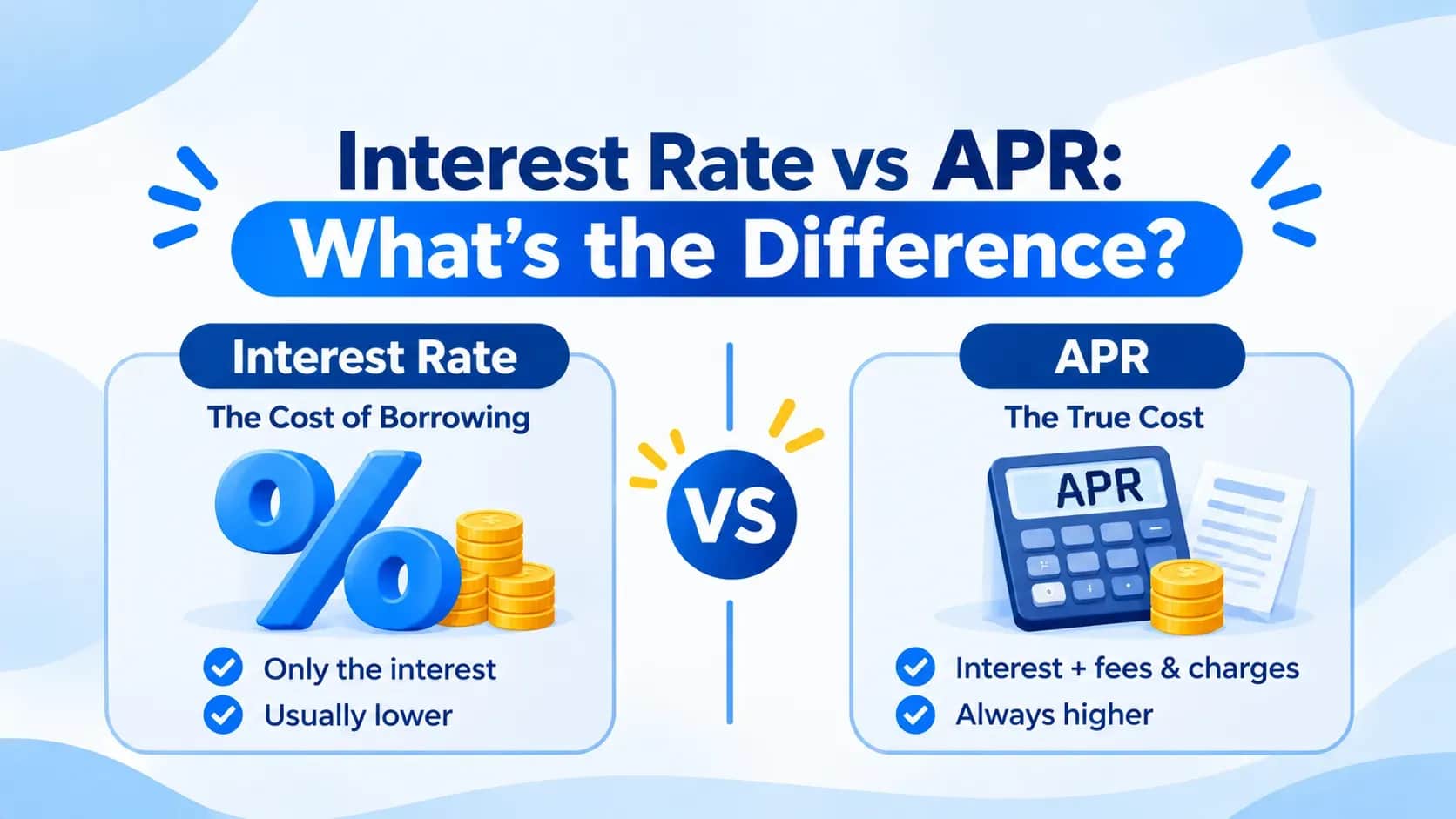
When comparing loan offers, the interest rate is often the first figure borrowers notice. However, it does not always reflect the full cost of borrowing. A loan may have a competitive interest rate but include processing fees or other charges that increase the overall cost. This is where the Annual Percentage Rate (APR) becomes important. Understanding the difference between the interest rate and APR can help you compare loan offers more accurately and assess how much a loan may cost over its tenure.
Key Takeaways
An interest rate is the percentage a lender charges a borrower for using the borrowed money. It is expressed as an annual percentage of the principal amount, although the actual interest calculation depends on the loan type and repayment terms.
For example, if you borrow ₹5 lakh at an annual interest rate of 12%, the lender charges interest based on the outstanding principal and the agreed repayment schedule.
The interest rate directly affects the interest component of your EMI. A higher rate can increase the amount you repay over the loan tenure, while a lower rate may reduce it, assuming other loan terms remain the same.
Lenders may offer different interest rates depending on factors such as:
The interest rate is an important part of loan pricing. However, it does not always account for every cost associated with borrowing.
The Annual Percentage Rate (APR) represents the annual cost of credit to a borrower. It includes the interest rate and other applicable charges associated with the credit facility.
Unlike the interest rate, APR gives borrowers a broader view of the cost of a loan. It considers charges levied by the lender and certain third-party charges recovered through the lender.
For example, a personal loan may have an interest rate of 11% per annum. The lender may also charge a processing fee. If applicable third-party charges are recovered through the lender, these may also form part of the APR.
As a result, the APR can be higher than the stated interest rate.
The Reserve Bank of India (RBI) defines APR as the annual cost of credit to the borrower, including the interest rate and all other charges associated with the credit facility. Its April 2024 circular also requires regulated entities to disclose the APR calculation in the Key Facts Statement for covered loans.
Both interest rate and APR help borrowers understand loan costs, but they represent different aspects of borrowing.
In simple terms: The interest rate tells you how much interest the lender charges, while APR gives you a broader picture of the annual cost of borrowing.
Looking only at the interest rate can give an incomplete picture of a loan's cost. Two lenders may offer similar interest rates but charge different fees. These charges can affect the overall cost of borrowing.
Here is why checking APR matters:
A loan may involve charges beyond interest. These can include processing fees and certain third-party expenses, such as insurance or legal charges, when recovered by the lender.
Under RBI's KFS framework, charges levied by the regulated entity form part of APR. Third-party charges recovered by the regulated entity on an actual basis, such as insurance and legal charges, also form part of APR and must be disclosed separately.
This makes APR a more comprehensive measure than the stated interest rate alone.
Consider two lenders offering personal loans with different interest rates and charges.
Lender B offers a lower interest rate and processing fee in this illustration. However, these details alone are not enough to establish which loan has the lower APR.
The APR calculation also depends on the repayment schedule, timing of disbursement and applicable charges. Borrowers should compare the APR stated in each lender's KFS before making a decision.
APR helps borrowers understand the cost of credit beyond the interest rate. The KFS also provides details such as the repayment schedule and applicable charges.
Reviewing these disclosures can help you identify costs that may not be immediately clear from an advertised interest rate.
A lower interest rate does not automatically mean a more affordable loan. A borrower should consider the APR alongside the EMI, loan tenure, total repayment and repayment capacity.
For example, a longer tenure may reduce the monthly EMI but increase the total interest payable. Checking all these details helps you assess whether the loan fits your financial position.
APR is calculated using an Internal Rate of Return (IRR)-based method. The calculation considers the net amount disbursed to the borrower and the scheduled repayments over the loan tenure.
In simple terms, the calculation accounts for the timing and amount of money received by the borrower and the payments made towards the loan.
The RBI's KFS framework requires lenders to provide an APR computation sheet. This allows borrowers to review the calculation instead of relying on a simple interest-plus-fees estimate.
Several factors can influence the APR of a loan:
APR should not be calculated by simply adding the total interest and fees, dividing the amount by the principal and multiplying by 100. That approach does not account for the timing of disbursement and repayments.
For an accurate comparison, refer to the APR computation sheet provided by the lender.
A Key Facts Statement (KFS) is a standardised document that presents important details of a loan in simple language. It helps prospective borrowers understand the terms and costs before entering into a loan agreement.
The RBI issued its harmonised KFS instructions on 15 April 2024. These instructions apply to retail and MSME term loan products offered by regulated entities. All new retail and MSME term loans sanctioned on or after 1 October 2024 must comply with the framework.
The provisions cover regulated entities such as banks and NBFCs. Credit card receivables are exempt from the provisions of this particular circular.
A KFS provides important information about the proposed loan, including:
The KFS must also include an APR computation sheet and the loan's amortisation schedule. The lender must explain its contents to the borrower and obtain acknowledgement that the borrower has understood them.
Under the RBI framework, the KFS must have a minimum validity period of:
This period gives borrowers time to review the loan terms and decide whether to accept the offer. If the borrower agrees to the terms within the validity period, the regulated entity is bound by the terms stated in the KFS.
Comparing loan offers requires more than checking the advertised interest rate. Review the following details before selecting a lender:
Check the APR mentioned in the KFS provided by each lender. It gives you a broader view of the annual cost of credit, including applicable charges. Compare offers with similar loan amounts and tenures wherever possible. This makes the comparison more meaningful.
Review the processing fee and any applicable third-party charges. Check whether these amounts are deducted from the loan disbursement or collected separately. Also look for charges related to late payments, foreclosure or other specific events. These may be disclosed separately from the APR and should still be considered when assessing the loan terms.
Check the monthly EMI and the number of instalments. Make sure the repayment amount fits your monthly budget after accounting for essential expenses and existing financial commitments. The amortisation schedule can help you understand how each instalment is divided between principal and interest.
Consider the total amount you will repay over the loan tenure. This includes the principal and interest, along with applicable charges. A lower EMI may result from a longer tenure, but it can increase the total interest payable. Avoid choosing an offer based only on the monthly instalment.
Review the loan agreement and check whether its terms match the KFS. Pay attention to the interest rate, charges, repayment dates and conditions for prepayment or foreclosure. If any fee or condition is unclear, ask the lender for an explanation before accepting the offer.
The interest rate and APR serve different purposes when assessing a loan. The interest rate shows the cost of borrowing, while APR provides a broader view by accounting for applicable charges. Comparing both figures, along with the EMI, tenure, total repayment and KFS, can help you assess loan offers more carefully. Before accepting a loan, review the complete terms and choose an option that fits your repayment capacity.
APR can be higher than the interest rate because it includes applicable charges associated with the credit facility. However, the difference depends on the loan terms and charges. If there are no additional applicable charges, the APR may be closer to the interest rate.
The interest rate represents the cost charged on the borrowed principal, while APR represents the annual cost of credit, including interest and applicable charges. APR therefore provides a broader view of borrowing costs.
Processing fees levied by the regulated entity form part of APR under the RBI's KFS framework. Certain third-party charges, such as insurance and legal charges recovered by the lender on an actual basis, also form part of APR and must be disclosed separately.
APR is calculated using an IRR-based method that considers the net amount disbursed and the scheduled repayments over the loan tenure. The lender must provide an APR computation sheet in the KFS for loans covered by RBI's framework. A simple addition of interest and fees does not give an accurate APR.
A lower APR can indicate a lower annual cost of credit, making it useful when comparing similar loan offers. However, also check the loan amount, tenure, EMI, total repayment and other conditions before choosing a loan.
RBI's harmonised KFS framework applies to retail and MSME term loan products offered by regulated entities. Credit card receivables are exempt from the provisions of the April 2024 circular. Other lending products may be subject to separate regulatory requirements.
APR represents the annual cost of credit, including interest and applicable charges. EMI is the fixed periodic instalment paid towards the repayment of a loan. It includes both principal and interest components.
Two loans with the same interest rate can have different APRs if their applicable charges, disbursement amounts or repayment schedules differ. Reviewing the KFS helps borrowers compare these details.
Contingent charges, such as penalty charges and foreclosure-related charges, are disclosed separately and are not automatically included in the APR calculation. Check the KFS and loan agreement for the applicable conditions and amounts.
The KFS provides important loan details, including the APR, applicable charges and repayment schedule. Reviewing it before accepting the offer helps you understand the borrowing terms and identify costs that may not be clear from the advertised interest rate.
Start your journey today
Apply Now*T&C apply